





















Admiral Yi Sun-sin: Why Japan Feared Him, Films and Places
On the 16th day of the 9th lunar month of 1597, in a strait off Korea's south-west tip so narrow and fast that it roars, thirteen Korean warships waited for a Japanese fleet about ten times their size. Their admiral had been arrested, harshly interrogated and stripped of his rank that spring. His navy had been wiped out without him in the summer. His mother had died while he walked south as a common soldier. By evening, about thirty Japanese ships were gone, and no loss of any of his thirteen is recorded.
This is the story of Admiral Yi Sun-sin, the man on the 100-won coin and the bronze giant in the middle of Seoul: what really happened, what is legend, why Japanese naval officers studied him around 1900, the films that made him Korea's biggest box-office hero, and the places in Korea where you can still stand where he stood. Tap a tab or open a story to read more.
Who: admiral of the Joseon navy during the Japanese invasions of 1592–1598 (the Imjin War)
Lived: 1545–1598. Born in Seoul, killed by a bullet in his last battle, at Noryang
Known for: never losing a battle he commanded · the turtle ship · 13 ships against about 133 at Myeongnyang · a war diary on UNESCO's Memory of the World register
See him in Seoul: the statue on Gwanghwamun Square (always open) and the free underground exhibition below it (10:00–18:30, closed Mondays)
The big shrine: Hyeonchungsa in Asan, free, closed Mondays, about 1.5 hours from Seoul by KTX and taxi
Watch first: The Admiral: Roaring Currents (2014), still Korea's most-watched film
Checked 27 October 2026 with the sources at the end.

In this guide
- Map: where to follow him
- His life in one table
- Seven battles
- The turtle ship: known and unknown
- Why Japan feared him, and what is myth
- The war diary: the human side
- Stories from his life
- Famous words, checked
- On screen
- Places to follow him
- Watch out, and outdated tips
Map: where to follow him
Seoul has the statue, the exhibition and his birthplace marker. Asan, south of Seoul, has his shrine and grave. The south coast, from Uldolmok in the west to Geoje in the east, is where he fought. Tap a number for its name.
Map © OpenFreeMap, data © OpenStreetMap contributors. Use Naver Map or KakaoMap for directions in Korea.
His life in one table
Yi Sun-sin was not born a sailor. He grew up in Geoncheon-dong in Seoul, in what is now Inhyeon-dong near Euljiro. He studied the classics with his brothers and only turned to the martial arts at 22. He failed his first military exam when his horse fell and broke his leg, and passed four years later at 32. For fifteen years after that he served in small frontier posts, was demoted once to a common soldier and was known mostly for refusing favours. He took command of the left navy of Jeolla province, based in Yeosu, in early 1591. The Japanese landed in Busan the following spring.
| Year | What happened | Where you can see it |
|---|---|---|
| 1545 | Born in Seoul (8th day of the 3rd lunar month; Korea marks his birthday on 28 April) | Birthplace marker near Euljiro 3-ga |
| 1572 | Falls from his horse in the military exam, breaks his left leg and fails | The willow-bark story below |
| 1576 | Passes the military exam, posted to the far north | — |
| 1587 | Jurchen raid on Nokdundo island; his commander blames him: first demotion to common soldier | Nokdundo is now in Russia |
| 1591 | Commander of the Left Navy of Jeolla, at Yeosu; prepares for war, with turtle ships ready by spring 1592 | Jinnamgwan and Seonso, Yeosu |
| 1592 | Japan invades. Okpo, Sacheon, Dangpo, Hansan, Busan: no defeats | Okpo park, Hansan-do |
| 1593 | First Supreme Naval Commander of three provinces, headquartered on Hansan-do | Jeseungdang, Hansan-do |
| 1597 | Arrested and harshly interrogated, released to serve as a common soldier again. His navy is destroyed at Chilcheollyang under Won Gyun. Reinstated with a dozen ships, wins at Myeongnyang | Chilcheollyang hall, Geoje · Uldolmok |
| 1598 | Killed by a bullet at Noryang, the last great battle of the war | Irakssa, Namhae |
| 1643 | Given the title Chungmu, "loyal and martial" | Shrines in Asan, Tongyeong and Namhae |
| 1968 | The Gwanghwamun statue goes up | Gwanghwamun Square |
Seven battles
All dates are in the lunar calendar Joseon used. Ship numbers are from the Encyclopedia of Korean Culture unless noted.
| Battle | Ships | What happened |
|---|---|---|
| Okpo 7th day, 5th month 1592 | Korea about 90 · Japan about 30 | Korea's first naval victory of the war: 26 Japanese ships destroyed off Geoje |
| Sacheon 29th day, 5th month 1592 | Korea 26 · Japan 13 | The turtle ship's first battle. Yi was shot in the left shoulder and kept commanding |
| Dangpo 2nd day, 6th month 1592 | Japan 21 (Yi's report) | All 21 burned. A turtle ship pushed in under the flagship's tower and fired from its dragon mouth |
| Hansan 8th day, 7th month 1592 | Korea 55 · Japan 73 | The "crane wing" trap: 47 destroyed and 12 captured, no Korean ships lost. Japanese records admit 39 |
| Busan 1st day, 9th month 1592 | Korea about 160 · Japan about 470 in port | About 100 ships destroyed, but the Japanese base held |
| Myeongnyang 16th day, 9th month 1597 | Korea 13 · Japan about 133 | In the roaring strait of Uldolmok: 31 Japanese ships destroyed; no loss of Yi's 13 is recorded |
| Noryang 19th day, 11th month 1598 | Korea and Ming China about 200 · Japan about 500 | About 200 Japanese ships burned or sunk. Yi was killed near dawn |
Thirteen against how many? The Myeongnyang numbers
The figure everyone quotes, 133, is the one in the Encyclopedia of Korean Culture. Yi's own report, as summarised in the royal annals, says "more than 130" Japanese warships came into the strait, against his 13 warships (plus 32 small scouting boats). His diary, in the 1795 printed edition, says "more than 330" closed around his ships, and his nephew's biography says 333. Historians usually read it as about 133 ships in the fight from a larger fleet behind. Either way, Yi's flagship fought alone at the front at first, while his captains held back.
The one great defeat, and why it was not his
In the 7th month of 1597, while Yi was serving as a common soldier, his rival Won Gyun led the whole Korean fleet, about 160 ships, to attack Busan. At Chilcheollyang, off Geoje, the Japanese caught them at anchor at night. Almost the whole fleet burned and Won Gyun was killed. Only Bae Seol escaped, with 12 ships. Those 12 were the fleet Yi was handed back a few weeks later. It was the only major defeat of the Korean navy in the whole war. The small exhibition hall at Chilcheollyang tells it from the losing side.
The turtle ship: known and unknown

The turtle ship, geobukseon, is Korea's most famous warship, and much of what you read about it online is guesswork. Here is what the records actually say.
- He did not invent it. The royal annals mention a "turtle ship" in 1413, 180 years earlier. Yi rebuilt the idea on top of the Korean panokseon warship.
- It was ready just in time. His diary records test-firing the turtle ship's cannons on the 12th day of the 4th month of 1592. The Japanese landed at Busan the next day.
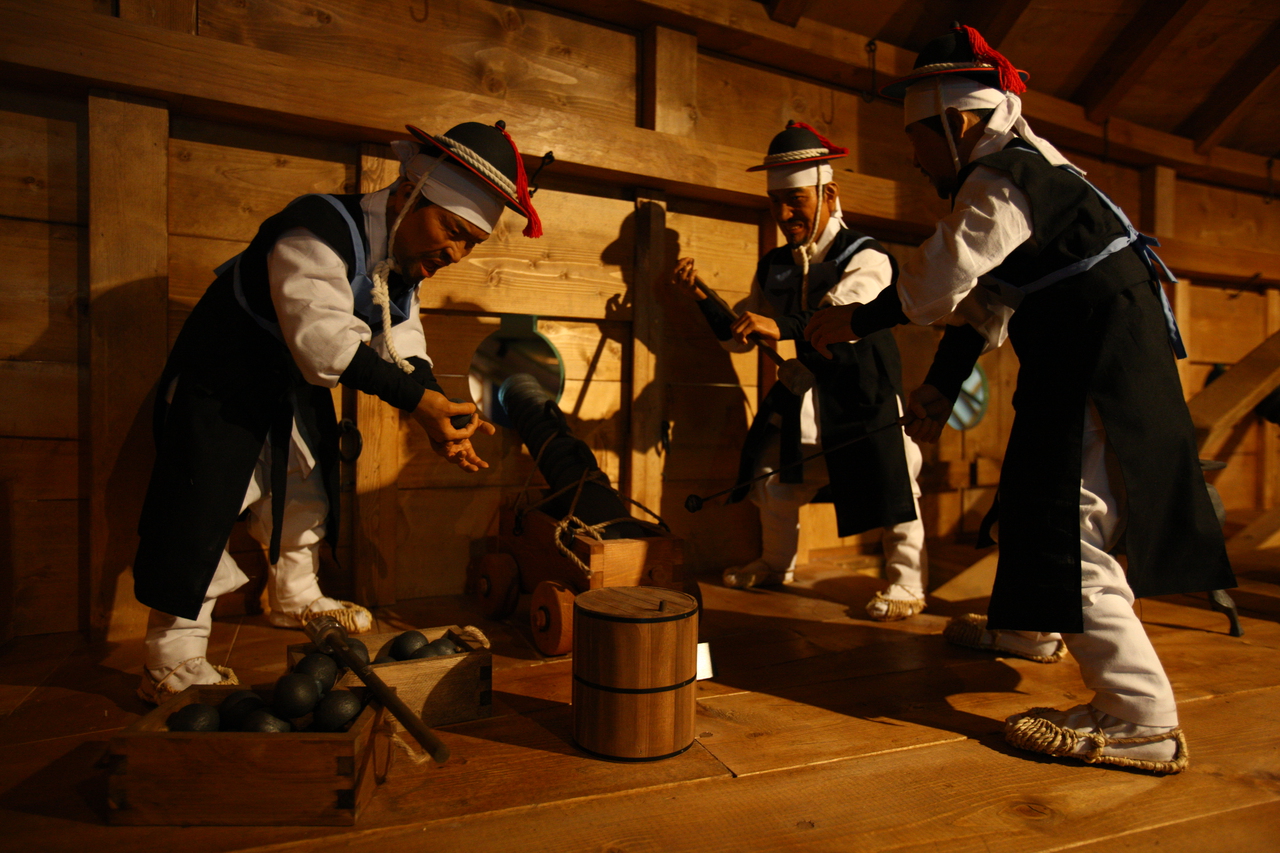
- His own description: a dragon head at the front that fires cannon from its mouth, iron spikes on its back, and "from inside you can see out, from outside you cannot see in", so it could charge into hundreds of enemy ships and fire.
- The spikes were hidden. His nephew wrote that in battle the roof was covered with straw mats so boarders jumped onto the blades.
- One record puts the crew at about 125 rowers and gunners.
- Was it iron-clad? No primary source says so. The records mention iron spikes and a plank roof. "The world's first iron-clad" appears from the late 19th century, and historians still argue about it.
- How many? Not known. Records name at least two or three in 1592–93: Yi's own, one from Bangdap and one from Suncheon.
- Two decks or three? Both have been argued. A restoration study published by Korea's maritime heritage institute in June 2026 concluded two.
- No plans survive, and no wreck has been found. The famous drawings in the Complete Works of Yi Sun-sin (1795) show turtle ships of 200 years later.
Replicas you can see: inside the entrance of the underground exhibition at Gwanghwamun (you can walk in), on Yi Sun-sin Square in Yeosu, in Gangguan harbour in Tongyeong, at Noryang in Namhae (500 won), and a model at the War Memorial of Korea (reported in 2019; ask at the desk). One of the Tongyeong boats, built in 1990 for the Han River, ended its display on 19 October 2026 because of its age; check before you go.
 ▶
Turtle ship restored by careful research: what changed from what we thought — SBS News (Korean)
An earlier Korean news report (December 2022) on turtle-ship restoration research.
Why Japan feared him, and what is myth
You will read online that the Japanese were terrified of Yi Sun-sin, and that the greatest Japanese admiral called him his superior. Some of that is in the records; one famous part was made up in Korea in 1955. Here is how to tell them apart.
Hideyoshi changed his orders. A week after Hansan, Toyotomi Hideyoshi wrote to his admirals, Wakizaka Yasuharu among them, telling them not to fight the Korean navy at sea on their own, but to build forts on Geoje island and defend the coast together with the army. A Japanese study of his letters (Ogawa, 2022) cites one dated the 14th day of the 7th month (Japanese calendar). Japan stopped trying to beat him at sea and waited behind forts instead. It worked, too: Yi never managed to take those coastal forts.
A colonial-era Japanese teaching guide admitted the loss. A teacher's guide to Japanese history written by Japanese authors in colonial Korea says Wakizaka "lost 39 warships" at Hansan and "barely escaped" in a fast boat.
The western route was closed. Japanese encyclopedias today say his victories won Korea control of the coastal sea. Some historians argue the main supply line from Japan to Busan was never cut; what is clear is that the Japanese fleet could no longer sail west along the coast.
Japanese naval officers studied him. In 1898 Ogasawara Naganari, a Japanese naval officer, called him "the peerless general of the eight provinces" and wrote that he "did not let us take half a step west". His book went to every middle school in Japan. Sato Tetsutaro, the Japanese navy's leading strategist, wrote around 1910 that Yi was "truly a naval commander without equal in his age", and that Nelson could not compare with him in character.
A British admiral agreed. Vice-Admiral George Alexander Ballard wrote in 1921: "It is always difficult for Englishmen to admit that Nelson ever had an equal in his profession, but if any man is entitled to be so regarded, it should surely be this great naval commander … who never knew defeat and died in the presence of the enemy."
The Japanese praise had a purpose: it was a lesson in sea power for a navy that wanted more ships. After Togo Heihachiro beat the Russians in 1905, Japan had its own "Nelson of the East", and Yi's place in Japanese writing shrank.
| The story | Verdict | Why |
|---|---|---|
| Admiral Togo said "you may compare me to Nelson, but not to Yi Sun-sin" | No source | A 2024 study by two Korea Naval Academy historians traced the sentence to a 1955 Korean newspaper column. Togo did call Yi "a great general of the peninsula, past and present" |
| The Japanese navy prayed to Yi's spirit before the battle of Tsushima (1905) | Unconfirmed | The scene comes from a 1925 Japanese novel and second-hand stories |
| "23 battles, 23 victories" | A modern count | He never lost a battle he commanded, but the number depends on what you count, and a Korean naval historian called the 23 tally weakly sourced |
| Hideyoshi banned his navy from fighting Yi | Mostly true | He banned fighting at sea alone and ordered forts, as above |
| The turtle ship was the world's first submarine | False | It was a surface warship with a covered deck |
 ▶
400-year-old Wakizaka family records on Yi Sun-sin — KBS Documentary (Korean)
A KBS documentary of 21 December 2025 on how the family of the admiral Yi beat at Hansan remembered the defeat.
The war diary: the human side
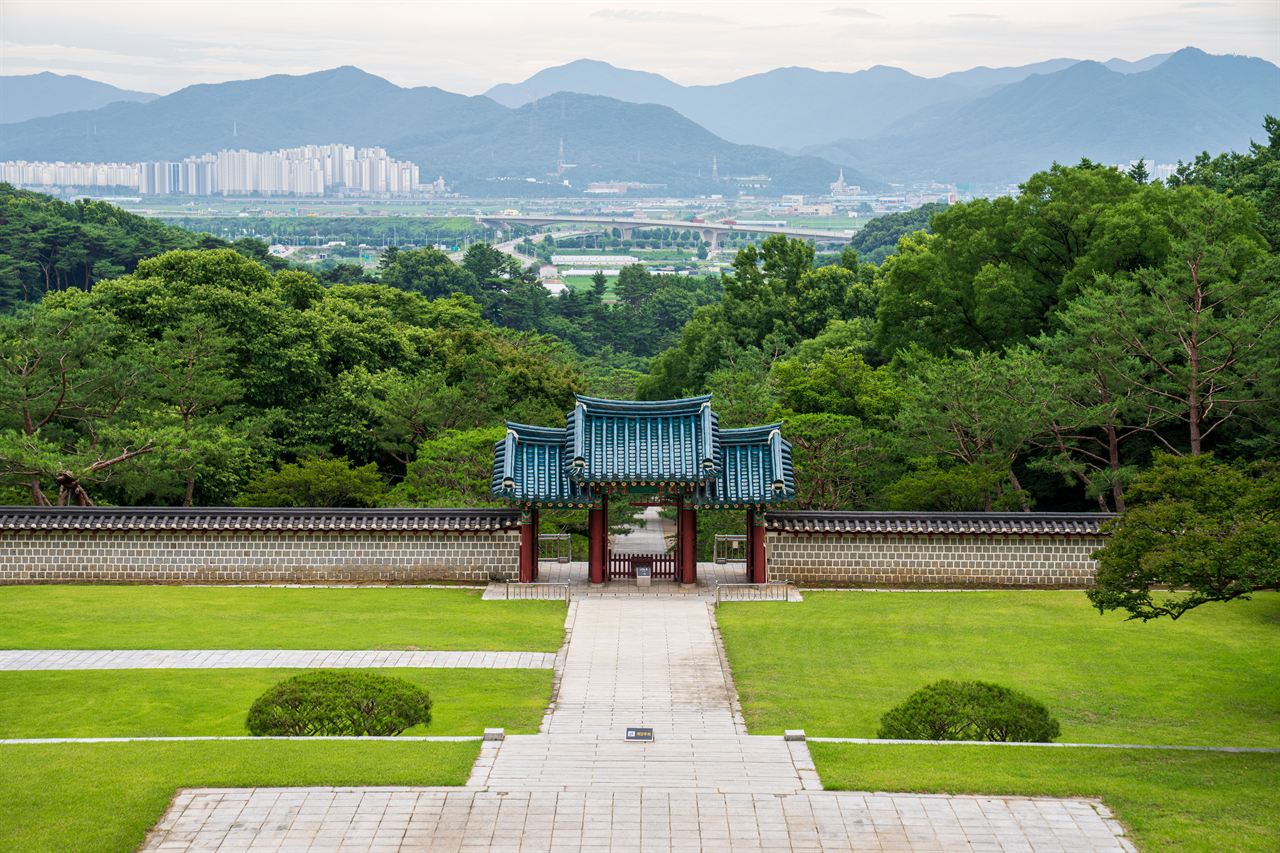
Yi kept a diary through almost the whole war, from January 1592 to two days before his death. It was named Nanjung Ilgi, "diary in the midst of war", in 1795, is a National Treasure, and was added to UNESCO's Memory of the World register in 2013. In the colonial period the Japanese imperial household asked for it and his descendant refused. It is short, plain and often very personal. All dates below are lunar.
His mother
New Year's Day 1592, his first entry: he is spending New Year in the south again, away from his mother, "and I cannot bear how much I miss her". In 1594: "I gain another year together with my mother. This is my good fortune in the middle of the war." On the 13th day of the 4th month of 1597, walking south as a common soldier after his release from prison, a servant brought news of her death: "I ran out, beating my chest and leaping. Even the sun in the sky went dark." Six days later he had to leave her body behind to report for duty: "How can there be anything like this in the world? Better to die soon."
His son
On the 14th day of the 10th month of 1597, a month after Myeongnyang, he dreamt before dawn that he fell from his horse into a stream and his youngest son, Myeon, seemed to hold him. That evening a letter came with two characters written on the envelope by his second son: "weeping bitterly". Myeon had been killed fighting Japanese raiders at home in Asan. "That I should die and you should live is the order of things. That you should die and I should live, what order is this? Heaven and earth are dark, the sun has lost its colour. … One night feels like a year." Two days later he went to a salt-maker's house so his men would not see him cry.
Dreams, drinking, archery, sickness
He wrote down his dreams and sometimes cast lots before battle. In one dream in 1594 "a beautiful woman sat alone and beckoned to me; I shook my sleeve and did not answer. How funny." In another he scolded Yi Il, the commander who had once had him demoted, for neglecting the country; Yi Il yawned and could not answer, and then he woke. The night before Myeongnyang, "a divine man appeared in my dream and told me, do this and you will win, do that and you will lose."
He drank, sometimes heavily: when villagers in Asan came with bottles to see him off in 1597, "I could not refuse their kindness and got very drunk." He practised archery constantly; on one day in 1592 he hit 42 of 50 arrows. He was often ill, sweating through the night, before and during the war.
Stories from his life
Most of these come from a biography written by his nephew Yi Bun, who fought beside him, and from the royal annals.
The willow-bark splint (1572)
In his first military exam his horse fell and his left leg broke. People thought he was dead. He stood up on one leg, broke off a willow branch, stripped its bark and bound his leg with it. The examiners were impressed; he still failed.
"Everyone who is born dies" (1576)
In his second exam an examiner asked whether the Han dynasty strategist Zhang Liang had really become an immortal. Yi answered that everyone who is born must die, and that the history books record Zhang Liang's death. The examiners asked each other how a soldier knew that.
Saying no to powerful people
The Minister of War offered him his daughter by a concubine in marriage; Yi said a new officer should not attach himself to a powerful house. The philosopher Yi I, from the same clan, asked to meet him while in charge of appointments; Yi said they could meet as relatives, but not while Yi I held that post. As a junior commander he refused to let his provincial admiral cut down a paulownia tree at his post to make a zither, because it belonged to the government.
The arrow he pulled out in secret (1587)
When Jurchen raiders attacked Nokdundo, an island at the mouth of the Tumen River, Yi had asked for more troops and been refused. He shot down their leaders, chased the raiders and rescued about 60 of the people they had carried off, and was hit by an arrow in the thigh. He pulled it out himself so his men would not panic. His commander tried to make him sign a confession; a friend begged him to drink first. "Life and death are fated. Why would I drink?" He walked in, refused to sign, and showed the letters asking for troops. The king ruled that he had not lost the battle and only ordered him to serve as a common soldier.
"An Wi! Do you want to die by military law?" (1597)
At Myeongnyang his captains hung back and his flagship fought alone. He stood at the bow and called to one of them twice: "An Wi, do you want to die by military law? Do you think you will live if you run?" An Wi charged into the Japanese line. Later a Japanese defector on Yi's ship recognised a body in red silk floating in the water as the enemy commander, recorded as Madasi; it was hauled up and beheaded, and the Japanese line broke.
"Do not announce my death" (1598)
At Noryang, near dawn, a bullet hit him. The royal annals record his words: "The battle is at its height. Do not tell anyone I am dead." Only his eldest son, his nephew and a servant knew; his nephew kept waving the flag and urging the ships on until the battle was won. When the Ming admiral Chen Lin called across, "Commander, come quickly!", his nephew answered that his uncle was dead. The annals say Chen Lin threw himself down and wept, and that crowds held on to the funeral cart so it could not move. Legend adds that the night before, as he prayed on deck, a great star fell into the sea.
Famous words, checked
| Words | Where they come from | Verdict |
|---|---|---|
| "I still have twelve ships" | His report to the king in 1597, when the court wanted to abolish the navy. The original is lost; his nephew's biography and later books quote it | Not in his diary, but quoted almost word for word by several early sources |
| "Those who seek death will live; those who seek life will die" | His diary, the night before Myeongnyang. He says himself it is a quotation from a military classic (Wuzi) | Genuine |
| "Do not announce my death" | The royal annals (revised edition) and family records | Recorded, though not by a witness on the day |
| "Turn fear into courage" | The 2014 film | Not in the records |
On screen
| Film | Battle · audience in Korea | Good to know |
|---|---|---|
| The Admiral: Roaring Currents (2014), Choi Min-sik | Myeongnyang · 17,616,791, still No. 1 of all time in October 2026 | Shot mostly at a set in Gwangyang with eight boats; the whirlpool is CGI. The assassination plot and the burning of the turtle ship are invented |
| Hansan: Rising Dragon (2022), Park Hae-il | Hansan · 7,267,202 | No sea at all: shot indoors at an ice-skating arena in Gangneung, water added by computer. The folding dragon head and Wakizaka being hit by an arrow are invented; he lived on |
| Noryang: Deadly Sea (2023), Kim Yoon-seok | Noryang · 4,573,785 | About 100 minutes of battle. The director said he gave Yi's death scene lines that are not in the records |
Audience figures: Korean Film Council box office, checked 27 October 2026.
Immortal Admiral Yi Sun-sin (KBS, 2004–2005, 104 episodes) made Kim Myung-min a star and won him KBS's top acting award in 2005. It was filmed partly at the Buan Film Theme Park in Jeonbuk, which is still open. KBS posts long clips on its "KBS Drama Classic" YouTube channel, in Korean.
In the 19 November 2016 episode of Infinite Challenge's history-and-hip-hop project, two rappers took an extra history lesson on him, partly inside a turtle ship.
In the United States, JustWatch listed Hansan and Noryang on Prime Video and several free ad-supported services in October 2026, with The Admiral to rent or buy; in the UK, The Admiral was on a Studiocanal channel. Listings change by country and month; check JustWatch for yours.
He is on the 100-won coin (since 1970; today's design since 1983). The lead ship of Korea's six Chungmugong Yi Sun-sin-class destroyers carries his name; it was launched in 2002. In front of his statue in Seoul, a fountain has jets for the battle at Myeongnyang. At the Tokyo Olympics in 2021 the Korean team hung a banner rewriting his line as "I still have the support of 50 million people"; it drew protests in Japan and came down after an IOC ruling.
 ▶
Korea: Admiral Yi – Keep Beating the Drum – Part 1 — Extra History
A popular English animated series on him (2015, five parts; part 1 has over 4.5 million views). The same channel's 'Lies' episode corrects what the series simplified.
 ▶
Imjin War – Rise of Admiral Yi Sun-sin – Hansando 1592 — Kings and Generals
An English documentary with maps of the Hansan battle (2020).
 ▶
The Admiral: Roaring Currents – main trailer — CJ ENM Movie
The official trailer from the film's distributor (2014).
 ▶
The secret of Hansan found in Yi's battle reports — KBS Documentary (Korean)
KBS History Special, first broadcast 28 April 2011, on the crane-wing formation.
Places to follow him
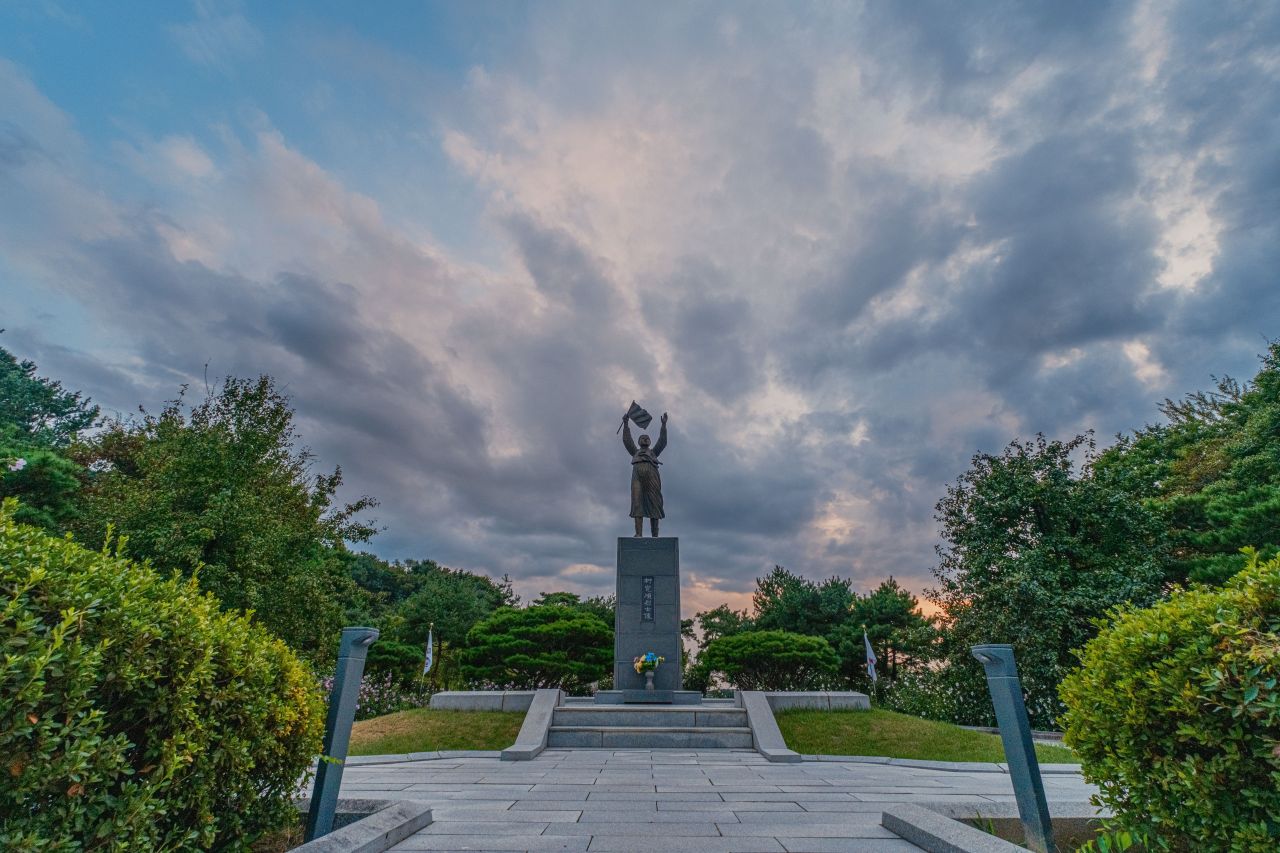
- The statue, Gwanghwamun Square: 17 m tall with its base, by Kim Se-joong, 1968; open all the time. It is on our palace route. Next to it, the Garden of Gratitude (opened May 2026) has 23 monuments: one for each of the 22 countries that sent combat troops or medical units in the Korean War, and one for Korea.
- The Story of Yi Sun-sin (underground, behind the King Sejong statue): free, 10:00–18:30, last entry 18:00, closed Mondays. A turtle ship you can enter, rowing and cannon games, the war diary.
- Birthplace marker: in front of Myeongbo Art Hall near Euljiro 3-ga station; a second sign stands about 100 m away at the site historians think is closer.
- War Memorial of Korea (Samgakji): free, 09:30–18:00, closed Mondays.
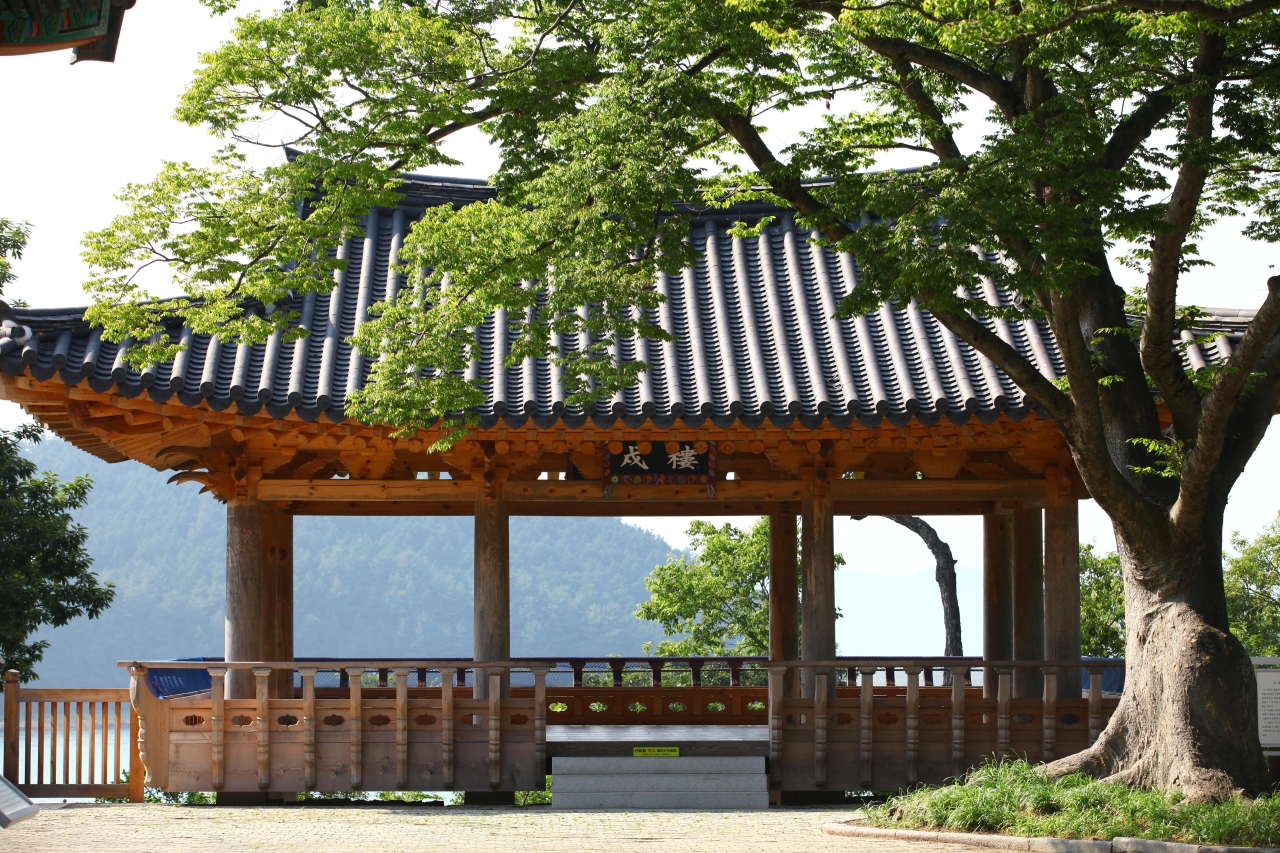
- Hyeonchungsa: his shrine (first built 1706), old family house, archery ground and a museum with the war diary and his long swords. Free, closed Mondays. March–October 09:00–18:00 (last entry 17:00), November–February 09:00–17:00 (last entry 16:00).
- His tomb, about 6 km north: same hours, closed Mondays. Take a taxi.
- Getting there: Seoul subway line 1 or the Janghang line to Onyangoncheon station, then about 4 km by taxi. KTX to Cheonan-Asan takes about 40 minutes from Seoul Station.
Yeosu
- Jinnamgwan: the vast hall first built in 1599 at his old headquarters and rebuilt in 1718, a National Treasure, reopened in May 2025 after ten years of repair. Free, 09:00–18:00, daily; English guides on request in advance. Until 8 November 2026 a free media-art show lights it up every night, 19:30–21:30.
- Yi Sun-sin Square: a turtle-ship replica and statue, 200 m away.
- Chungminsa: a shrine to him from 1601. Free, 09:00–18:00.
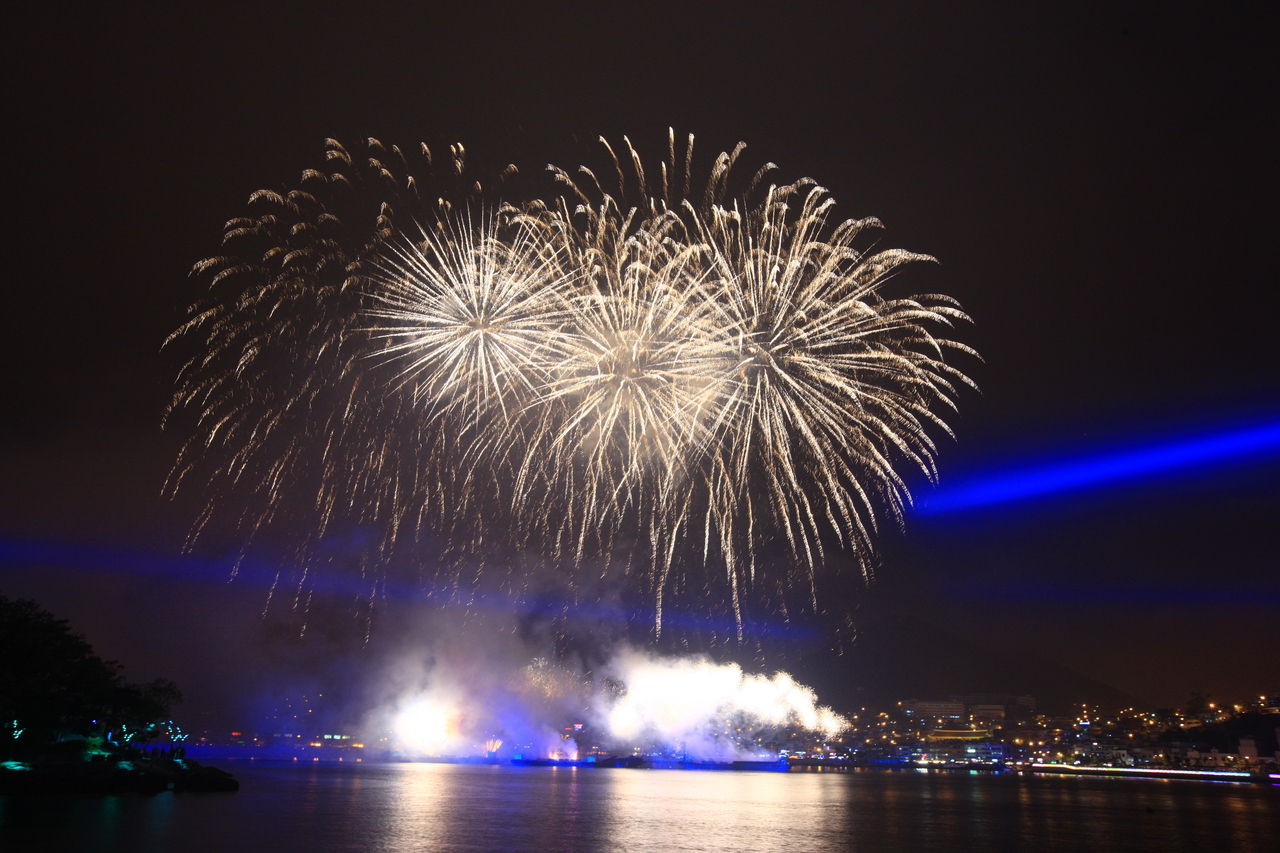
- Our Yeosu fireworks guide has the history of the town and how to get there.
Namhae (Noryang)
- Irakssa, "the place where Admiral Yi fell", above Gwaneumpo bay where he was killed (always open, free), and the Yi Sun-sin Martyrdom Park beside it (free, 09:00–18:00, closed Tuesdays).
- Chungnyeolsa, Noryang, where his body first rested, and a turtle-ship exhibition next to it (500 won, closed Tuesdays).
- Getting there: bus to Namhae from Seoul (4.5–5 hours), Busan or Jinju, then a local bus.
Tongyeong and Geoje
- Jeseungdang, Hansan-do: his headquarters island, free, 09:00–18:00. Ferries from Tongyeong ferry terminal take about 30 minutes; six sailings a day were listed in late October 2026 (07:00–16:30), adult one way from 6,300 won. Bring ID.
- Sebyeonggwan: the great hall of the naval headquarters, which moved to Tongyeong after his death. 3,000 won.
- Chungnyeolsa, Tongyeong: his shrine, 1,000 won, holding gifts sent by the Ming emperor.
- Okpo Victory Memorial Park and the Chilcheollyang Battle Hall on Geoje: free, closed Mondays.
- From Seoul, buses to Tongyeong take about 4 hours; Geoje is 40–60 minutes on.
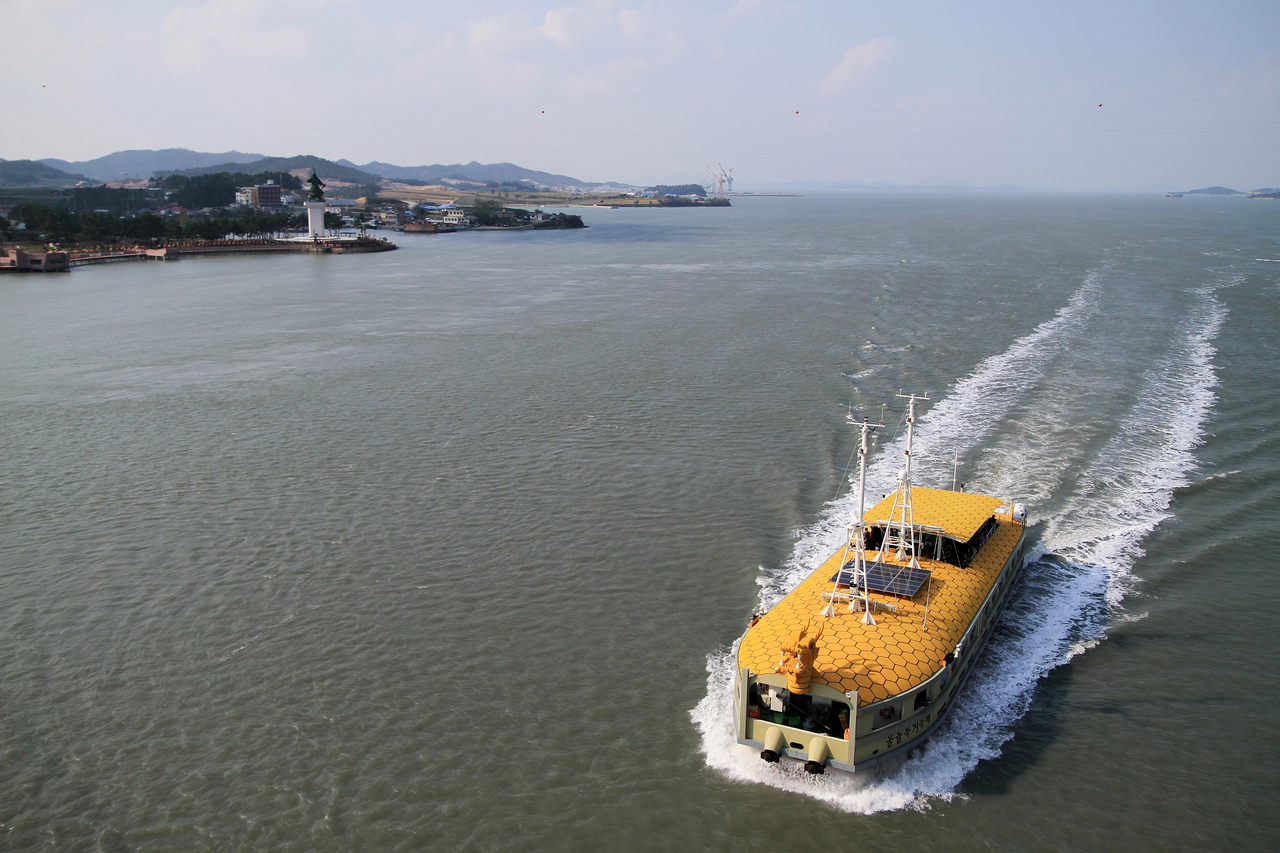
- The strait of Myeongnyang, between Haenam and Jindo island. At its narrowest it is about 300 m wide and the tide races through it.
- Usuyeong tourist site and the battle exhibition hall: free, 09:00–17:30. The skywalk over the current is free; the Myeongnyang cable car across to Jindo is 15,000 won return.
- Getting there: KTX to Mokpo, then a bus of about 45 minutes to Usuyeong.
- The Myeongnyang festival with its sea re-enactment is held in September; it ran 11–13 September in 2026.
| Days | Route | Avoid |
|---|---|---|
| 1 day | Seoul: statue → underground exhibition → birthplace marker → War Memorial | Mondays |
| 1–2 days | Seoul + Asan: Hyeonchungsa and the tomb, a hot-spring hotel in Onyang | Mondays |
| 3–4 days | Yeosu → Namhae → Tongyeong and Hansan-do → Geoje. Without a car, Yeosu to Namhae goes via Suncheon or Jinju; or go Yeosu → Busan → Tongyeong | Tuesday in Namhae, Monday in Geoje |
Festivals in his name
Asan holds its Yi Sun-sin festival around his birthday, 28 April (28 April to 3 May in 2026). Tongyeong's Hansan Great Victory festival is in August (12–16 August in 2026). The Myeongnyang festival at Uldolmok is in September. The 2027 dates were not out yet when we checked.
· Most of these places close one day a week, and not the same day: Mondays in Seoul, Asan and Geoje, Tuesdays in Namhae.
· In winter, Hyeonchungsa stops letting people in at 16:00.
· Tongyeong's long-distance bus terminal is in Jungnim, far from the harbour; take a taxi to the ferry.
· Ferry times to Hansan-do change by season, so call or check at the terminal.
Outdated tips you will still find online
| You may read | What is right | Source |
|---|---|---|
| Togo said he could not compare with Yi | No record of this; the line first appears in a 1955 Korean column | Seok and Kim, 2024 |
| Board all four historic ships (three turtle ships and a panokseon) in Gangguan, Tongyeong | The ex-Han River turtle ship ended its display on 19 October 2026; check the others | KNN, 16 Oct 2026 |
| Jinnamgwan is under repair | Reopened on 30 May 2025 | Yeosu city via news, Mar 2025 |
| Hyeonchungsa is open until 18:00 | Only March–October; until 17:00 (last entry 16:00) in winter | Korea Tourism Organization |
FAQ
Who was Admiral Yi Sun-sin?
The Korean admiral who defeated the Japanese navy again and again during the invasions of 1592–1598, and was killed in the last battle. Koreans see him as the man who saved the country.
Did Yi Sun-sin really win with 13 ships?
Yes. At Myeongnyang in 1597 he had 13 warships against about 133 Japanese ships in the strait (some records say 330), and no loss of any of them is recorded.
Was the turtle ship made of iron?
No record from the time says so. It had iron spikes on a plank roof. Whether it was iron-clad is still argued.
Where can I see Yi Sun-sin in Seoul?
His statue on Gwanghwamun Square, and the free underground exhibition below it, closed on Mondays.
Which Yi Sun-sin film should I watch first?
The Admiral: Roaring Currents (2014), about Myeongnyang. Hansan (2022) tells his great victory of 1592, and Noryang (2023) his last battle.
Sources (checked 27 October 2026)
Encyclopedia of Korean Culture (Yi Sun-sin, Nokdundo incident, Okpo, Sacheon, Hansan, Busan, Myeongnyang, Noryang, Chilcheollyang, turtle ship, Nanjung Ilgi); Annals of the Joseon Dynasty (King Seonjo, 1597 and 1598 entries); National Archives of Korea (honours, Hyeonchungsa); Bank of Korea (100-won coin); UNESCO Memory of the World nomination file for Nanjung Ilgi; the Complete Works of Yi Sun-sin (1795: diary, reports, Yi Bun's biography, Choe Yu-hae's biography); Seoul Metropolitan Government Media Hub (birthplace, diary, Gwanghwamun); Weekly Kyunghyang (2009, the 23-battle count); Seoul Shinmun (statue 2024; turtle-ship restoration report, July 2026); Mudeung Ilbo (Dangpo); Ogawa Takaaki, research note (2022, Hideyoshi's letters and the supply-line debate); Korea National Institute of History, Uri History Net (colonial-era teacher's guide); Kim Jun-bae (2017, 2018) on Meiji naval writers; Seok Young-dal and Kim Jun-bae (2024) on the Togo quotation; G. A. Ballard, The Influence of the Sea on the Political History of Japan (1921); Japanese encyclopedias via Kotobank; Al Jazeera (2021 Olympic banner); Korean Film Council (box office); Korea JoongAng Daily and Korea Times (film accuracy); Far East Films; JustWatch (streaming, October 2026); KBS (drama); Korea Tourism Organization TourAPI (hours, fees, festivals); KNN (Tongyeong turtle ship, 16 October 2026); a ferry timetable site (Hansan-do); bus and train timetable sites. Videos are embedded from their creators' YouTube channels. Photos: Korea Tourism Organization photo gallery; none were taken in 2026.


Comments
Post a Comment