





















Yanghwajin Foreign Missionary Cemetery: Hours, Tours, Graves
One gravestone on a hill above the Han River is carved in English: "If I had a thousand lives to give, Korea should have them all." Ruby Kendrick wrote those words in a letter home to young people in Texas. She had come to Korea in 1907 to teach, and she died in Songdo in June 1908, eight months after she arrived.
This guide is for visiting the Yanghwajin Foreign Missionary Cemetery in Seoul, where 417 people from 15 countries are buried. Among them are an American who carried King Gojong's appeals abroad and a British newspaperman Korea honours as an independence patriot, along with teachers, doctors and their children. It covers opening days (Sundays are closed and Saturdays are tricky), the free guided tours and how to ask for one in English, the stories behind the best-known graves, Jeoldusan Martyrs' Shrine next door, and an afternoon by the river in Mangwon. Tap a tab or open a box to read more.
Open: Monday–Saturday 10:00–17:00; closed Sundays. On Saturdays only people booked on a guided tour may enter from 10:00 to 15:00
Entry: the official site lists no admission fee; the guided tours are free and run by volunteers
Guided tours: Mon–Fri 10:00, 11:30, 14:00; Sat 10:00, 11:30, 13:30, 15:00. Book online by 18:00 the day before; no same-day booking
In English: choose "English-speaking" on the booking form to ask for an interpreter, or scan the QR codes at the graves for short videos in English, Korean, Japanese and Chinese
Time needed: about an hour for the tour, longer if you add Jeoldusan next door
Best days: Tuesday to Friday. The cemetery closes on Sundays and the Jeoldusan museum on Mondays
Getting there: Hapjeong Station (Lines 2 and 6), Exit 7, about 300 m
Checked 4 November 2026 with the sources at the end.

In this guide
- Map and walking route
- Visiting: hours, guided tours, rules
- From ferry to cemetery: one table
- Who is buried here
- Jeoldusan Martyrs' Shrine next door
- On screen and videos
- Nearby: the river, Mangwon Market, Seonyudo
- Couples and families
- Where to stay, tours, and before you go
- Watch out, and outdated tips
- FAQ
Map and walking route
From Hapjeong Station Exit 7 the cemetery gate is about 300 m on foot, and Jeoldusan Martyrs' Shrine is a few minutes further along the same road. The red line is the walk from the station to both, about 1 km in all (OpenStreetMap route). Letters are nearby places. Tap a number for its name.
Map © OpenFreeMap, data © OpenStreetMap contributors. Use Naver Map or KakaoMap for directions in Korea; for a taxi, the cemetery's own page suggests "100th Anniversary Memorial Church" (100주년기념교회) as the destination.
Visiting: hours, guided tours, rules
| Day | What you can do |
|---|---|
| Mon–Fri | Walk in freely 10:00–17:00, or join a booked tour |
| Saturday | 10:00–15:00 for people booked on a tour only; free entry after that until 17:00 |
| Sunday | Closed to visitors; the church on the site holds its services |
| No tours | 1 January, the Seollal and Chuseok holidays, 25 December and church event days |
The cemetery's English page does not yet mention the Saturday limit; its Korean page and Visit Seoul do. Whether the gate stays open for walk-in visitors on the holidays is not stated, so call ahead on those days: 02-332-9174 (10:00–15:30).
The tour has three parts of about 30 minutes each: a film about the missionaries, a walk through the graves, and Yanghwajin Hall, a small exhibition of their belongings and of how the Bible was translated into Korean. The official FAQ puts the whole visit at one hour to an hour and ten minutes, and asks you to be seated ten minutes before the film starts.
Book on the cemetery website by 18:00 the day before. On the form, choose the English-speaking region and write in the notes that you need the tour in English; there is a separate English form, and an email address can stand in for a Korean phone number. The site says an interpreter can be requested; it does not say one is guaranteed on every tour. Without a booking you can still walk the graves, but the film and the hall may not be open to you.
· Take photos only from the paths between the graves; during a tour, one person in the group takes them, and nobody films the missionary video.
· No food or drinks inside the grounds. There is no café or restaurant; picnics go in Yanghwajin History Park next door, which has benches and drinking water.
· Walk single file on the paths, keep quiet, and do not touch gravestones or mounds. Tell children before you go in.
· The official rules name no dress code.

From ferry to cemetery: one table
Yanghwa was a Han River ferry crossing from the Goryeo period, nicknamed for the willow blossom on its banks; goods landed at Jemulpo passed through it on their way to the capital. In 1754 the Joseon court put a garrison here to guard the river. Next door, the old ferry site and Jamdubong hill (Jeoldusan) became a national Historic Site in 1997; the official description of that site does not mention the cemetery.
| Year | What happened |
|---|---|
| 1754 | A garrison is set up at Yanghwa ferry to guard the river and the capital |
| 1866 | French warships sail up the river as far as Yanghwa; afterwards Catholics are executed here, and the hill is said to have been called Jeoldusan from then on |
| Jul 1890 | The American doctor John Heron dies; at the US legation's request the government sets the hill aside for foreigners, and he is the first buried |
| Aug 1890 | The foreign office buys the private land, about 280 pyeong (about 900 m²), under the 1883 treaty with Britain |
| 1897, 1904–05 | The cemetery is enlarged twice, with the Korean Empire paying |
| 1910 | A memorial stone to Ernest Bethell goes up; the Japanese authorities have its words chiselled off |
| 1942 | In the Pacific War Western residents are forced out and their property seized; the cemetery is left with no legal owner |
| 1946 | The foreign residents' cemetery society registers it again |
| 1964 | Korean journalists pay to have Bethell's inscription carved again |
| 1979 | A plan to move the graves for subway Line 2 is dropped after protests; the cemetery lies neglected |
| 1985–86 | A Korean Protestant centennial council takes over, clears about 150 truckloads of rubbish, raises fallen stones and opens a memorial hall |
| 2005–06 | The 100th Anniversary Memorial Church takes charge; the name becomes Yanghwajin Foreign Missionary Cemetery |
Many English pages say King Gojong "granted" the land. The cemetery's own history and the Encyclopedia of Korean Culture say instead that the government chose the site at the American legation's request and then paid for the private plots inside it.
Who is buried here
The cemetery counts 417 people from 15 countries: South Africa, New Zealand, Denmark, Germany, Russia, the United States, Sweden, the United Kingdom, Italy, Japan, Canada, France, the Philippines, Australia and Korea. 145 of them are missionaries and their families, from six of those countries. Each grave has a number, and the letter is its section.
Homer B. Hulbert (1863–1949, USA, grave B-07). He came in 1886 to teach at Yugyeong Gongwon, the royal school in Seoul, and wrote Samin Pilji, a world geography in pure Hangeul. After the 1905 protectorate treaty he went to the United States as King Gojong's secret envoy, and in 1907 he urged the king to send envoys to the Hague peace conference and pleaded Korea's case to the press there. In 1919 he sent the US Senate's foreign relations committee a statement against Japanese rule.
He was invited back by President Syngman Rhee and landed at Incheon on 29 July 1949, forty years after he had left. He died a week later, on 5 August, and was buried where his son, who died at the age of one, already lay. He was awarded the Order of Merit for National Foundation (Independence Medal) in 1950.
Words often quoted from him, "I would rather be buried in Korea than in Westminster Abbey," are carved on his gravestone in Korean. When and where he first said them is unclear; they are remembered as his wish. The heading on the stone is in the handwriting of former President Kim Dae-jung.
Ernest T. Bethell (1872–1909, UK, grave A-02), known in Korea as Bae Seol. He came as a correspondent for the Russo-Japanese War in 1904 and, with Yang Gi-tak and others, founded the Daehan Maeil Sinbo and the Korea Daily News. The paper printed the protest editorial against the 1905 treaty in a special edition and collected money for the National Debt Repayment Movement. Japan had him charged twice, in 1907 and 1908, before the British consular court, and he served three weeks' imprisonment in Shanghai.
He died on 1 May 1909, aged 37. Korea awarded him the Order of Merit for National Foundation in 1968.
In 1910 a memorial stone was raised with an inscription by the journalist Jang Ji-yeon. The Japanese authorities had the words cut away. In 1964 Korean journalists collected money and had them carved again. His last words are reported as: "Though I die, let the Sinbo live forever and save the Korean people."
Ruby Rachel Kendrick (1883–1908, USA). Sent by the Epworth League youth groups of Texas with the Southern Methodist mission, she arrived in 1907 and taught in Songdo (today's Kaesong). She died there on 19 June 1908, eight months after she arrived. The cemetery says overwork; newspapers have said appendicitis. Her stone gives the date as 15 August, which the mission journal of 1908 shows is wrong.
The line on her grave comes from a letter she sent to the young people in Texas who supported her. After the letter reached Texas, the cemetery says, young people there volunteered for mission work in Korea.
William James Hall (1860–1894, Canada) was a Methodist doctor in Pyongyang who caught typhus while treating the wounded of the Sino-Japanese War there; he died on 24 November 1894, aged 34. His wife, Rosetta Sherwood Hall (1865–1951, USA), was a doctor too. She trained Korean women in medicine and is remembered for adapting braille for blind children in the 1890s and for helping found a women's medical training institute in 1928. Their daughter Edith, born after her father died, died in 1898 at three. Rosetta was buried beside them in 1951.
Their son Sherwood Hall, also buried here with his wife, opened a tuberculosis sanatorium in Haeju in 1928 and issued Korea's first Christmas seals in 1932 to pay for the fight against TB.
Rosetta lost her husband after two years of marriage and then their little girl. She named a new wing of the women's hospital in Pyongyang, the Edith Margaret Memorial Wing (1899), after her. Many of the small graves here belong to missionaries' children.
John W. Heron (USA) came in 1885 and became head of Jejungwon, the royal hospital. He caught dysentery from the patients he treated and died on 26 July 1890, the first person buried here.
Henry G. Appenzeller (1858–1902, USA, B-37) landed at Incheon on Easter Day 1885 and founded Paichai school; our Jeongdong walk passes the school and the church that grew from his home. In 1902, on his way to a Bible translation meeting in Mokpo, his ship sank after a collision off Gunsan. His body was never found; the grave here is a memorial.
Mary F. Scranton (1832–1909, USA, B-44) was 52 when the Methodist women's mission sent her. The school she started in her home became Ewha, the school Yu Gwan-sun attended. Horace G. Underwood (1859–1916, born in Britain, American) arrived on the same Easter Day as Appenzeller, founded Saemunan Church and the college that became Yonsei University, and led the first Bible translation committee. He died in the United States; seven members of four generations of the family are in the Underwood plot (F-25).

Not all are missionaries. Soda Gaichi (1867–1962), a Japanese man who cared for orphans in Seoul with his wife, was invited back to Korea in 1961 and buried beside her the next year, aged 95.

Visitors describe the cemetery as a quiet, tree-lined hill in the middle of a city, with the river below. Weekday mornings are the calmest; spring and autumn, when the trees along the stone paths are green or turning, are the seasons people recommend.
How Korea says thank you today
| What | When | Details |
|---|---|---|
| Hulbert memorial | Each August (27 August in 2025 and 2026) | The Hulbert memorial society holds it at Yanghwajin; the 76th, on 27 August 2025, drew about 300 people, his American descendants among them |
| Bethell memorial | Around 1 May | Held at his grave in some years; in 2019 the British ambassador's speech was read by his deputy |
| US Memorial Day | Late May | American Legion Post 38 holds a ceremony here (confirmed for 2024) |
| Hulbert in Vermont | October 2026 | A bust in his birthplace, New Haven, Vermont, reported by the Korea Times |
The cemetery's dates for 2027 memorials are not posted yet. For the War Memorial of Korea's corridors of names and the 22 nations of the Korean War, see our War Memorial guide.
Jeoldusan Martyrs' Shrine next door
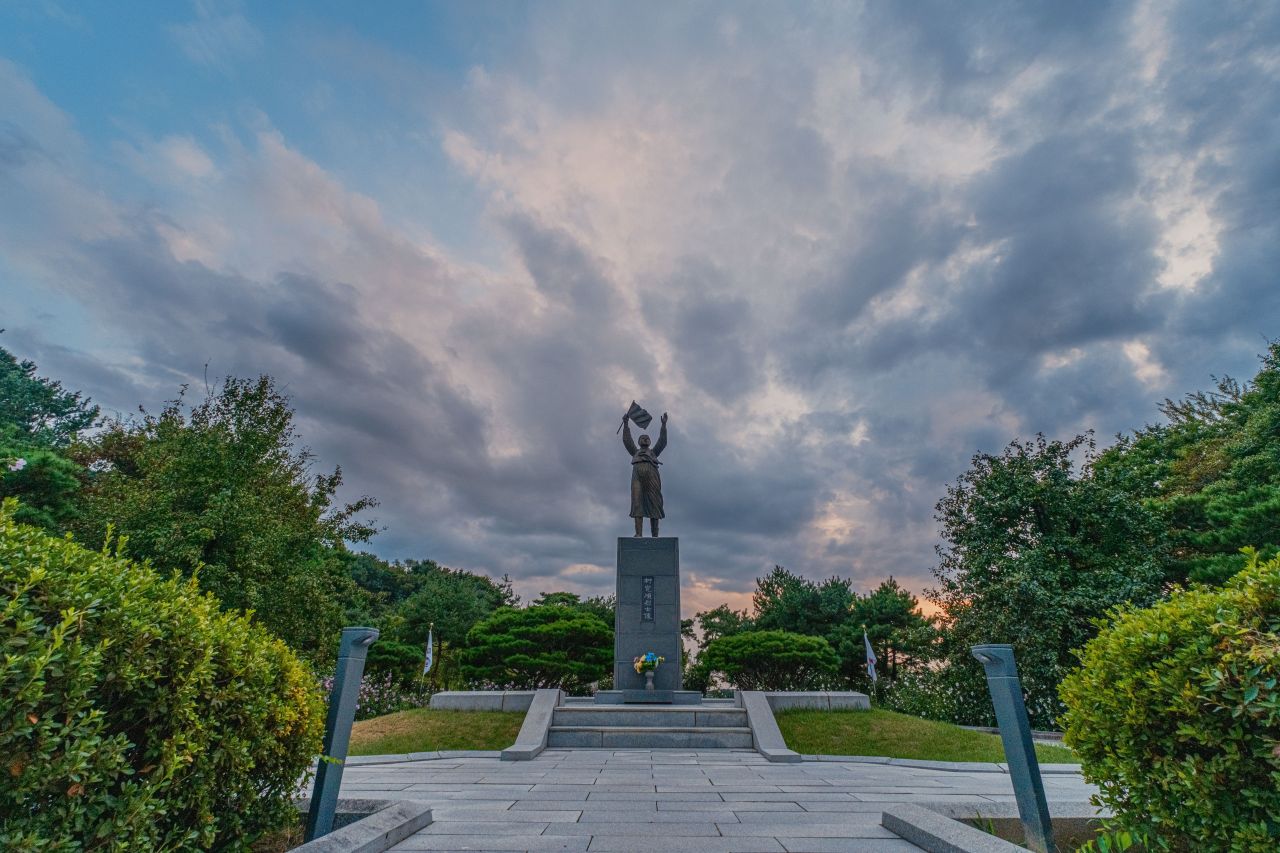
A few minutes' walk south along the river is Jamdubong, "silkworm head peak", named for the shape of the cliff. After the French warships came in 1866, the government executed Catholics here, and the hill, it is said, came to be called Jeoldusan, "the hill where heads were cut". There is no reliable count for this one place; in the whole persecution of 1866–73, about 2,000 people were arrested and some 1,400 killed, according to the Encyclopedia of Korean Culture. The Catholic church acquired the site in 1956 and finished the memorial church and museum in 1967 for the centenary.

| Part | Hours | Cost |
|---|---|---|
| Korean Catholic Martyrs' Museum | Tue–Sun 09:30–17:00; closed Mondays, 1 January, Seollal and Chuseok | A voluntary donation |
| Memorial church | 07:00–17:00 (Mondays to 13:00); Mass Tue–Sun 10:00 and 15:00, Mon 10:00 | Free |
| Special exhibition | "Staying in That Light", 10 Oct 2026 – 24 Jan 2027, B1 | Inside the museum |
The shrine's address is 6 Tojeong-ro, about 450 m (10 minutes) from Hapjeong Exit 7. Its website showed a certificate warning on 4 November 2026; the hours above are from its own pages.
On screen and videos
SBS's investigative programme Unanswered Questions (그것이 알고 싶다) told Hulbert's story in episode 767, "100 years since annexation: where did Emperor Gojong's secret funds go?" (28 August 2010), including his return in 1949 and his burial here. The SBS drama Jejungwon (2010, 36 episodes) is set in the royal hospital that John Heron later ran.
 ▶
[Full] 위대한 발걸음ㅣ양화진 외국인선교사묘원 1 | 위대한 발걸음 35화 — CTS기독교TV
CTS Christian TV (Korean) episode on the cemetery and its graves, November 2025.
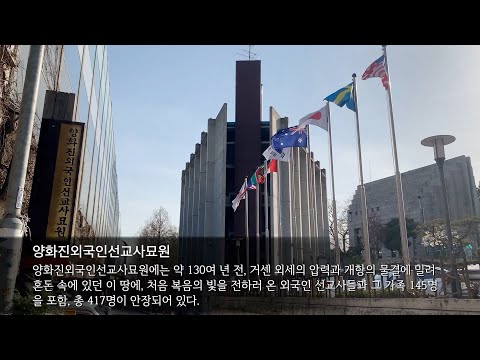 ▶
2023년_양화진외국인선교사묘원 무료 안내 참배객 100만명 기념 동영상 — 100주년기념교회
The 100th Anniversary Memorial Church, which runs the cemetery, marks one million visitors on its free guided tours, September 2023.
 ▶
Missionary Cemetery in Korea? - Visiting Yanghwajin Foreign Missionary Cemetery — Maria Sun An
A visitor walks through the cemetery and explains who is buried there, in English, March 2026.
 ▶
현대건축 유산 ‘절두산순교성지’ / KBS 2022.08.06. — KBS News
KBS News (Korean) on the shrine building as a modern-architecture heritage site, August 2022.
Nearby: the river, Mangwon Market, Seonyudo
| Place | Why go | Hours, cost |
|---|---|---|
| Mangwon Hangang Park | The riverbank below the cemetery; the ferry pier area is on Seoul's list of Han River sunset spots | Free |
| Seoul Battleship Park | Three retired navy vessels, the ROKS Seoul, a patrol boat and a submarine, in Mangwon Hangang Park, with an indoor play room | Tue–Sun 10:00–18:00 in winter (last entry 17:30); ₩3,000 adults, ₩1,000 children |
| Mangwon Market | A 250 m covered market lane of snacks: croquettes, fried chicken bites, tteokgalbi, pork cutlets | About 09:00–21:00, each stall differs; Mangwon Station (Line 6) Exit 2 |
| Seonyudo Park | An old water-treatment plant on a river island, turned into gardens; reached on foot over Yanghwa Bridge | 06:00–24:00, free; about 21 minutes' walk from Hapjeong Exit 8 |
| Mapo Saebit Culture Forest | The park on top of the old Dangin-ri power plant, with a lift down to the river; the arts centre inside is not open yet (planned for December 2027) | Open every day, about 890 m from Sangsu Station |
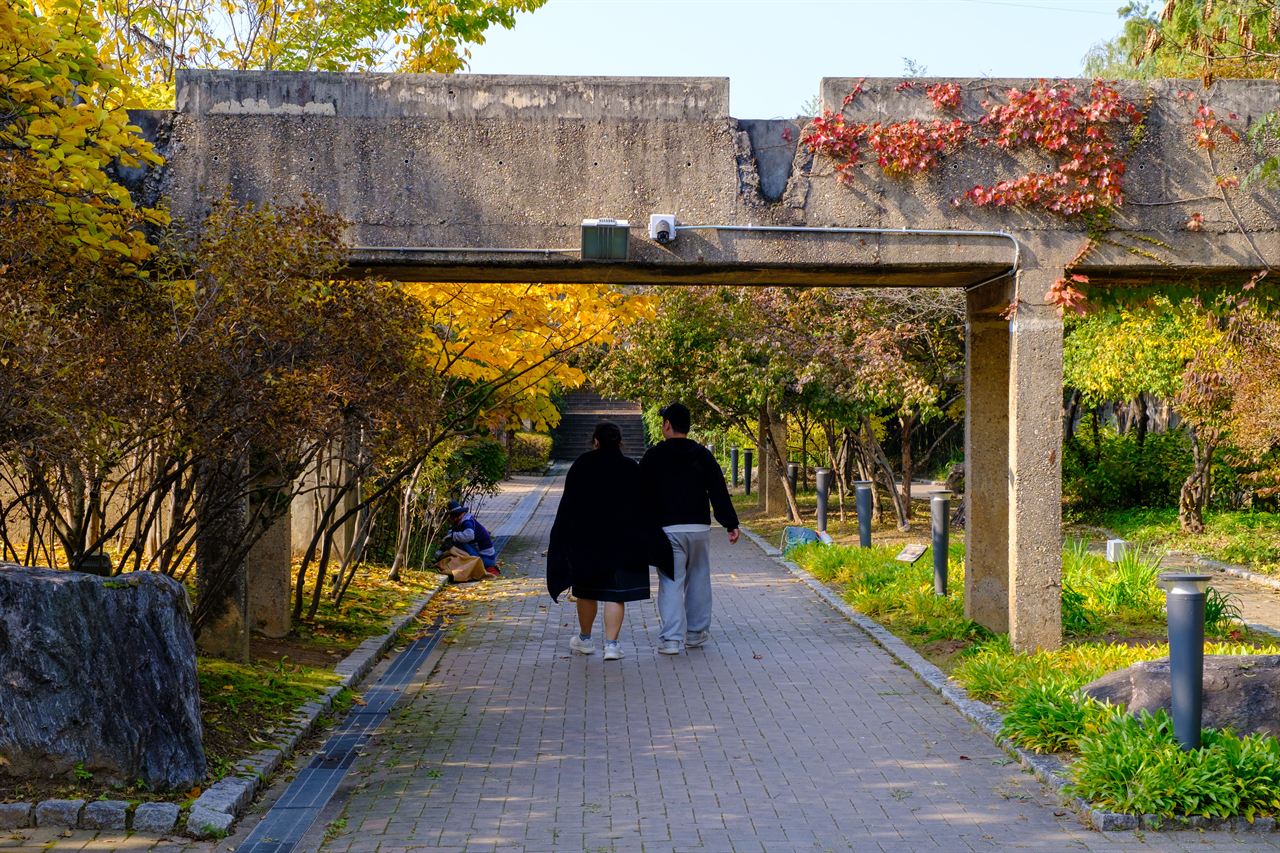
There is nowhere to eat at the cemetery; Mangwon Market is the nearest place for lunch. Mangwon Market grew up in the 1970s among the houses, and in 2026 the tourism ministry named it one of its "K-Tourism Markets", with signs in English, Chinese and Japanese. Its foreign visitors rose from about 270,000 in 2024 to 390,000 in 2025, according to the Korea Tourism Data Lab.
On Korean TV, MBC's I Live Alone filmed the singer Yuk Jung-wan touring the market with his parents (10 April 2015).
What a meal costs: in Seoul, bibimbap averaged ₩12,000 in September 2026; naengmyeon averaged ₩12,615 and kimchi-stew set meals ₩8,654 in April 2026 (Korea Consumer Agency).
 ▶
Everything I ate at Mangwon Market in South Korea! 🇰🇷 — Josh Slavin
A food creator eats his way through Mangwon Market, January 2026.
 ▶
EATING EVERYTHING at Mangwon Market ft. Jimmy Kim! | BEST FOOD MARKET IN SEOUL! | Korean Street Food — Zermatt Neo
A food creator eats through Mangwon Market with Jimmy Kim, December 2024.
| A day here | Cost |
|---|---|
| Cemetery, guided tour, Jeoldusan museum | ₩0 (a donation at Jeoldusan if you like) |
| Lunch in Mangwon | about ₩8,000–12,000 (Seoul averages for a stew set or bibimbap) |
| Seoul Battleship Park | ₩3,000 adult |
| Han River cruise from Yeouido | from about US$7 on Klook |
Couples and families
| Idea | Why |
|---|---|
| Cemetery by day, river at sunset | The cemetery closes at 17:00; walk down to the Mangwon ferry pier for the sunset over the river |
| Yanghwa Bridge to Seonyudo | A walk of about 2 km between Mangwon Market and Seonyudo; the park is open until midnight |
| Market dinner | Snacks and small plates in Mangwon Market and the lanes around it |
| Idea | Why |
|---|---|
| Yanghwajin Hall | Recommended from age 8, on the booked tour |
| Seoul Battleship Park | Inside a real warship, plus ball pit and Lego indoors; ₩1,000 children. Stairs are steep |
| Seonyudo Park | A car-free island garden to run around in |
Explain the quiet rules to children before going into the cemetery; the picnic spot is Yanghwajin History Park next door. The battleship park closes on Mondays; check holidays on 02-332-7500.
Where to stay, tours, and before you go
Hongdae, next to Hapjeong, has the most hotels nearby; our Hongdae guide compares where to stay there. The hotel and tour links in this part are affiliate links: if you book through them, Korea Routes may earn a commission, at no extra cost to you. These hotels are on Klook; prices are the lowest nightly rates shown in Klook's search, checked 4 November 2026, and change by date.
| Hotel | Why | From |
|---|---|---|
| L7 Hongdae | By Hongik University Station Exit 1, about 400 m | about US$146 |
| High Street Guest House | Budget, about 400 m from Hongik University Station | about US$44 |
Tours (on Klook; prices checked 4 November 2026): for more of the people who stood with Korea under Japanese rule, the Blood, Tears & Independence walking tour visits Seodaemun Prison, Independence Gate, Dilkusha (the house of the American Albert W. Taylor) and Tapgol Park in about three and a half hours (about US$65).
Book the tour: by 18:00 the day before, and say you need English
Phone and earphones: for the QR video guide at the graves; the cemetery asks you to use earphones
Data: a Korea eSIM, for the QR videos and Naver Map
Transit card: a T-money card for the subway and buses; our Seoul transport guide explains it
Food: eat before or after; nothing to eat or drink is allowed inside
Watch out, and outdated tips
· No same-day booking. If you missed the deadline, walk in on a weekday and use the QR videos.
· Two closing days. The cemetery shuts on Sundays, the Jeoldusan museum on Mondays.
· Driving: parking is small; Jeoldusan's car park is only for shrine visitors and the shrine suggests public transport at weekends.
Outdated tips you will still find online
| You may read | What is right | Source |
|---|---|---|
| Tours Mon–Sat at 10:00, 11:30, 14:00 and 15:30 | Mon–Fri 10:00, 11:30, 14:00; Sat 10:00, 11:30, 13:30, 15:00 | Cemetery booking page |
| Open 09:30–17:00; about 400 people from 14 countries | 10:00–17:00; 417 people from 15 countries | Cemetery site |
| Book until 21:00 the day before | Until 18:00 the day before | Cemetery booking page |
| Usually open on Sundays | Closed on Sundays | Cemetery site; Visit Seoul |
| King Gojong granted the land | The government set the site aside at the US legation's request and bought the private land | Cemetery history; Encyclopedia of Korean Culture |
| Jeoldusan museum costs ₩2,000 | A voluntary donation | Jeoldusan site |
| Appenzeller is buried here | His body was never found; the grave is a memorial | Korean press |
FAQ
Is the Yanghwajin cemetery free?
The official site lists no admission fee, and its guided tours are free.
Can I visit on a Sunday?
No. Come Monday to Friday, or on Saturday after 15:00 unless you have booked a tour.
Is there a tour in English?
You can ask for one when you book, by choosing the English-speaking region and adding a note. Without a booking, the QR codes at the graves play short videos in English.
Who are the most famous people buried here?
Homer Hulbert and Ernest Bethell, both honoured by Korea for its independence, Ruby Kendrick, the Hall family, Mary Scranton and the Underwood family, with a memorial for Henry Appenzeller.
How far is Jeoldusan?
A few minutes' walk along the same road; it is about 450 m from Hapjeong Exit 7.
Sources (checked 4 November 2026)
Yanghwajin Foreign Missionary Cemetery official site (overview, history, people, guide, booking, rules, FAQ, smart guide, location, news); 100th Anniversary Memorial Church (service times, Feb 2026); Visit Seoul English page (updated Sep 2026); Encyclopedia of Korean Culture (Yanghwajin cemetery, Yanghwa ferry and Jamdubong, Byeongin persecution, Jeoldusan memorial hall); Korea Heritage Service (Historic Site, 1997); Jeoldusan Martyrs' Shrine official site (hours, museum, Mass, history); The Korea Mission Field (Aug 1908, via the cemetery); Kyunggi Ilbo (gravestone inscriptions, 2008); Korea JoongAng Daily (2004, 2008, 2010); Kyunghyang Shinmun (Bethell, 2023); Seoul Shinmun (Bethell, 2018); Seoul city media hub (Hulbert's gravestone; 2021 tour times); Korea Education News (the Halls); Christmas Seal Society (Sherwood Hall); OhmyNews (Hulbert memorial, 2025); Korea Times (Hulbert memorials 2021–2026, Bethell memorials 2013 and 2019, Vermont bust 2026); American Legion Post 38 (Memorial Day 2024); SBS (Unanswered Questions ep. 767, 2010); Sports Kyunghyang and Seoul Shinmun (Jejungwon, 2010); ktriptips (older booking times); travellers' blogs (What's Stewin, 2017; On Walkabout, 2009); Seoul city media hub (Seoul Battleship Park, Seonyudo, Mangwon Market, sunset spots, 2026); Hangang park office; Korea Consumer Agency price survey via Financial News and Hankyung (2026); Korea Tourism Data Lab via Newsis (Mangwon visitors, 2026); Aju Business Daily (Dangin-ri arts centre, 2026); MBC (I Live Alone, 2015); Klook product and hotel pages. Videos are embedded from their creators' YouTube channels. Photos: Korea Tourism Organization (Visit Korea) image library and photo gallery; not taken this year.


Comments
Post a Comment