






















Ahn Jung-geun: Why He Shot Itō, the Trial, Films and Places
At about half past nine on the morning of 26 October 1909, a train from the south pulled into Harbin station in Manchuria. Prince Itō Hirobumi, a former prime minister of Japan and the first Resident-General of Korea, stepped down to inspect a Russian guard of honour. In the crowd behind the soldiers stood a 30-year-old Korean. He fired six or seven shots. Three hit Itō, who died within half an hour. The gunman shouted "Korea, hurrah!" three times in Russian, and let the Russian gendarmes take him.
This is the story of Ahn Jung-geun, the man whose handprint, with its shortened ring finger, you will see on Korean stamps, T-shirts and museum walls: why he shot Itō and the fifteen charges he laid out under interrogation and wrote down in prison, the trial in which he called himself a prisoner of war, the Japanese guard who kept his last calligraphy for life, the book on East Asian peace he did not live to finish, what Japan, China and the West say about him, the films and the musical, and the places in Seoul and beyond where you can follow him. Tap a tab or open a story to read more.
Who: a Korean independence fighter who shot Itō Hirobumi at Harbin station on 26 October 1909 and was hanged in Lüshun prison on 26 March 1910, aged 30
Lived: 1879–1910. Born in Haeju, in today's North Korea; a Catholic, baptised Thomas; a school founder, then a guerrilla officer in the Russian Far East
Known for: the Harbin shooting · the pledge of twelve men who cut off a fingertip and wrote "Korean Independence" in blood · his unfinished On Peace in the East · about 60 pieces of prison calligraphy, 31 of them designated Treasures
See him in Seoul: the Ahn Jung-geun Memorial Hall on Namsan (free, closed Mondays) and his empty tomb in Hyochang Park
This autumn: a free special exhibition of his last calligraphy, returned from Japan in 2026, at the National Palace Museum until 27 December 2026
Watch first: Harbin (2024), the spy thriller with Hyun Bin that premiered at Toronto
Checked 28 October 2026 with the sources at the end.

In this guide
- Map: where to follow him
- His life in one table
- Why he shot Itō: the fifteen charges
- The trial at Lüshun
- Peace in the East: the book he did not finish
- What Japan, China and the West say, and what is myth
- Mocked online, and what happened
- Stories from his life
- On screen and on stage
- Places to follow him
- Watch out, and outdated tips
Map: where to follow him
The map shows the six Seoul sites. The memorial hall, the old Residency-General site and Myeongdong Cathedral are within one walk on the north slope of Namsan; Hyochang Park is a short subway ride west. The places outside Seoul, and Harbin and Lüshun in north-east China, are in the tabs further down. Tap a number for its name.
Map © OpenFreeMap, data © OpenStreetMap contributors. Use Naver Map or KakaoMap for directions in Korea.
His life in one table
Ahn was born in 1879 in Haeju, a town in Hwanghae province that is now in North Korea, the eldest son of a local scholar. When he was a boy the family moved to a village called Cheonggye-dong, where his father ran a school and the son became known as a crack shot who went hunting every day. In 1897 the whole family was baptised in their village by a French missionary, Father Wilhelm; Ahn took the name Thomas and kept it to the end. After Japan made Korea a protectorate in 1905 he founded one school and took over another in the port of Jinnampo, joined the campaign to repay the national debt, and in 1907, when Korea's emperor was forced to abdicate and the army disbanded, he left for the Russian Far East to fight.
| Year | What happened | Where you can see it |
|---|---|---|
| 1879 | Born 2 September in Haeju, Hwanghae province (now North Korea) | Memorial Hall, room 1 |
| 1897 | Baptised a Catholic with his family, taking the name Thomas (one encyclopedia says 1895) | Memorial Hall, room 2; Myeongdong Cathedral |
| 1906–07 | Founds Samheung School and takes over Donui School in Jinnampo; leads the national-debt repayment campaign in the north-west | Memorial Hall, room 2 |
| 1907 | Leaves Korea for Vladivostok after the emperor's forced abdication and the disbanding of the army | — |
| 1908 | Helps found a volunteer army, the Righteous Army, and is made a staff general; raids across the border, frees Japanese prisoners, and is routed at Yeongsan | Memorial Hall, room 2 |
| Early 1909 | Twelve men cut off the tip of a finger and write "Korean Independence" in blood on a Korean flag | Memorial Hall, room 2 |
| 26 Oct 1909 | Shoots Itō Hirobumi at Harbin station | Memorial Hall, room 3; Harbin station |
| Nov 1909 | Moved to Lüshun prison; in December begins his autobiography | Lüshun prison museum |
| 7–14 Feb 1910 | Six court sessions; sentenced to death on 14 February | Memorial Hall, room 3 |
| Feb–Mar 1910 | Writes most of his calligraphy and starts On Peace in the East | Memorial Hall calligraphy gallery; National Palace Museum (this autumn) |
| 26 Mar 1910 | Hanged at 10 a.m. in Lüshun prison; buried in the prison ground, the body never returned | Hyochang Park (empty tomb) |
| 1946 | Kim Ku builds an empty tomb for him beside three other martyrs in Hyochang Park | Hyochang Park |
| 1962 | Awarded the Republic of Korea's highest order of merit | — |
| 1970 · 2010 | The memorial hall opens on Namsan; a new building replaces it in 2010 | Memorial Hall |
Why he shot Itō: the fifteen charges
When the Japanese prosecutor asked him why, Ahn answered with a list. His prison autobiography gives it as fifteen charges against Itō, and the memorial hall in Seoul shows the pages. In his own order:
- Having Korea's Empress Myeongseong murdered (1895)
- Deposing Korea's emperor (1907)
- Forcing the treaties of 1905 and 1907 on Korea
- Massacring innocent Koreans
- Seizing the government by force
- Taking Korea's railways, mines, forests and rivers
- Forcing Japanese bank notes on Korea
- Disbanding the Korean army
- Obstructing education and banning Koreans from reading newspapers
- Forbidding Koreans to study abroad
- Confiscating and burning textbooks
- Telling the world that Koreans wanted Japan's protection
- Deceiving the Japanese emperor that Korea was at peace while killing went on
- Destroying the peace of East Asia
- Killing the previous Japanese emperor, the father of the one then reigning
Some of these are facts of the day, some his reading of them, and the last is a rumour he believed. A Singapore newspaper that reported his interrogation in December 1909 printed a slightly different list. What matters is the shape of it: he was not avenging one act but, as he put it, punishing the man who, as he put it, had destroyed the peace of the East. A Western historian of his trial, Franklin Rausch, notes the irony that Itō was more moderate than many in Tokyo and had opposed immediate annexation; to Ahn he was the man who had destroyed Korea's sovereignty in practice.
The trial at Lüshun
Harbin was in the Russian railway zone, so Russian gendarmes arrested him and Russian officials took the first statements. They then handed him to the Japanese consulate, and Japan tried him in its own court at Lüshun, the naval port it had taken from Russia. Whether a Japanese court could try a Korean for an act on Russian-leased land was argued at the time and is still argued by legal scholars.
The trial ran from 7 to 14 February 1910: six sessions, with three companions in the dock beside him, U Deok-sun, Jo Do-seon and Yu Dong-ha. U and Jo had waited at the previous station, Caijiagou, in case the train stopped there instead; it did not. Koreans in Vladivostok raised money for an international defence and engaged a British barrister from Shanghai, J. C. E. Douglas, and a Russian lawyer, and the family hired a Korean lawyer. The judge allowed none of them: only two court-appointed Japanese lawyers could speak. Even they argued that Ahn was a political offender and that the court had no jurisdiction. He was sentenced to death on 14 February. He did not appeal.
Ahn did not deny the shooting. He denied that it was murder. His final statement, as translated in a German study of the trial, put it this way: he was a soldier of the Korean army, had been captured by the enemy in that capacity, and should therefore be dealt with under international law. He held the rank of staff general in the Righteous Army, he said, and had executed an enemy commander in a war of independence; he should be treated as a prisoner of war, not a criminal.
The prosecution answered that his motive was personal, not political. His autobiography says the prosecutor who first questioned him was moved by the fifteen charges and called him "a righteous man of the East"; that line comes only from Ahn's own account, and the indictment later painted him as driven by a craving for fame. Korean newspapers of the time reported that his mother, through his brothers, had sent word that she did not expect to see him again in this life.
The most unexpected figure in the story is a Japanese military policeman named Chiba Toshichi, who guarded him in Lüshun. On the morning of 26 March 1910, shortly before he was led out, Ahn wrote eight characters for Chiba: 爲國獻身軍人本分, "To give one's body for one's country is a soldier's duty." Chiba took the scroll home to Miyagi prefecture and kept it until he died in 1934. In 1979, on the hundredth anniversary of Ahn's birth, his family gave it back to Korea; it is now a designated Treasure. At the family temple, Dairinji in Kurihara, Ahn's and Chiba's memorial tablets stand side by side, a stone carved with the eight characters stands in the grounds, and a memorial service has been held every year since 1981. In March 2025 the temple received a Korean peace prize named after Ahn.
Ahn went to the gallows in new white Korean clothes sent from home. By a Japanese newspaper's account he said only that his act had been for the peace of the East, and that he hoped Korea and Japan would work for it together after his death. His brothers were refused the body. He had asked to be buried beside the park in Harbin until Korea was free, then carried home. The grave has never been found.
Peace in the East: the book he did not finish
In the forty days between sentence and execution Ahn wrote an autobiography, dozens of pieces of calligraphy for the Japanese officials and guards who asked for them, and the opening of a treatise, On Peace in the East. He had planned five chapters and wrote only the preface and part of the first. The chief judge had told him the execution would be delayed so that he could write; it was not.
What survives is an argument, not a plan. It opens: "That those who unite prosper and those who scatter perish is a truth unchanged through all ages." Japan, it says, had won its war with Russia in 1904–05 by promising to "preserve the peace of East Asia and secure the independence of Korea", and had then turned on the neighbour it promised to protect. "One who harms a neighbouring nation of his own kind," it ends, "will in the end not escape the fate of the tyrant left standing alone."
The concrete proposals that Korean writers often quote come from a different document: a recorded interview with the chief judge of the high court in February 1910. There Ahn proposed returning Lüshun to China and making it a neutral port run jointly by Korea, China and Japan, a standing peace council of the three countries based there, a joint bank and a shared currency, and a joint army of young men from all three. Korean and Japanese scholars have since compared the scheme to Kant's essay on perpetual peace and to the coal-and-steel community that began the European Union; a Japanese historian, Ogawara Hiroyuki, wrote in 2025 that it anticipated of what peace studies now call "positive peace". It is not on any UNESCO register, and the original manuscript, taken by the Japanese authorities, has never been found.
What his calligraphy says
About 60 pieces written in Lüshun in February and March 1910 are known, most of them for Japanese prosecutors, guards and a monk who visited him. Thirty-one are designated Treasures, and the memorial hall in Seoul shows a changing selection. Most end with his left handprint, the ring finger short. Three lines you will see most often: "A day without reading grows thorns in the mouth"; "Worry over the safety of the nation burns the heart"; and the one given to the guard Chiba, "To give one's body for one's country is a soldier's duty." A piece reading "International law is no match for a cannon" came back from Japan in August 2026 and is the centre of the National Palace Museum's exhibition this autumn; another, "Poor without fawning, rich without pride", was lent by the Tokyo metropolitan government for six months from spring 2026 and shown at the memorial hall.
What Japan, China and the West say, and what is myth
Officially, Japan sees a crime. In November 2013 the chief cabinet secretary, Suga Yoshihide, said at a press conference that Japan had told Korea Ahn was "a criminal"; in January 2014, when the Harbin memorial opened, he called him "a terrorist who killed our first prime minister and was sentenced to death". The cabinet's written answers to parliament in 2014 and 2015 used plainer words, "a person who killed Itō Hirobumi and was sentenced to death", expressed regret over the Harbin memorial, and said Japan had repeatedly conveyed its concern to Seoul and Beijing. The 1909 Residency-General report had called him "a rioter".
Privately, Japan has long been more divided. Around 1910 the anarchist Kōtoku Shūsui wrote a poem in praise of Ahn on a postcard that survives in a Tokyo university library. The sign at Itō's grave in Tokyo, rewritten in 1996, now says he was shot by "a Korean independence activist"; an earlier version said "a rioter". Ryukoku University in Kyoto runs a research centre named after Ahn's peace treatise and owns one of his calligraphies. The temple in Miyagi that holds Chiba's memory has drawn about a hundred Japanese to its annual service. When the film Harbin opened in Japan in July 2025, a liberal columnist wrote that calling Ahn a terrorist, after decades of official apology for the annexation, was open to question. Ogawara put the dispute this way: Japan says terrorist, Korea says martyr, and both judge the man by the shooting alone.
Chinese revolutionaries cheered at the time. A paper of the revolutionary camp wrote that the shots "did more than a thousand petitions". A poem attributed to Sun Yat-sen, praising the man whose "merit covers the three Han and whose name reaches ten thousand nations", hangs in the Seoul memorial hall; Zhou Enlai is reported to have called the Harbin shooting the start of Chinese and Korean resistance together. The original sources of these lines have not been traced; they are best read as tradition.
The state came round later. A statue put up at Harbin station by a Korean businessman in 2006 was removed by the Chinese authorities after eleven days and now stands in Bucheon, near Seoul. In 2013 President Park Geun-hye asked Xi Jinping for a marker at the station; China built a memorial room instead, which opened in January 2014. Its foreign ministry called Ahn "a famous anti-Japanese fighter respected by the Chinese people", and when Tokyo said "terrorist", a ministry spokesman is reported to have asked what that made the fourteen Class A war criminals enshrined at Yasukuni. The room moved out during station works in 2017, came back to its original place in March 2019, and was reported open and busy by China's state news agency in September 2026.
In 1909 the Western press mourned Itō. The Times of London ran "Prince Ito" on 27 October; the Daily Telegraph called him "the greatest man of the East"; the Illustrated London News headed its piece "The Maker of Modern Japan Assassinated". Ahn was "the murderer" or "a Korean fanatic", and his own words hardly reached print, because the news came through Japanese channels. Film said to show the shooting was offered for sale by a St Petersburg firm and bought by a Japanese agent, the trade press reported; in 1910 the New York Times said two reels had reached the United States. Their whereabouts are unknown.
A century on, the English-language view is calmer. An English translation of everything he wrote, with trial excerpts, appeared from Brill in 2020. A case study published in 2025 by a European history-education institute calls the Harbin memorial one of the most contested sites in East Asia's modern memory, used by three countries for three different stories. The phrase two American commentators reached for in 2014 is the old one: one man's terrorist is another man's freedom fighter.
| The story | Verdict | Why |
|---|---|---|
| His mother wrote to him: "Do not beg for your life. Die." | No original | The letter is known only from a 1994 book by a Japanese monk, relaying the guard Chiba's memory. Korean newspapers of December 1909 record only a spoken message passed on by his brothers |
| Itō's last words were "Fool" | Tradition | Korean accounts cite Japanese sources, but no primary document has been found; another version says he died without speaking |
| He fired seven shots and three hit | Half true | Three hits are in the Japanese doctor's report. His own account says four shots at Itō, then three more; other sources count six in all |
| The prosecutor called him "a righteous man of the East" | Only his word | The line is in his autobiography; the indictment argued a personal motive |
| He is buried in Hyochang Park | False | The tomb there is empty. A joint Korean-Chinese dig at Lüshun in 2008 found nothing; a new task force started work in March 2026 |
| The Catholic Church excommunicated him and lifted it in 1993 | Overstated | No formal excommunication is on record. The French bishop of the day condemned the killing; in 1993 Cardinal Kim Sou-hwan said a memorial Mass and called it self-defence |
| On Peace in the East is on UNESCO's Memory of the World register | False | No UNESCO listing exists for him or his writings |
| Korea printed a 100,000-won note with his face | False | The image that circulates online was made by a user in 2018; the Bank of Korea never issued one |
Mocked online, and what happened
Foreign visitors sometimes ask why Koreans react so sharply when their independence fighters are joked about. Part of the answer is that it keeps happening, and that the law has had almost nothing to say. These are the cases reported by the Korean press; the people behind the anonymous accounts were not named in the reports and are not named here.
| When | What | What happened |
|---|---|---|
| May 2021 | Two streamers on the platform AfreecaTV, one with about a million YouTube subscribers, joked about Yu Gwan-sun, the 17-year-old of the 1919 independence movement who died in prison, in a sexual context during a live show | Both apologised on video; the platform suspended them for 90 days; a petition drew 16,000 signatures; her memorial society said it would not sue but would act if it happened again |
| Feb 2026 | AI-made clips restored Yu's prison photograph, taken after torture, and had her break wind in a restaurant and fly off as a rocket; three TikTok clips passed 200,000 views and two more went up as YouTube Shorts | A descendant said it was "like being stabbed with a knife"; the broadcasting standards body asked for removal and TikTok said it would delete; police said no investigation had been opened |
| Mar 2026 | Five TikTok clips, 130,000 views, pasted Ahn's photograph onto trains and balloons with the same joke, alongside clips of Yu, Yun Bong-gil and Kim Ku | The veterans ministry asked TikTok Korea to act, and the posts and the account were deleted |
| Apr–Aug 2026 | Posts drew Ahn and Yu as a couple in sexual poses, and ranked independence fighters by their looks | On 14 August 2026 the ministry wrote to YouTube, Meta and TikTok asking for monitoring and a joint response |
| Jun 2026, Japan | A hotel in Kōchi unveiled a memorial stone to Ahn proposed by a Japan-Korea friendship group | After online posts called it the glorification of a terrorist, the hotel apologised and had the stone removed within a week |
Why no one has been punished
Korea's insult law protects only the living. Defaming the dead is a crime, but only for false statements of fact, and only if the family brings a complaint; a fart joke is an opinion, not a fact. In 2022 the Seoul High Court confirmed that criticism of a historical figure grounded in the record is not defamation at all. So the 2026 clips were deleted by the platforms, not prosecuted. In April 2026 a lawmaker, Kim Yong-man, with the veterans minister beside him, proposed a ban on making or spreading content that mocks independence fighters online, with ministry take-down orders and fines of up to 5 million won, and exceptions for art, scholarship and news. By August it had not yet reached committee.
Stories from his life
Twelve fingers (early 1909)
In a Korean inn near the Russian-Korean border, twelve members of his band each cut off the tip of the left ring finger and, with the blood, wrote the four characters for "Korean Independence" across a Korean flag, swearing to kill Itō within three years or die. His autobiography records it; the memorial hall's second room ends with it, and the building itself has twelve columns for the twelve men. The day before he died he told his brothers that the fingertip had been left for safekeeping in Vladivostok, and asked them to fetch it. It was never found.
The prisoners he let go (1908)
Leading a raid into north-east Korea in the summer of 1908, his unit captured Japanese soldiers. His men wanted them shot. Ahn released them, arguing, as he wrote, that "nowhere in international law is there a rule that captured enemy soldiers must be killed." The freed men gave away his position, and the unit was routed at Yeongsan. The 2024 film Harbin shows him carrying this defeat and the quarrel over the prisoners.
The teenager with the short gun
Kim Ku, later head of Korea's government in exile, hid in Cheonggye-dong as a young man in 1895 after the failed peasant uprising. In his memoir he remembered the scholar's eldest son: hair tied with a purple cloth, a short gun on his shoulder, out hunting every day, "the best shot among the Cheonggye-dong men". The memoir gives the boy's age as thirteen; he was in fact about sixteen. Fifty-one years later Kim built his empty tomb.
The film that vanished
A camera was running at Harbin station for Itō's arrival. In December 1909 the trade paper Variety reported that a St Petersburg firm was offering film "taken during the shooting" for 150,000 roubles, and a Singapore paper that a Japanese buyer had paid 15,000 yen. In August 1910 the New York Times said two reels had reached America and been shown at the trial before the Japanese government seized them. The short clips shown on Korean and Japanese television since the 1990s are cut from a 1940s Japanese documentary and do not show the shooting. Where the reels are, if they survive, nobody knows.
The grave that was not there
His will asked for burial beside the park in Harbin, "until our sovereignty is restored, then carry me home". The Japanese buried him instead in the prison ground at Lüshun and refused the family the body. In 1946 Kim Ku built him an empty mound in Seoul, with no stone. In 2008 Korean and Chinese teams dug for 29 days on a hill behind the prison, where apartment building had already begun, and found nothing; the site is now an apartment estate. The likeliest place today is Dongshanpo, the old prison cemetery about a kilometre away: a south-facing hillside with hundreds of graves, protected by the city of Dalian since 2001, with eleven-storey blocks built across the village below it. In April 2026 a Korean researcher published a 1910 Osaka newspaper report describing a deeper-than-usual grave there, and in March 2026 the Korean government set up a task force. By mid-2026 the hillside had cameras and was closed to the public, and Korean scholars said that as a naval zone it could not be excavated by foreigners without China's consent. As of October 2026 the grave is still unfound.
On screen and on stage
| Film | Ahn · audience in Korea | Good to know |
|---|---|---|
| Harbin (2024) | Hyun Bin · about 4.9 million | A spy thriller: betrayal and pursuit on the way to the station. World premiere as a gala at the Toronto film festival, September 2024. Shot in Korea, Mongolia and Latvia. Best film at the 2025 Baeksang awards, where its cinematographer Hong Kyung-pyo took the grand prize. Released in the United States by Well Go USA |
| Hero (2022) | Jung Sung-hwa · about 3.3 million | The stage musical filmed. His last year, from Harbin to the gallows, in songs; Jung had played the part on stage since 2009 |
| Thomas Ahn Jung-geun (2004) | Yu Oh-seong | A drama by the comedian turned director Seo Se-won, who paid more than half of its 4-billion-won budget himself |
| Ahn Jung-geun, the Martyr (1972) | Kim Jin-kyu | Best film at that year's Grand Bell awards |
| Emperor Gojong and Martyr Ahn Jung-geun (1959) | — | By Jeon Chang-geun; on a Korean Film Archive DVD set with English subtitles |
Audience figures: Korean Film Council totals as reported by the Korean press, checked 28 October 2026. North Korea made its own two-part film in 1979, which was dubbed into Chinese and widely seen in China in the early 1980s.
Hero, the musical, opened at the LG Arts Center in Seoul on 26 October 2009, the hundredth anniversary of the shooting, and has run in most years since. It played the David H. Koch Theater at Lincoln Center in New York for two weeks in August and September 2011, in Korean with English surtitles, with the UN secretary-general Ban Ki-moon in the audience; it played Harbin in February 2015; and it passed a million tickets in March 2023. Its best-known number is the courtroom song "Who Is the Criminal?", in which Ahn sings the fifteen charges. The fifteenth-anniversary run was at the Sejong Center in summer 2024. There is no regular season in 2026; the only performances listed this year are a gala concert in Naju in June and highlights at the National Assembly on 14 August. A new ballet about him, Ahn Jung-geun, a Dance in Heaven, played the Seoul Arts Center in March 2026.
Korean variety shows have followed his route. 2 Days 1 Night (KBS) went to Harbin and Lüshun prison in March 2016 and drew 14.8 percent of viewers; Crossing Lines Returns (MBC) rode the Trans-Siberian railway in his footsteps in November 2019. For the centenary of his death, 26 March 2010, EBS and KBS each aired a documentary the same night, one tracing his grave, one his calligraphy. In English, Arirang TV made a three-part mini-documentary, A Man of Conviction, in 2019. In March 2026 a Korean bank released a four-minute film with English subtitles about Ahn and the guard Chiba.
Harbin went to Netflix worldwide in April 2025, Korean press reported. In the United States in October 2026 JustWatch listed it on Prime Video, Hulu and the free services Tubi and Roku, but no longer on Netflix; a 4K and Blu-ray edition with English subtitles came out in April 2025. Hero was free on Tubi in Canada. Listings change by country and month; check JustWatch for yours. The musical's official channel has the courtroom number filmed at Seodaemun Prison, in Korean.
 ▶
Harbin – official US trailer — Well Go USA Entertainment (English subtitles)
The American distributor's trailer for the 2024 film, with English subtitles.
 ▶
Hero the musical – 'Who Is the Criminal?' — ACOM Musical (Korean)
The producer's own music video of the courtroom number, filmed at Seodaemun Prison for the tenth anniversary in 2019.
 ▶
Ahn Jung-geun, a man of conviction — Arirang TV (English)
Korea's international broadcaster's English mini-documentary, made for the centenary of the 1919 independence movement.
 ▶
Ahn Jung-geun calligraphy returns — KBS News (English)
KBS's English report on a piece of Ahn's calligraphy returning from Japan, August 2025.
Places to follow him

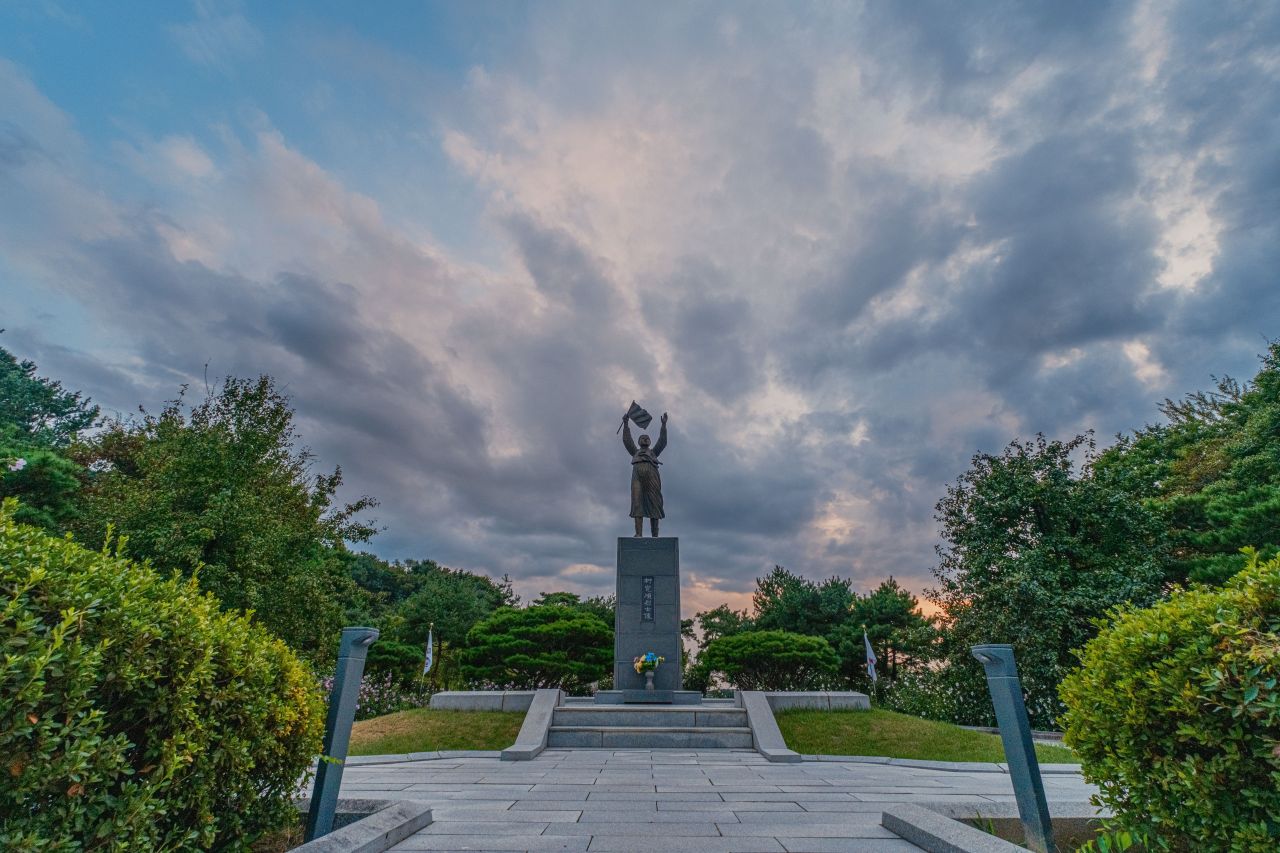
- Ahn Jung-geun Memorial Hall, 91 Sowol-ro: free. March–October 10:00–18:00 (last entry 17:00), November–February 10:00–17:00 (last entry 16:00). Closed Mondays (open if the Monday is a holiday, closed the next day), 1 January, the days of Seollal and Chuseok, and 1 May. The 2010 building stands on the site of the Shinto shrine Japan built over Seoul, and its twelve columns are for the twelve men of the finger pledge. Inside: a large seated statue in the central hall, his life in three rooms (the third, on Harbin and the trial, was rebuilt with screens in 2025), a gallery of his prison calligraphy, and a hands-on room where you can stamp copies of his calligraphy and make a "blood-oath" postcard. Multilingual guide apps exist; ask at the desk. Outside are his statue (2010), stones carved with his calligraphy, and Baekbeom Square with the statue of Kim Ku.
- Getting there: buses 402 or 405 to Namsan Library; or exit 4 of Hoehyeon station (line 4) and about 750 m uphill through Baekbeom Square, 10–15 minutes. The Namsan cable car's lower station is about 500 m east.
- From Itō's seat to Ahn's: Seoul city marks a 1.7 km "path of national shame" that starts at the site of the Residency-General's official residence, where Itō lived as Resident-General and where the annexation treaty was signed in 1910 (now the Memory Site for the Japanese military's "comfort women", 6 Toegye-ro 26ga-gil, seven minutes from exit 1 of Myeongdong station), and ends at the shrine site, which is the memorial hall. Walk it in either direction.
- Hyochang Park, Yongsan: his empty tomb is the leftmost of four mounds on the terrace of the "three martyrs", beside Yi Bong-chang, Yun Bong-gil and Baek Jeong-gi; it has no stone. Kim Ku's own grave is at the top of the park, and the Kim Koo Museum beside it is free, Tuesday to Sunday 10:00–18:00. The park is free and open daily from early morning to evening. About 870 m from exit 1 of Hyochang Park station (line 6), or ten minutes' walk west from exit 9 of Sookmyung Women's University station (line 4). The Museum of Japanese Colonial History, six minutes' walk away, is free, Tuesday to Sunday 10:30–18:00. From Namsan, bus 400 runs from Baekbeom Square to the Kim Koo Museum.
- Myeongdong Cathedral: he was baptised Thomas in 1897 in his home village in Hwanghae, and the French bishop in Seoul condemned the killing at the time. On 21 August 1993 Cardinal Kim Sou-hwan said a memorial Mass here and called the act self-defence; the cathedral held the centenary Mass of his death on 26 March 2010. An English Mass is said on Sundays; check the schedule.
- National Palace Museum of Korea, beside Gyeongbokgung: the free special exhibition "Dokdae: the eight characters Ahn Jung-geun left" runs 27 October to 27 December 2026, around the calligraphy returned from Japan in August 2026, "International law is no match for a cannon", with his handprint on it. Closed the last Monday of the month, open late on Saturdays.

- Independence Hall of Korea, Cheonan, about an hour south of Seoul: March–October 09:30–18:00, November–February 09:30–17:00, closed Mondays. The armed-struggle hall (hall 5) covers the period, and a statue of him with two other fighters stands outside between halls 5 and 6.
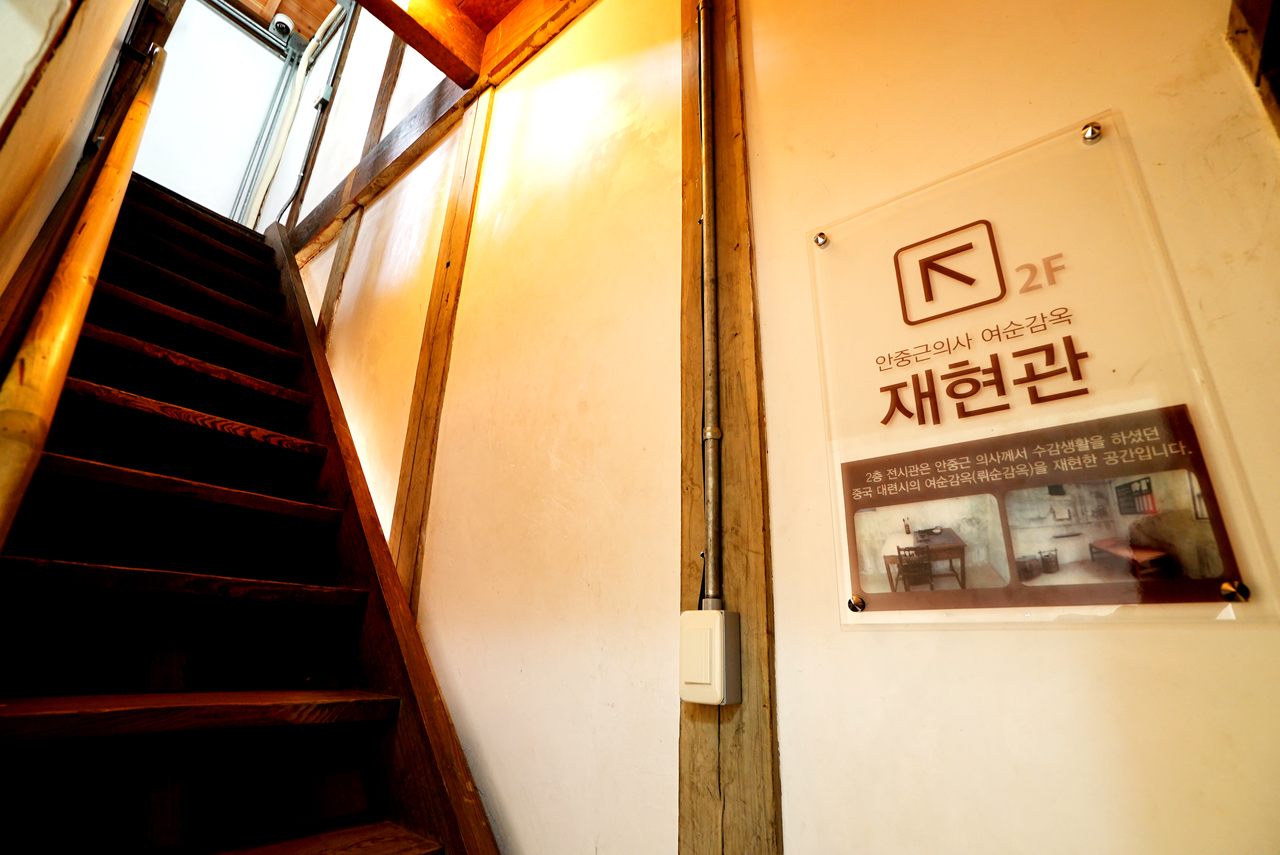
- Gunsan Modern Art Museum, in the old port district of Gunsan on the west coast: a room reconstructs his Lüshun cell, with the flag and his photograph (photographed in 2015; check it is still on show).
- Ahn Jung-geun Park, Bucheon, west of Seoul: the statue that stood eleven days at Harbin station in 2006 before the Chinese authorities removed it; memorial ceremonies every 26 March and 26 October.
- Other statues: in front of Uijeongbu station (2018, a gift from a Chinese society) and at Daegu Catholic University; Gwangju's Jung-oe Park has the site of the first memorial stele to him, from 1961. A shrine in Jangheung, in the far south-west, keeps his memorial tablet. His birthplace in Haeju is in North Korea and cannot be visited.

- Harbin station, China: the memorial room is inside the station building on the south square, to the left of the main entrance, with a red sign and no sign on the front. A clock over the door is set to 9:30. Through a window at the far end you can see the two marks on platform 1, a triangle where he stood and a square where Itō fell, about five metres apart. Free when it opened; the state news agency showed it open in September 2026. Bring your passport, as for any Chinese station. Zhaolin Park, ten minutes away by taxi, is the "Harbin park" of his will; a stele there carries his calligraphy.
- Lüshun prison museum, Dalian: his cell and the execution ground are kept. A memorial room was added in 2009, but after the museum reopened in April 2026 Korean press reported that his portrait had gone, his bust had been moved to the old execution ground and the room had become an information desk. Lüshun is a naval port and rules for foreign visitors have changed over the years; book through a Dalian agency and ask first.
- Visas: in 2026 holders of South Korean, British, Canadian and most European passports can enter China visa-free for 30 days; United States passports are not on the list. Check the Chinese embassy before you book.
- Dairinji temple, Kurihara, Miyagi prefecture, Japan: the guard Chiba's family temple, with the two memorial tablets and the stone of the eight characters, in quiet farming country near Kurikoma-Kōgen station on the Tōhoku shinkansen. The annual service is in early September, around his birthday. Ask the temple before visiting.
| Time | Route | Avoid |
|---|---|---|
| Half a day | Hoehyeon station → Baekbeom Square → Memorial Hall → the path of national shame down to the Residency-General site → Myeongdong Cathedral and lunch | Mondays |
| 1 day | Add Hyochang Park by subway (Sookmyung Women's University station), the Kim Koo Museum and the Museum of Japanese Colonial History; this autumn, the Palace Museum exhibition | Mondays |
| Day trip | Independence Hall in Cheonan, by KTX or bus | Mondays |
26 October and 26 March
Korea marks two days. On 26 October, the day of the shooting, the memorial society holds a ceremony at the Namsan hall; in 2026, the 117th anniversary, a new official portrait, the first in 56 years, was unveiled there with the minister for veterans. On 26 March, the day of his death, the government holds a memorial at the same hall and a memorial society holds a smaller ceremony at his empty tomb in Hyochang Park around the same date (21 March in 2026). Both are open to watch. The memorial hall also marks 14 February, the day of his death sentence, which falls on Valentine's Day.
· The memorial hall, Hyochang Park's museums and the Independence Hall all close on Mondays. Tuesday to Sunday is safe.
· The hall's last entry is an hour before closing: 17:00 in summer, 16:00 in winter.
· The Harbin room is easy to miss; it is inside the station, on the left of the main entrance, not on the square.
· Lüshun has had restrictions on foreign visitors; check with a local agency before you go.
Outdated tips you will still find online
| You may read | What is right | Source |
|---|---|---|
| The Harbin memorial moved out of the station in 2017 | It returned to its original place in the station in March 2019 and was open in September 2026 | Yonhap, Apr 2019; Xinhua, Sep 2026 |
| See the musical Hero in Seoul any year | No regular season in 2026; the last full run was the 2024 anniversary season | The Musical database; 2026 event listings |
| His calligraphy for the guard was returned in 1980 | Chiba's family returned it in 1979, the centenary of his birth | Seoul Shinmun, Mar 2025 |
| Lüshun prison is closed to foreigners | Korean groups have visited for years; rules change, so ask locally | Jeonbuk Ilbo, Feb 2016 |
FAQ
Who was Ahn Jung-geun?
A Korean independence fighter (1879–1910) who shot Itō Hirobumi, Japan's first Resident-General of Korea, at Harbin station on 26 October 1909, and was hanged in Lüshun prison on 26 March 1910.
Why did he shoot Itō?
He gave the court fifteen charges, from the murder of Korea's empress and the forced treaties of 1905 and 1907 to the disbanding of the army and "destroying the peace of East Asia". He said he acted as an officer of Korea's volunteer army in a war of independence.
Was he a terrorist?
Japan's chief cabinet secretary called him a criminal in 2013 and a terrorist in 2014, though the cabinet's formal answers say only that he killed Itō and was sentenced to death; Korea and China call him a martyr and a righteous fighter. He himself asked to be treated as a prisoner of war. Historians on all sides still argue it.
Where can I see him in Seoul?
The Ahn Jung-geun Memorial Hall on Namsan (free, closed Mondays), his empty tomb in Hyochang Park, and, until 27 December 2026, a special exhibition of his last calligraphy at the National Palace Museum.
What should I watch?
Harbin (2024) for a thriller about the shooting, and Hero (2022) for the musical of his last year.
Sources (checked 28 October 2026)
Ahn Jung-geun Memorial Hall (hours, exhibitions, history); Ahn Jung-geun Memorial Society (life, chronology, 2026 ceremonies); Encyclopedia of Korean Culture (Ahn Jung-geun, the finger-pledge society, Ahn Gong-geun); Korea Heritage Service open data (calligraphy treasures 569-1 to 569-31); Ministry of Patriots and Veterans Affairs press releases (2025 reopening, 2026 task force); Ahn's prison autobiography and On Peace in the East in Korean translation; Seoul city news site (Namsan path, Hyochang Park, Memory Site); Independence Hall of Korea; Hero the Musical database (The Musical); Korean Film Council figures via Korean press; Well Go USA; Box Office Mojo; JustWatch (US and Canada, Oct 2026); Japanese House of Representatives and House of Councillors written answers (2014, 2015); Newsweek Japan and J-CAST (cabinet secretary's remarks); Ritsumeikan University Asia Map essay by Ogawara Hiroyuki (2025); Xinhua (Harbin memorial, Sep 2026); Yonhap and Seoul Shinmun (Harbin memorial 2019; Dairinji temple 2025; last day accounts); Korea JoongAng Daily (film reels, 2014); Contested Histories case study no. 38 (2025); Franklin Rausch, Korea Times (2009) and An Chunggŭn: His Life and Thought in His Own Words (Brill, 2020); Newstof fact check on the mother's letter (2019); Kyunghyang Shinmun, Seoul Shinmun, Kukinews and Newspim (2008 excavation, 2026 ceremonies, 2026 exhibition); Chinese and Korean government notices on visa-free entry (Nov 2025, Feb 2026); on the online mockery: Yonhap, Herald Economy and Korea JoongAng Daily (Feb 2026), Korea Times (Apr 2026), Segye Ilbo (ministry letters, Aug 2026), Financial News and Sports Kyunghyang (2021), Sankei via Korean press (Kōchi, Jun 2026), the 2026 bill text as reported, and the 2022 Seoul High Court ruling as reported; on the grave: Kyunghyang (2008), JoongAng Ilbo and Munhwa Ilbo (2025–26), Yonhap (Tokyo conference, Jul 2026). Photos are from the Korea Tourism Organization gallery and were taken in 2014–2024, not this year.


Comments
Post a Comment