





















Jeju Olle Walking Festival 2026: Routes 19–20 Day by Day
In 2006 a Korean journalist named Suh Myung-sook walked the Camino de Santiago, and came home to Jeju, where she was born, with the idea of a path like it. In September 2007 she opened the first route of the Jeju Olle Trail, named after the Jeju word for the narrow lane that leads from the main road to a family's gate. Today the trail circles the island in 27 routes and 437 km. She died in April 2026, and this November, at the 16th Jeju Olle Walking Festival, thousands of walkers will take her paths along Jeju's north-east coast: past a 1919 independence protest site, one of the island's most painful villages, a white-sand beach, and the shore where the women divers still work.
This guide gives you the 2026 festival day by day, in English: the routes, the start and finish points, the village lunches, the shuttle times, and how to join now that online registration has closed. It also covers the stories along Routes 19 and 20. Tap a tab or open a story to read more.
When: Thursday 5 to Saturday 7 November 2026. Programmes from 08:00; you set off any time between 09:30 and 10:00, and should reach the finish by 16:00
Where: Jeju Olle Routes 19 and 20 on the island's north-east coast, in Jocheon-eup and Gujwa-eup, Jeju-si: about 11.5–13 km a day
Joining now: online registration closed on 9 October. You can still register at each day's start point, cash only: ₩35,000 (₩30,000 discounted), while souvenirs last. Or simply walk free, without the souvenir set
Bring: your passport, cash, your own cup and a raincoat
Last of its kind: 2026 is the final edition in which the crowd walks one route together; from 2027 the festival is planned to run for 25 days along 23 routes
Checked 26 October 2026 with the sources at the end.

In this guide
- Map
- The festival, day by day
- How to join now
- Following the trail
- Lost and remembered: the story of the route
- Stories on the way
- Date, family, eat, on screen
- Getting here
- Watch out, and outdated tips
- FAQ
Map
Route 19 runs east from Jocheon to Gimnyeong; Route 20 carries on from Gimnyeong to the Haenyeo Museum at Hado. Tap a number for its name.
Map © OpenFreeMap, data © OpenStreetMap contributors. The day 1 finish (Dongbok-ri Sports Center) and the day 2 and 3 finish (Jeju Batdam Theme Park, Woljeong-ri) are not marked; search them in Naver Map or KakaoMap.
The festival, day by day
The festival is hosted by Jeju Special Self-Governing Province and run by the Jeju Olle Foundation, under the slogan "Be happy on the Olle trail", an echo of the first festival in 2010. About 10,000 people walk it each year, and around 3,000 had registered in advance for 2026. There is no mass start: after the morning programme, you set off when you like between 09:30 and 10:00, at your own pace (the organisers count about an hour for every 3 km).
| Day | Route | Start → finish |
|---|---|---|
| Thu 5 Nov | Route 19, 13 km 4–5 hours | Jocheon Manse Dongsan → Dongbok-ri Sports Center |
| Fri 6 Nov | Routes 19–20, 11.5 km 3.5–4 hours | Dongbok-ri Sports Center → Jeju Batdam Theme Park |
| Sat 7 Nov | Route 20 in reverse, 12.9 km 4–5 hours | Jeju Haenyeo Museum → Jeju Batdam Theme Park |
| Time · place | What happens | Note |
|---|---|---|
| 08:00, Jocheon Manse Dongsan | Programmes, booths and cafés open; souvenir pick-up at the booth | Coffee from the Haengwon-ri village café |
| 09:00–10:00 | The Hado-ri Haenyeo Choir, opening ceremony at 09:20, a taekwondo team, and an Olle warm-up with a children's choir | Set off between 09:30 and 10:00 |
| On the way | Traditional games at Hamdeok Beach, gypsy jazz on Seoubong, and at 13:00 a 4·3 programme at Neobeunsungi with a guide, a lullaby and testimony from bereaved families | Lunch 11:00–14:00 at Haedong-pogu, Bukchon-ri |
| Afternoon, Dongbok-ri | Finish stage with singer Lim Byung-soo, the Marine Corps 9th Brigade band and SEODo BAND, until 16:00 | Last shuttle 16:20 |
Day 1 passes Hamdeok Beach, the Seoubong hill and the 4·3 memorial in Bukchon-ri. At the finish, the temple-food nun Jeong Kwan serves lotus-leaf rice to 500 people chosen in an advance draw.
| Time · place | What happens | Note |
|---|---|---|
| 08:00, Dongbok-ri Sports Center | Booths open; carrot juice and potato bread from the Sehwa village co-op café | Set off between 09:30 and 10:00 |
| On the way | A pine-forest path and the farm roads of Gimnyeong, kite-flying, and Gimnyeong's anchovy fishing song, "Mel Huriyeoneun Sori", a Jeju intangible heritage | Lunch 11:00–14:00 at Gujwa Gymnasium, Gimnyeong-ri |
| Deonggae coast | A beach clean-up; a small gift of local produce while it lasts | Gimnyeong Seopogu is where Route 20 begins |
| Afternoon, Batdam Theme Park | A talk on the stone walls by the Woljeong-ri village chief (9 people a session); at the finish, the band South Carnival, who sing in the Jeju language | Last shuttle 15:20 |
Day 2 is the shortest day, a good one if you can join for only one.
| Time · place | What happens | Note |
|---|---|---|
| 08:00, Jeju Haenyeo Museum, Hado | Booths open; a 20th-anniversary archive booth; the Jeju Gaonnuri Choir sings in the Jeju language | Follow the orange arrows today |
| On the way | The coast from Sehwa to Woljeong, where you may see women divers at work; hula and buskers at Haengwon port | Lunch 11:00–14:00 at the Haengwon-ri fishing cooperative |
| 15:00, Batdam Theme Park | Closing parade with children's drummers, closing ceremony, then singer BMK, 15:30–16:00 | Last shuttle 15:50 |
Day 3 walks Route 20 backwards, from its end at the Haenyeo Museum, so the arrows to follow are the orange reverse-direction ones.
Stamp tour: a QR stamp tour in the Olle Pass app, with a gift at the finish. Photo frames along the way, and a "Heart-beat Café" run by the Olle Finisher's Club. At the finish, everyone shouts "Poksak sogasuda!", Jeju dialect for "you've worked so hard".
Free tea and drinks go to walkers who bring their own cup. The organisers are cutting disposables, so bring cutlery for lunch and a bag to carry your rubbish home.
This year's festival also has an exhibition, "Jeju Olle, collecting 20 years of footsteps", and a memorial space for founder Suh Myung-sook.

How to join now
Advance registration in the Olle Pass app ran from 8 July to 9 October and is closed. Meal tickets and shuttle tickets were sold in advance only, and they are closed too. You still have three ways in:
| Option | Cost | What you get |
|---|---|---|
| Register on the day at the start-point booth | ₩35,000; ₩30,000 for under-19s (born 2008 or later), people with disabilities, national merit recipients and groups of 20+. Cash only | The souvenir set: a scarf, Route 19 and 20 labels, a festival pouch and a sports towel, plus sponsor gifts. Limited, first come first served |
| Walk free | Nothing | The routes and the programmes, without the souvenirs and some event gifts |
| Already registered | Paid | Show your passport at the booth to collect your set; one set per person, however many days you walk |
One fee covers one, two or all three days. Without a meal ticket, you can buy snacks on the route for cash, bring your own lunch, or eat in the villages.
Following the trail
Three signs lead the way on every Olle route, but keep a map app open too, as walkers do sometimes miss a turn:
- Ribbons, one blue (Jeju's sea) and one orange (Jeju's tangerines), tied above eye level on trees and poles.
- Arrows on walls and stones: blue for the forward direction, orange for the reverse. On Saturday you follow the orange ones.
- Ganse, a small blue pony, Jeju's horse, pointing the way at forks. The name comes from the Jeju word ganse-dari, a slowpoke: the idea is to walk slowly.
Each route has three stamp boxes shaped like Ganse, at the start, the middle and the finish. Collect them in a Jeju Olle Passport (paper, passport size, ₩20,000, or a mobile version in the Olle Pass app for the same price; the two can't be combined), and if you finish all the routes you get a certificate and a medal. The passport is not included in the festival fee. The route 19 start has an official Olle information desk (Jocheon Buk 6-gil 44, 08:30–17:00).

Lost and remembered: the story of the route
| Year | What happened | Where |
|---|---|---|
| 1374 | A gate tower is built on the walls of Jocheon fort; in 1599 it is renamed Yeonbukjeong, "the pavilion of longing for the north", for the king far away | Jocheon port, near the Day 1 start |
| Mar 1919 | Jeju's independence protests against Japanese rule, from 21 to 24 March; about 1,500 people join on the 24th | Jocheon Manse Dongsan, the Day 1 start |
| Jan 1932 | The women divers' uprising: hundreds of haenyeo march on Sehwa market against the colonial-era divers' union | Sehwa and Hado, the Day 3 start |
| 1945 | Japanese forces dig caves into Seoubong to hide suicide boats | Seoubong, Day 1 |
| 17 Jan 1949 | The Bukchon-ri massacre, one of the worst single killings of the Jeju 4·3 tragedy | Bukchon-ri, Day 1 |
| 2007–2012 | The Olle trail opens route by route; Route 19 opens in Sept 2011, and the circle round the island is complete in Nov 2012 | All of Jeju |
| 2014–2016 | Jeju's stone-walled fields become a FAO agricultural heritage (2014) and haenyeo culture a UNESCO heritage (2016) | Days 2 and 3 |
| Apr 2026 | Founder Suh Myung-sook dies, aged 68 | Her farewell was held on Route 6 |
Stories on the way
The cheers of March 1919
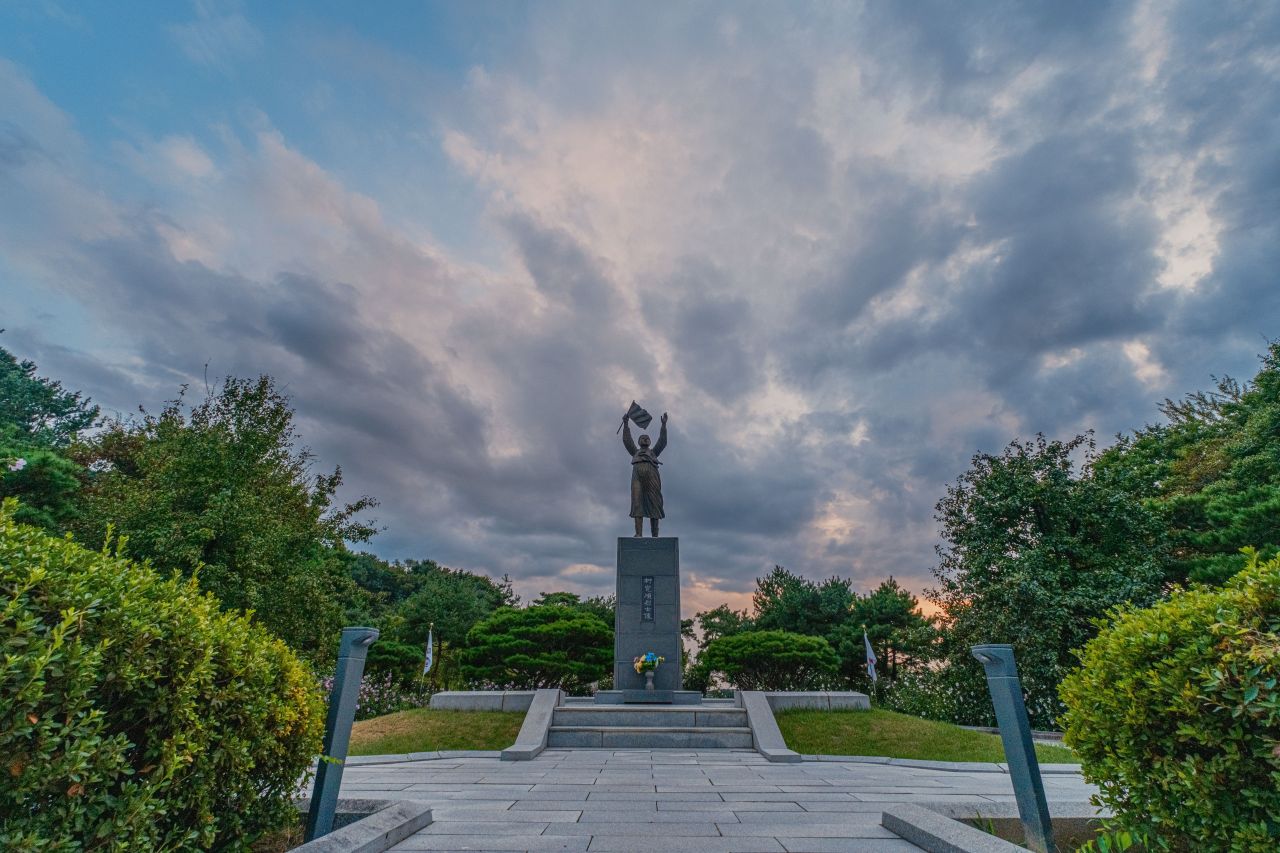
A student named Kim Jang-hwan came home from Seoul in March 1919 with a copy of the Declaration of Independence hidden in his luggage. On 21 March, on the hill now called Manse Dongsan, "hill of the cheers", Kim Si-beom read it aloud, and the crowd marched shouting "Manse!" (long live Korean independence). The protests spread to Hamdeok, Sinheung and Sincheon over four days, and about 1,500 villagers turned out on the 24th. Twenty-nine people were charged in the first trial. The hill is now a memorial park with the Jeju Anti-Japanese Memorial Hall, and the Day 1 start.

Bukchon-ri and "Sun-i Samchon"
Jeju 4·3 is the name Koreans give to the violence on the island from 1947 to 1954, when an armed uprising was crushed by government forces and many thousands of civilians died; a 2003 government report estimated 25,000 to 30,000. On 17 January 1949, after two soldiers were killed near Bukchon-ri, troops gathered the villagers in the primary school yard, shot hundreds of them in the fields around it, and burned the village.
For decades 4·3 was a subject people did not speak of. In 1978 the novelist Hyun Ki-young published Sun-i Samchon ("Aunt Suni"), set in Bukchon-ri, the first story to break the silence about 4·3; he was arrested and tortured for it. Today the Neobeunsungi 4·3 Memorial Hall stands where the killing happened, with the small stone graves of children, and stones in a sunken field carved with lines from the novel. The hall is free, 09:00–18:00 (last entry 17:00). On Day 1, bereaved families speak there at 13:00.
Seoubong, the water-buffalo hill
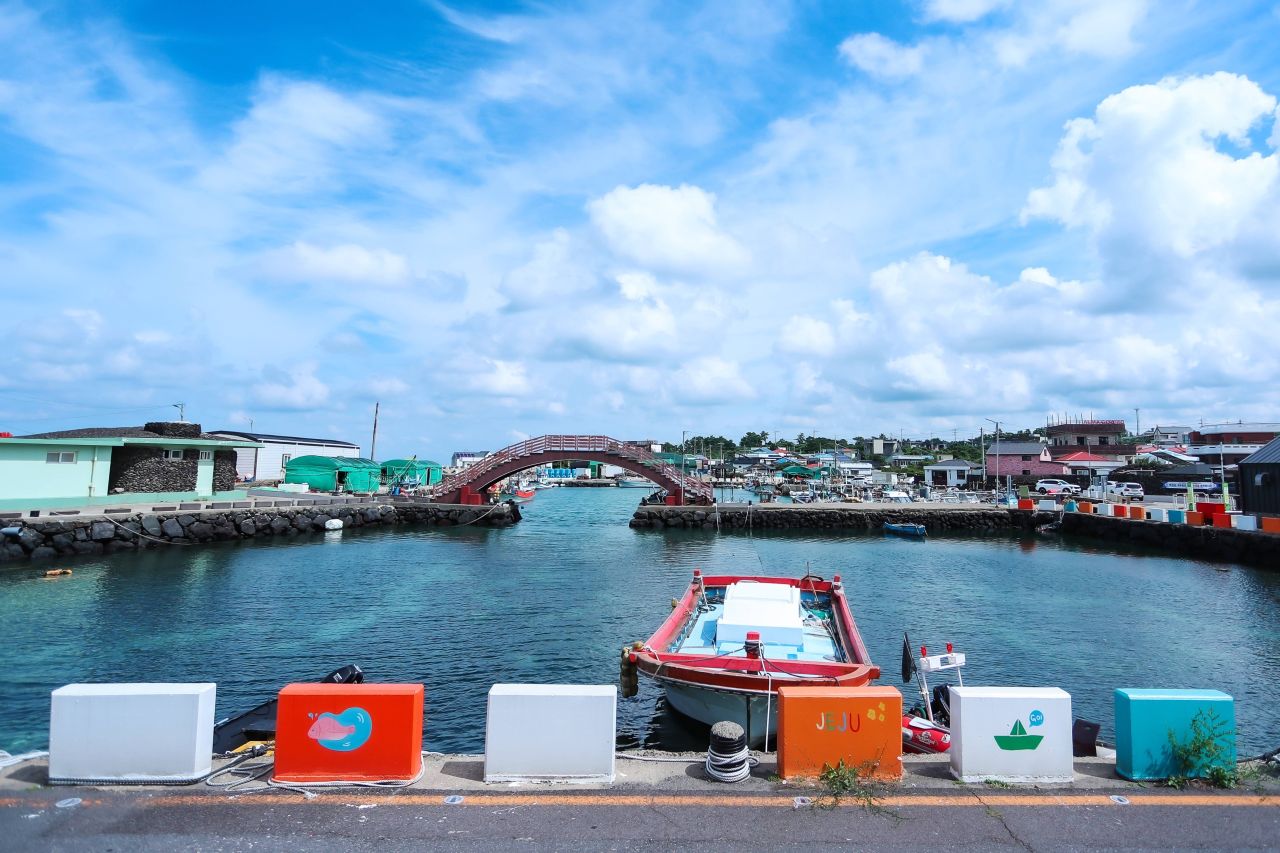
The green hill above Hamdeok Beach, 113 m high, was called Seomo-oreum in the old Jeju language. The later name, Seoubong, is said to come from its shape, like a water buffalo climbing out of the sea. The path over it was cut by the young men of Hamdeok with hoes and sickles over two years from 2003. Beneath it are caves dug by Japanese forces in 1945 to hide small suicide boats, now a registered national heritage. In autumn, cosmos cover its slopes.
The women who dive
Jeju's haenyeo, women divers, hold their breath to dive about 10 m for shellfish and seaweed, for a minute at a time and up to seven hours a day, without oxygen tanks; some are in their eighties. UNESCO added their culture to its list of intangible heritage in 2016. In January 1932 the divers of Hado and Sehwa, led by Bu Chun-hwa, Kim Ok-ryeon and Bu Deok-ryang, marched on Sehwa market with their hoes and abalone knives against the abuses of the colonial-era divers' union; it is described as the largest anti-colonial movement in Korea led by women. The Jeju Haenyeo Museum, on the square where they gathered, is the Day 3 start (09:00–18:00, closed Mondays, ₩1,100).

Half the earth in stone walls
Walk the farm roads of Gimnyeong and Woljeong and you will see fields boxed in by low walls of black basalt, the stones farmers pulled out of the soil and stacked against Jeju's wind. One estimate puts their total length at about 22,000 km, more than half the way round the earth. In 2014 the stone-walled fields became one of Korea's first Globally Important Agricultural Heritage Systems of the UN's FAO. The festival ends among them, at Jeju Batdam ("field wall") Theme Park.
A trail with friends abroad
The Olle trail began with a promise: on the Camino, its founder met a British walker, and the two agreed that each would make a path like it at home. Since 2010 Jeju Olle has paired its routes with "friendship trails" abroad. Route 19, the festival's first day, is twinned with the Denmark-to-Albany section of the Bibbulmun Track in Western Australia (2015). Jeju also lent its name, Ganse ponies, ribbons and arrows to the Kyushu Olle in Japan (opened 2012), and its ribbons and markers to the Mongolia Olle (2017).
The snake of Gimnyeong cave
Legend says a huge serpent lived in a cave inland from Gimnyeong, where Route 20 begins, and demanded a young woman as a sacrifice every year, until in 1515 a magistrate named Seo Ryeon led soldiers in and killed it. The cave is near the route, not on it.
Date, family, eat, on screen
| Place | Why it works for a date | Time · cost |
|---|---|---|
| Seoubong | A short climb with cosmos and a view back over Hamdeok's turquoise water | Free, on Day 1 |
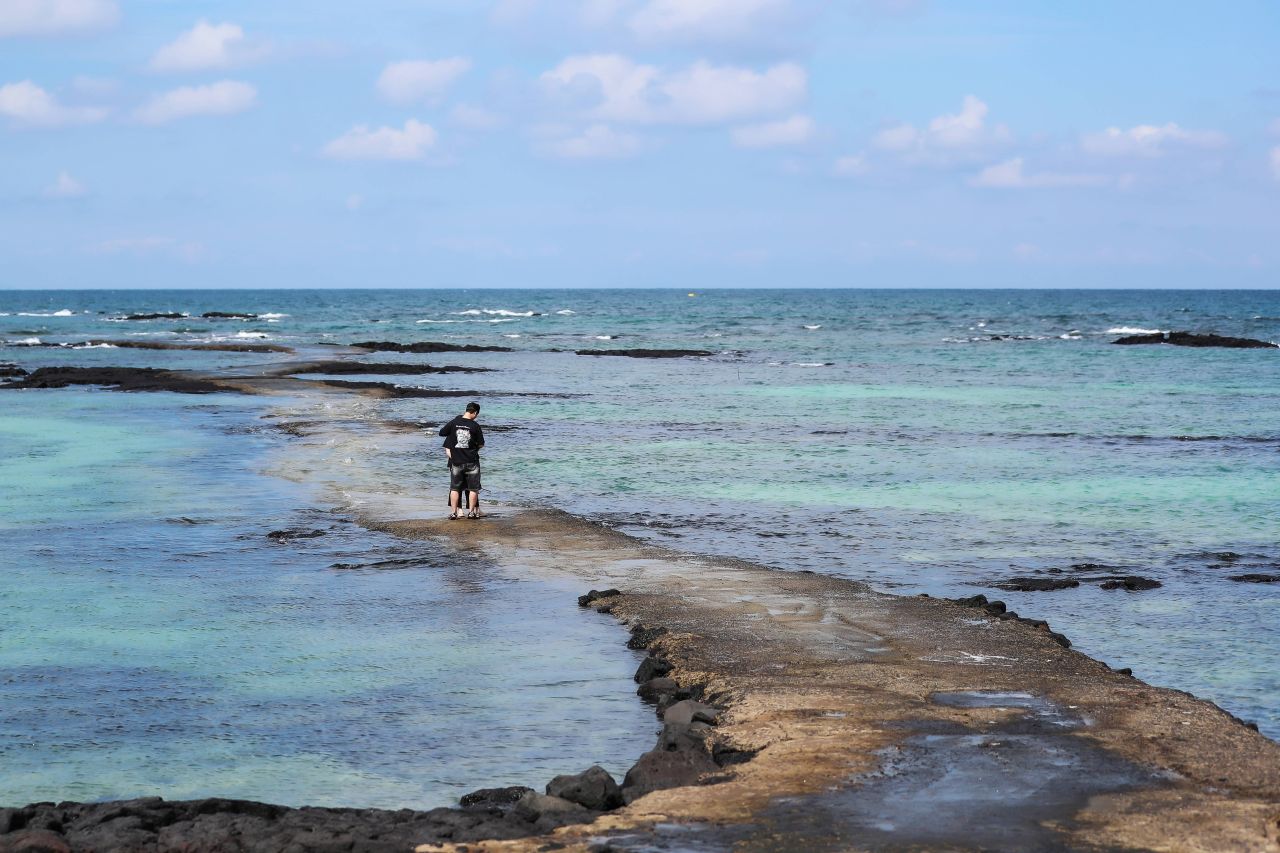
| Gimnyeong sea road | A stone path that runs out into the shallows, near Gimnyeong, where Route 20 begins | Free, near the Day 2 route |
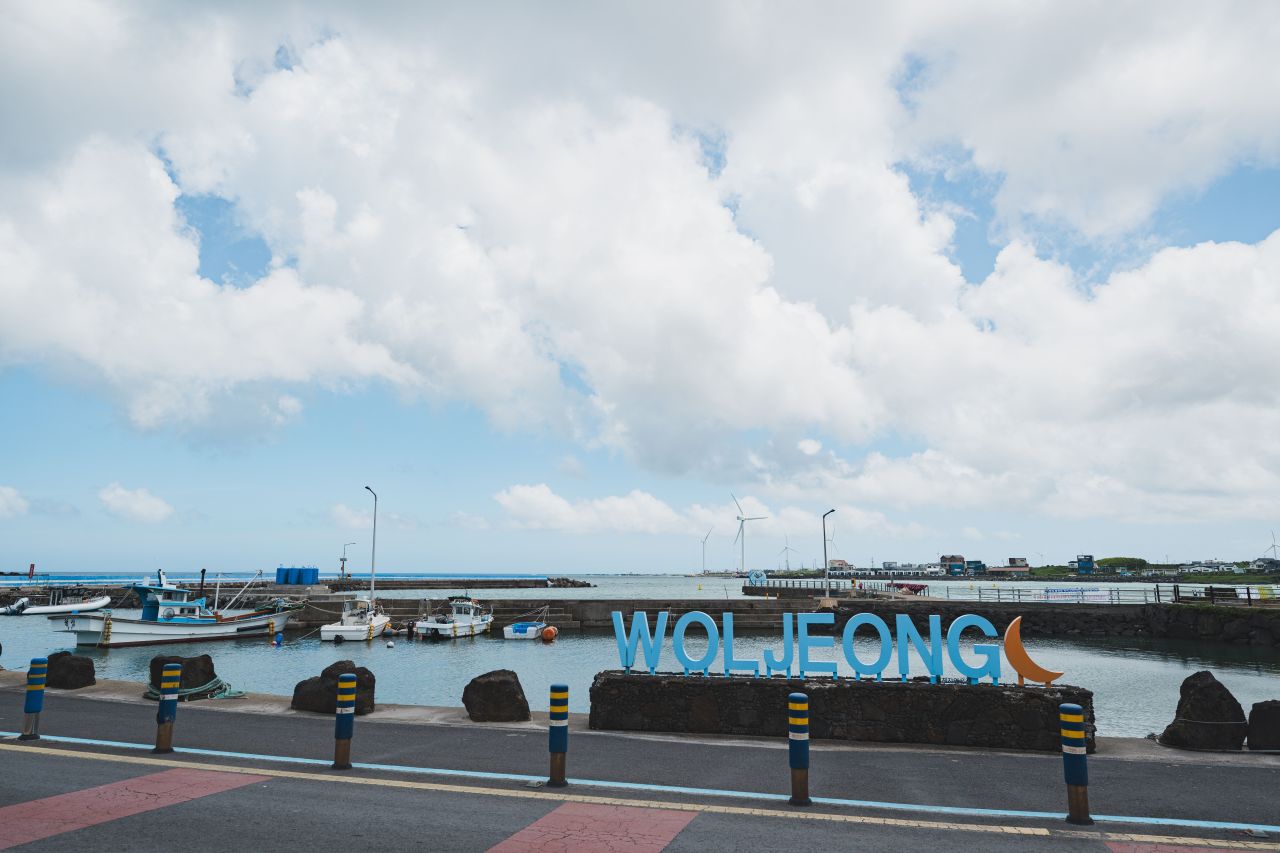
| Woljeong Beach | White sand and clear water on the last stretch to the finish | Free, on Days 2 and 3 |
| Place | Why kids like it | Time · cost |
|---|---|---|
| Hamdeok Beach | Shallow, gentle water for about 1 km out; traditional games on Day 1 | Free |
| Jeju Haenyeo Museum | The divers' tools and a real divers' house moved inside | 09:00–18:00, ₩1,100, closed Mondays |
| Day 2 | The shortest day, with kite-flying and a beach clean-up | 11.5 km |
Children 13 and under rode the shuttle free. The routes are 11.5–13 km a day, long for small legs; you can walk part of a day.
| Day | The village lunch | Price |
|---|---|---|
| Thu 5 | Mungae-juk, octopus porridge, by the Bukchon women's club (vegan: hijiki seaweed and tofu porridge) | ₩12,000 / ₩10,000 |
| Fri 6 | Gimnyeong onion and hijiki gimbap with tofu pancakes and seaweed-soybean soup, by the Gimnyeong-ri women's club | ₩10,000 |
| Sat 7 | Haengwon abalone bibimbap, by the Haengwon women's club (vegan: mushroom bibimbap) | ₩12,000 / ₩10,000 |
These lunches were sold as advance tickets only. On Days 2 and 3 the finish has a food stall run by the Woljeong-ri women's club, with chicken, vegetable pancakes, turban-shell skewers and makgeolli (cash or bank transfer).
| Where | Why go | Note |
|---|---|---|
| Hamdeok Golmok, Jocheon Buk 6-gil 62 | Beef hangover soup (haejangguk) a few minutes from the Day 1 start; singer Sung Si-kyung ate here on his food channel (Jan 2024) | From 07:00, closes 13:30 · ₩11,000–12,000 |
| Dongbok Haenyeochon, Dongbok-ro 33 | Raw-fish noodles (hoe-guksu) in Dongbok-ri, the village of the Day 1 finish and Day 2 start; on Sung Si-kyung's channel (Jan 2024) | A listing shows it closed on Tuesdays |
| Myeongjin Jeonbok, Haemaji-haean-ro 1282, Pyeongdae | Abalone porridge and abalone rice on the Day 3 coast; on tvN's Wednesday Food Talk (10 Jun 2015) | Last order 20:00 |
 ▶
Dongbok-ri Haenyeochon, Jeju — Sung Si-kyung (Meogeultende)
The singer eats hoe-guksu at Dongbok-ri's divers' restaurant (29 Jan 2024)
| Title (year) | Where on the route | The story, in a line |
|---|---|---|
| When Life Gives You Tangerines (Netflix, 2025) | Gimnyeong Beach, on Day 2: Korean press reported the women divers' scenes, their fire pit and the seaside road of episode 1 were filmed here | A girl from a Jeju diving family, Ae-sun, grows up from the 1950s on |
The show's 1950s fishing village was a set built in Andong, on the mainland, not in Jeju.
 ▶
2025 Jeju Olle Trail Festival Highlights — Jeju Olle
The foundation's own film of last year's festival, with English captions (9 Dec 2025)
Getting here
By bus: no official 2026 bus directions have been published. Express bus 101, from the airport along the north-east coast via Jocheon, Hamdeok, Gimnyeong and Sehwa, is the route to check in Naver Map or KakaoMap. Jeju city buses take no cash: pay with T-money or, since August 2025, a Visa contactless card.
By taxi: book or call one to the start, or back from the finish. For Route 20, the trail page lists Seongsan call taxis: +82 64-784-3030 and +82 64-784-8585.
Parking: very limited, and there is no festival car park.
Bags: there is no luggage storage at the venue or on the shuttles.
Where to stay and tours
The shuttles start at Jeju Airport and in Jeju City (two more leave from Seogwipo), so a hotel in Jeju City is the easy base; Hamdeok, on Day 1's route, is the seaside choice. Crossing the island without a car is slow.
The two Klook links below are affiliate links: if you book the transfer or the tour through them, Korea Routes may earn a commission, at no extra cost to you.
- Private airport transfers in Jeju on Klook, useful for an early start on Day 3.
- East Jeju day tour on Klook, with Hamdeok, the Haenyeo Museum and Seongsan Ilchulbong, for a day after the festival.
Watch out
Finish by 16:00. Activities close then, and the last shuttles leave between 15:20 and 16:20.
Wind and rain. Jeju in November averages about 16 °C by day and 10 °C at night, with rain on about one day in three. It is windy on the coast. Bring layers and a raincoat. No rain plan has been published; the organisers say programmes can change with the weather.
Neobeunsungi is a memorial. The Day 1 route passes the site of a massacre.
Saturday goes backwards. Follow the orange arrows on Day 3.
Walking alone? Tell the Jeju Olle call centre your plan (+82 64-762-2190) and staff will call you every hour on the route (08:00–18:30 weekdays, 09:00–18:00 weekends).
Insurance. The organisers say walkers are responsible for their own safety.
Outdated tips you will still find online
| You may read | Correct in 2026 | Source |
|---|---|---|
| The festival is 6–8 November on Routes 17 and 18 | That was 2025. In 2026 it is 5–7 November on Routes 19 and 20 | Jeju Olle Foundation |
| Day 1 opens at Jocheon Sports Ground | The opening is at Jocheon Manse Dongsan, 09:20 | Official festival site, shuttle timetable |
| Register for ₩30,000 | That was the advance price, closed on 9 October. On the day it is ₩35,000, cash | Official festival site |
FAQ
Can I still join the Jeju Olle Walking Festival 2026?
Yes. Register at the start-point booth on the day, in cash (₩35,000), while souvenir sets last, or walk free without one.
Do I have to walk all three days?
No. One fee covers any number of days, and you can come for one.
Which day is shortest?
Day 2, Friday 6 November: 11.5 km, from Dongbok-ri to the Batdam Theme Park. All three days are rated moderate.
Is there an English website?
Yes, the official festival site has an English version, and the Olle Pass app comes in Korean, English, Japanese, Chinese and Spanish.
What is the Olle passport?
A stamp book for all the routes, ₩20,000, sold separately from the festival fee. The stamp boxes are at the start, middle and end of each route.
Sources (checked 26 October 2026)
Jeju Olle Walking Festival 2026 official site, Korean and English (overview, registration, routes for each day, shuttle timetable and boarding points, tips, FAQ and notices of July–October 2026); jejuolle.org (festival listings 2025–26, routes 19 and 20, passport, Olle Travel Center, history and friendship trails); Korea Tourism Organization TourAPI; Financial News and twig24 (2026 festival, the 2027 change); Herald and Kyunghyang (Suh Myung-sook, 2026); Seoul Shinmun (Route 19 opening, Bukchon-ri, Jeju batdam, friendship trails, Kyushu and Miyagi Olle); Bibbulmun Track Foundation (friendship trail with Route 19); Encyclopedia of Korean Culture (Yeonbukjeong, the March First Movement, Jeju 4·3); Encyclopedia of Jeju Culture (the Jocheon protests, Hamdeok Beach, Seoubong, the haenyeo uprising); Jeju 4·3 Peace Foundation; UPI and Korea Times (Bukchon-ri, Hyun Ki-young); UNESCO (Culture of Jeju Haenyeo); Pressian (Seoubong caves); the Korea Meteorological Administration's 1991–2020 climate normals; Jeju Regional Office of Aviation (bus 101); Segye Ilbo and Financial News (cashless buses, Visa cards); Kyunghyang (Olle safety check-in calls); Naver Place listings, Sung Si-kyung's YouTube channel, HuffPost Korea and TenAsia (restaurants); Economist Korea, Elle Korea and Gyeongbuk Maeil (When Life Gives You Tangerines). Videos are embedded from their creators' YouTube channels. Photos: Korea Tourism Organization photo gallery; none were taken in 2026, and none show the festival itself.


Comments
Post a Comment