





















Korea Autumn Foliage 2026 Peak Dates: Seorak to Seoul
In the summer of 1592, with a Japanese army marching north through Korea, two country scholars loaded the kingdom's official history onto the backs of hired porters and carried it up into the maples of Naejangsan. They hid more than 800 volumes of the Annals of the Joseon Dynasty in mountain hermitages and took turns guarding them for about a year. Every other copy in Korea burned. The one you can read today exists because of an autumn mountain.
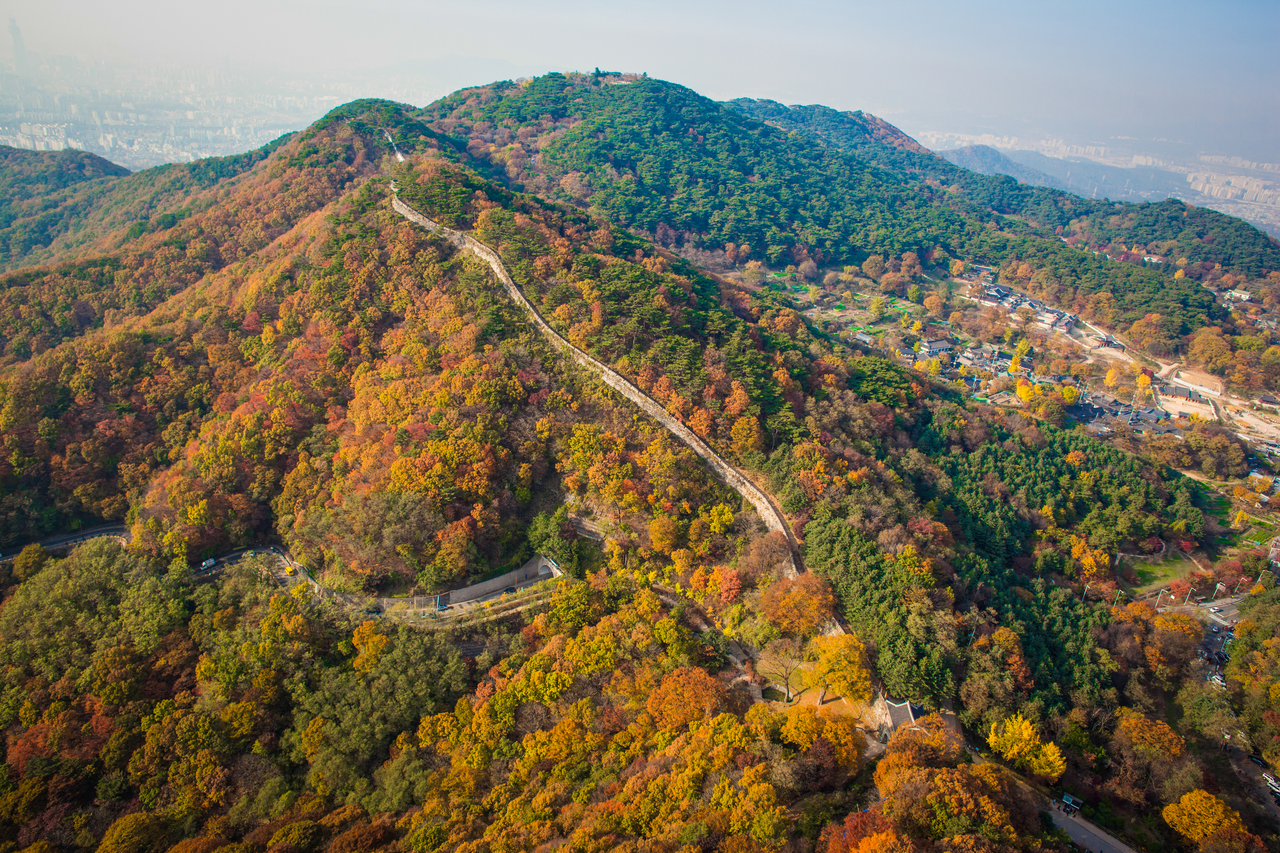
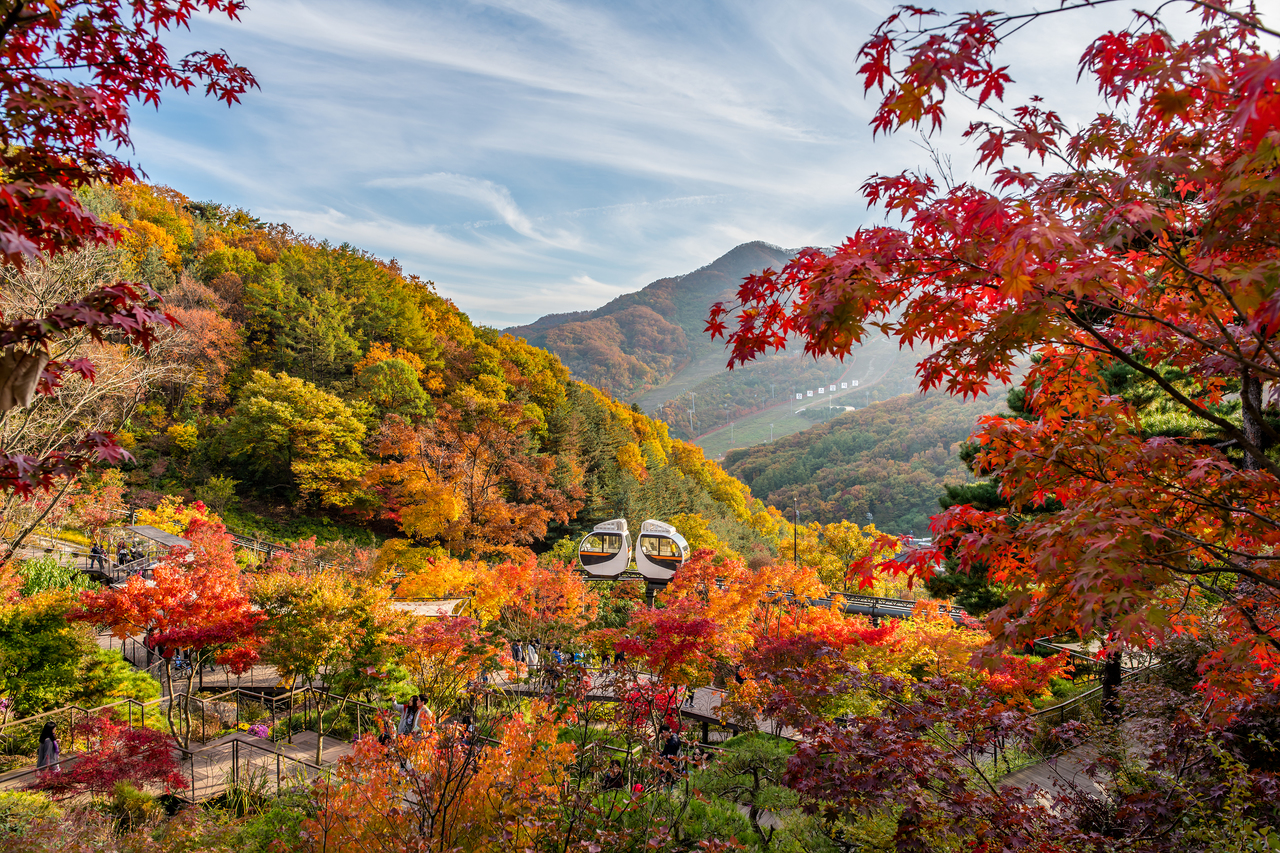
This guide follows Korea's autumn colour the way it actually moves: Seoraksan in the northeast first, then Seoul's palaces and ginkgo streets, then Naejangsan in the southwest, and, if you have more time, on to Tokyo and Kyoto, where forecasts put the peak in late November, several weeks after Seoul's hills. You get the 2026 dates Korea's weather agency has observed so far, the forecasts for what is still to come, how to reach each place from Seoul with a foreign card, what it costs, and the outdated advice to ignore.
1Seoraksan: peak observed on 16 October. Upper slopes are past their best; because colour moves down the mountain, the lower valleys around Sogongwon are the place to look in late October.
2Seoul: Bukhansan usually peaks around 28 October; in past years the city's ginkgo streets and palace gardens have followed from late October into mid-November.
3Naejangsan: colour expected from about 29 October, peak around 4–8 November. The inner park road is closed to cars every day, 07:00–18:00, from 30 October to 15 November.
4Japan next: Tokyo ginkgo about 26 November, Kyoto's Arashiyama about 24 November.
Entry fees: none for the national parks, Sinheungsa or Baegyangsa; Naejangsa's temple fee could not be confirmed. Seorak cable car ₩16,000 return, sold on the day only.
Checked on 23 October 2026 with the Korea Meteorological Administration's mountain foliage observations, the Korea National Park Service and the other sources listed at the end.

In this guide
- Map of the three regions
- 2026 peak dates, and why sources disagree
- Burned, hidden, rebuilt: the story in one table
- Seoraksan
- Seoul's palaces and ginkgo streets
- Naejangsan
- Korea first, then Japan
- What to bring
- Getting there and apps
- Costs and where to stay
- Watch out, and outdated tips
- FAQ
Map of the three regions
Seoraksan is about 2½ hours east of Seoul by express bus; Naejangsan is about 3½ hours south by train and local bus. Tap a number for directions.
Map © OpenFreeMap, data © OpenStreetMap contributors. Google Maps still gives weak walking and transit directions in Korea; most visitors use Naver Map or KakaoMap.
2026 peak dates, and why sources disagree
You will read three different "peak" dates for the same mountain. That is not a mistake: Korea's weather agency calls it peak when about 80% of the mountain has turned, and records the day it sees it. The Korea Forest Service publishes a forecast map in September and calls it peak when 50% of the leaves of each tree species have turned. Private forecasters use their own methods. The table uses the observed dates where they exist.
| Mountain | 2026 | Usual peak |
|---|---|---|
| Odaesan | Peak observed 14 Oct (first in Korea this year) | — |
| Seoraksan | First colour 28 Sep · peak observed 16 Oct | 17 Oct |
| Chiaksan | Peak observed 19 Oct | 21 Oct |
| Jirisan | Peak observed 22 Oct | 23 Oct |
| Bukhansan (Seoul) | First colour 14 Oct · peak not yet | 28 Oct |
| Hallasan (Jeju) | First colour 14 Oct · peak not yet | 28 Oct |
| Naejangsan | No colour yet · park office expects peak around 7–8 Nov; Forest Service forecast 4 Nov | 4 Nov |
Korea Meteorological Administration mountain foliage observations, checked 23 October 2026; usual dates are the 1991–2020 averages. Leaves turn from the summits down, and from north to south.
What happens when this season
| Dates | Where | What |
|---|---|---|
| Weekends until 8 Nov | Seoraksan | Sokcho city traffic plan: when the Sogongwon car park fills, cars are sent to free car parks with free shuttles |
| Until 30 Nov | Seoraksan (Osaek) | Heullimgol trail by reservation only, 5,000 people a day |
| Until 16 Nov | Naejangsan | Seoraebong ridge trail by reservation only, 520 people a day |
| 24–25 Oct · 30 Oct–15 Nov · 21–22 Nov | Naejangsan | Inner park road closed to cars 07:00–18:00 |
| 30 Oct–15 Nov | Naejangsan | Free shuttle bus from Naejangho car park to Wollyeonggyo bridge |
| 29 Oct–15 Nov | Seoul | Gyeongbokgung free for everyone (closed Tuesdays) |
| 7–8 Nov | Seoul | Namsan Dulle-gil "autumn picnic" walking event |
| Until 19 Nov | Seoul | Deoksugung outer wall repairs; Pyeongseongmun gate closed 25 Oct–19 Nov |
Burned, hidden, rebuilt: the story in one table
The places on this route have been burned by invaders, divided by a border and set on fire again within living memory. Knowing that changes what you see.
| Year | Place | What happened |
|---|---|---|
| 636 | Naejangsan | Yeongeunsa temple founded; the mountain was first named after it |
| 652 | Seoraksan | Hyangseongsa founded, the temple later rebuilt as Sinheungsa |
| 1398 | Seoul | Sungkyunkwan, the royal Confucian academy, founded |
| 1519 | Seoul | The academy's ginkgo tree is said to have been planted |
| 1557 | Naejangsan | The temple is rebuilt and renamed Naejangsa, "temple of hidden treasures" |
| 1592 | Naejangsan | The Jeonju copy of the royal Annals is hidden in the mountain; every other copy is destroyed in the war |
| 1644 | Seoraksan | Sinheungsa rebuilt after a fire in 1642 |
| 1945 | Seoraksan | The area lies north of the 38th parallel and comes under North Korean rule |
| 1951 | Both mountains | South Korean forces take the Sokcho area; in January, Naejangsa burns during the war |
| 1970–1971 | Both mountains | Seoraksan (1970) and Naejangsan (1971) become national parks; Seoul names the ginkgo its city tree (1971) |
| 1982 | Seoraksan | UNESCO Biosphere Reserve |
| 1997 | Seoraksan | The bronze Unification Buddha at Sinheungsa completed, a prayer for a reunited Korea |
| 2012–2021 | Naejangsan | Naejangsa's main hall burns in 2012, is rebuilt in 2015, and is destroyed again by arson in 2021 |
1Seoraksan — the mountain that changed countries
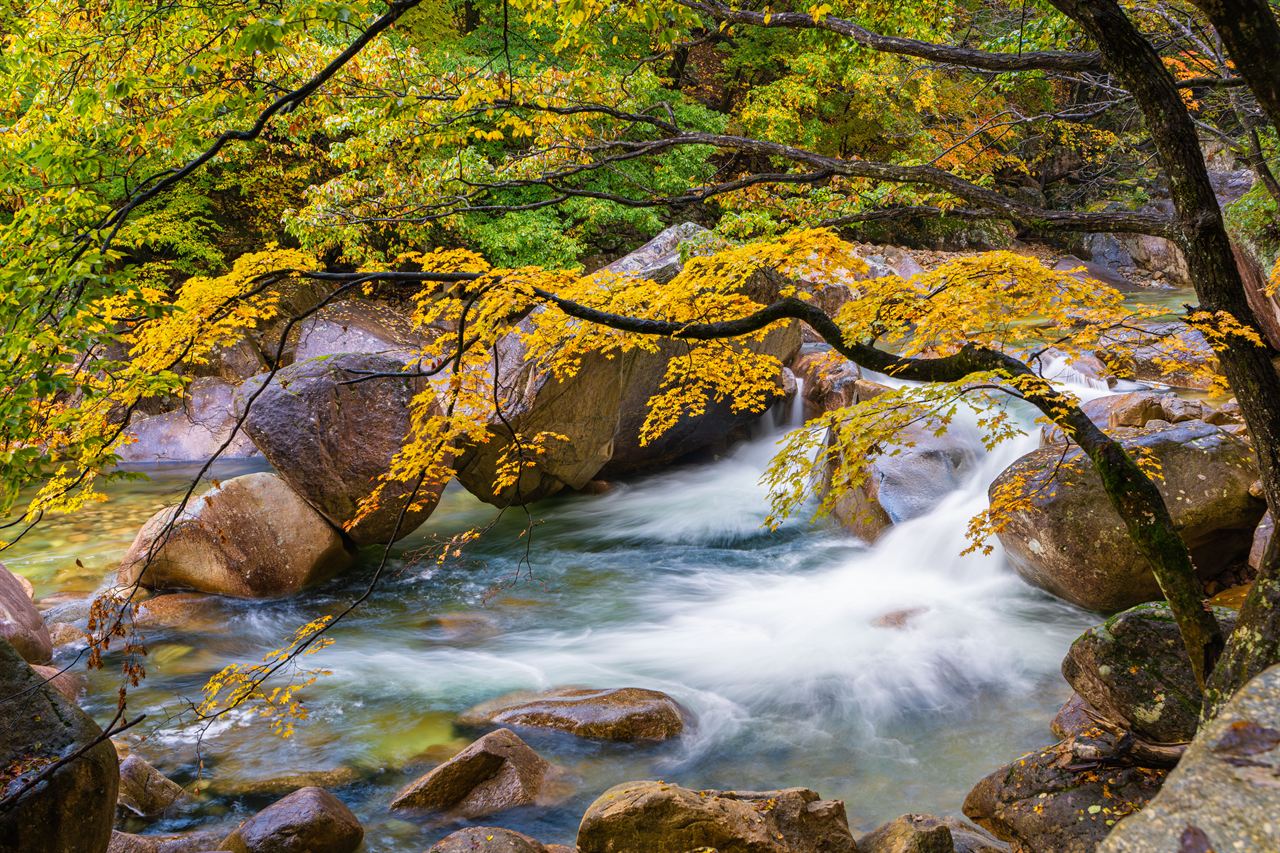
Seoraksan is a range of rocky peaks on the east coast, topped by Daecheongbong (1,708 m), South Korea's third-highest peak. Korea's weather agency announces Seoraksan's first colour separately each year, and it is usually one of the first major mountains where autumn colour is reported. In 2026 it turned on 28 September and peaked on 16 October.

- Entry: free. National park entry fees were abolished in 2007, and Sinheungsa's heritage fee in May 2023. The cable car's official page states that there is no entrance fee.
- Seorak cable car: Sogongwon to Gwongeumseong (699 m), about 5 minutes. Return tickets only, ₩16,000 adults, ₩12,000 children. No advance booking; tickets are sold on the day at the station. Hours change daily (06:30–17:00 on Saturday 24 October). There is no walking path down from the top.
- Getting there: express bus from Seoul to Sokcho, then city bus 7 or 7-1 to the Seoraksan terminus (see transport below).
- Walks: Sinheungsa and the Unification Buddha, close to the park entrance; Biseondae in the Cheonbuldong valley; Heundeulbawi, the "rocking rock," about 1 hour; Ulsanbawi a little over another hour.
- Sunset: about 17:28 on 1 November and 17:20 on 8 November. Valleys go dark earlier; start down by mid-afternoon.
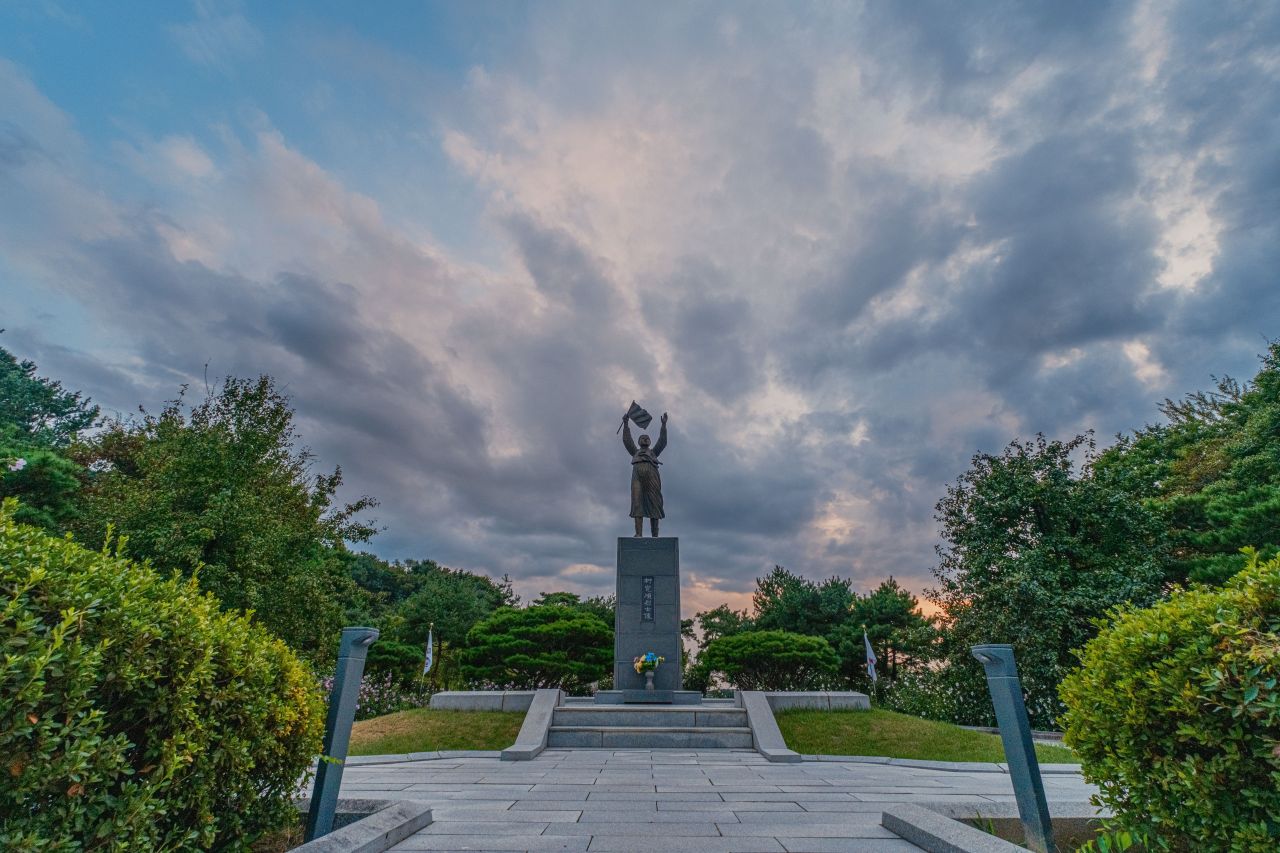
When Korea was divided along the 38th parallel in 1945, Sokcho and Seoraksan fell on the northern side. The area was under North Korean rule until South Korean forces took it in 1951, during the Korean War, and civilian government only returned in 1954. A Korean newspaper report on Sinheungsa says that soldiers sheltering at the temple in the cold of 1951 burned many of its printing woodblocks for heat; 277 survive in the temple museum.
Legend says that when word went out that the finest rocks in Korea were being gathered at Geumgangsan, a great rock set off from Ulsan, far to the south. It was slow, stopped to rest at Seoraksan, heard that Geumgangsan was already full, and stayed. That, the story goes, is Ulsanbawi, "Ulsan rock." It is a legend; the rock itself is a protected scenic site with six peaks and cliffs 200–300 m high.

In 2026 the upper slopes were at their best in mid-October. Colour moves down the mountain, so in late October look lower: Biseondae and the stream below Cheonbuldong, and the view of Ulsanbawi from near Sogongwon. Weekday mornings before 9:00 are the quietest time you can count on; visitors report the car parks almost full by then even on weekdays.
No verified filming location inside the park was found. Nearby in Sokcho, the city's official tourism site names Abai Village and its hand-pulled ferry as a location of the drama Autumn in My Heart. The ferry costs ₩500.
2Seoul — palaces, a 500-year-old ginkgo and yellow streets
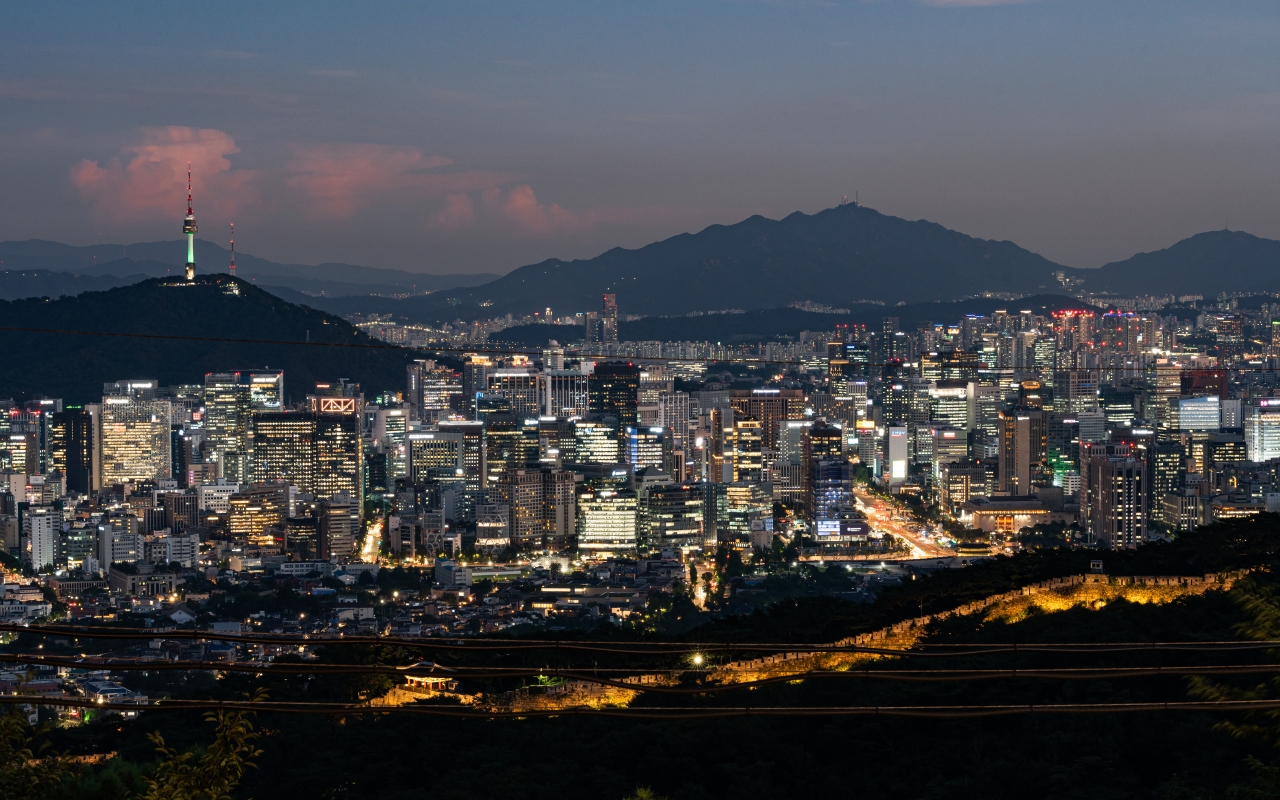
Seoul turns later than the mountains: the hills around the city first (Bukhansan usually peaks around 28 October), then, in past years, the palace gardens and the ginkgo-lined streets from late October into mid-November. Seoul made the ginkgo its official tree in 1971; there were 102,794 ginkgo street trees in 2024.
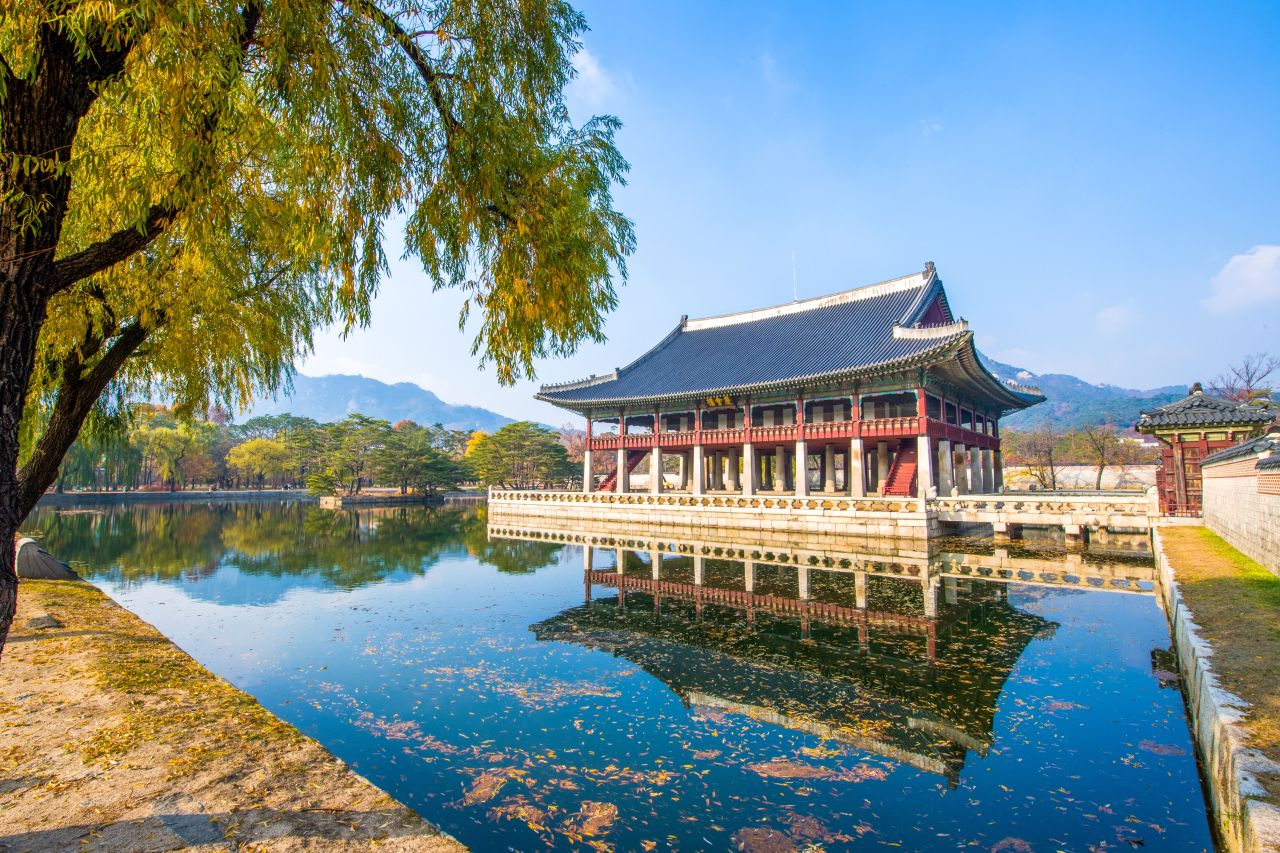
Changdeokgung's Secret Garden

The royal garden behind Changdeokgung is the best single place in Seoul for autumn colour, and the hardest to get into. Our one-day route through Gyeongbokgung and Changdeokgung explains how to fit it into a palace day.
- Hours in November: 9:00–17:30, last entry 16:30. Closed Mondays.
- Tickets: palace ₩3,000 + Secret Garden ₩5,000; you need both. Hanbok gets you into the palace free, but not the garden. The Ongnyucheon stream area is closed for repairs.
- English tours: 10:30, 11:30, 14:30 and 15:30 (Tuesday to Sunday, until November).
- Tickets: for each session, half are sold online from 6 days ahead at 10:00 and half on the day from 9:00; the official site warns that October and November sell out very fast. Check the English-tour booking rules on the palace site.
Kingdom (Netflix, 2019–2020). A 2020 YTN report, citing a video by the palace authority, shows the Secret Garden among the zombie period drama's filming locations; Seoul city lists nearby Changgyeonggung as another.
Sungkyunkwan's ginkgo tree

In front of Myeongnyundang, the lecture hall of Joseon's royal academy, stands a ginkgo said to have been planted in 1519, so about 500 years old. It has been a natural monument since 1962. Confucius is said to have taught under a ginkgo tree, which is why Confucian schools planted them. The academy's ginkgos are all male trees, so you will not smell the fruit here that fills Seoul's streets in November.
- Visiting: free. Reported hours are 9:00–17:00 from November (not confirmed for 2026).
Sungkyunkwan Scandal (KBS2, 2010) is set at this academy: a young woman disguises herself as a man to study among Joseon's future officials. A 2010 report says the lecture-hall scenes were filmed at Jeonju Hyanggyo, a Confucian school in Jeonju; no source we found places the filming here. Jeonju makes an easy stop on the way to Naejangsan.
Deoksugung's stone-wall road

The road along Deoksugung's wall is one of Seoul's official autumn walks, with ginkgo and zelkova trees, and it runs straight into Jeongdong. Our Deoksugung and Jeongdong night walk covers the palace, which stays open until 21:00 (₩1,000).
Seoul has an old saying that couples who walk this wall together will split up. One explanation is that the city's family court, where divorces were settled, once stood beside it, in the building that is now the Seoul Museum of Art. Another is that the road used to dead-end at the British Embassy, "cutting off" the walk. It is only a saying; the section by the embassy was opened to the public in 2017–2018, so the loop now goes all the way round.
This autumn: the palace's outer wall is under repair until 19 November, and Pyeongseongmun gate is closed from 25 October to 19 November.
More of Seoul in yellow
| Place | Why go | Hours · fee |
|---|---|---|
| Samcheong-dong | 1.2 km of ginkgo and zelkova along Gyeongbokgung's east wall, with galleries | Street, free |
| Seoul Forest | A wood of about 600 ginkgo trees and a yellow stairway | Park, free |
| Namsan | Wooded paths in the middle of the city; N Seoul Tower on top | Park, free. The Myeong-dong gondola is not running (delayed to 2027) |
| Olympic Park | Open lawns and the "Lone Tree" | Free; some areas closed for construction |
| Nami Island (day trip) | Ginkgo and metasequoia avenues | ₩19,000 adults incl. ferry; no separate foreigner price |

My Love from the Star (SBS, 2013–2014). A 2014 report describes the padlock scene and the revolving restaurant scene at N Seoul Tower on Namsan; the tower later sold a "star confession" package after the show.
3Naejangsan — the mountain that saved Korea's history
Naejangsan means "mountain with hidden treasures inside." It is small, the main peak is 763 m, and its colour comes from dense, small-leaved maples that locals call aegi danpung, "baby maples." It is one of the last major mountains on the mainland to turn, which makes it the place to go in early November.
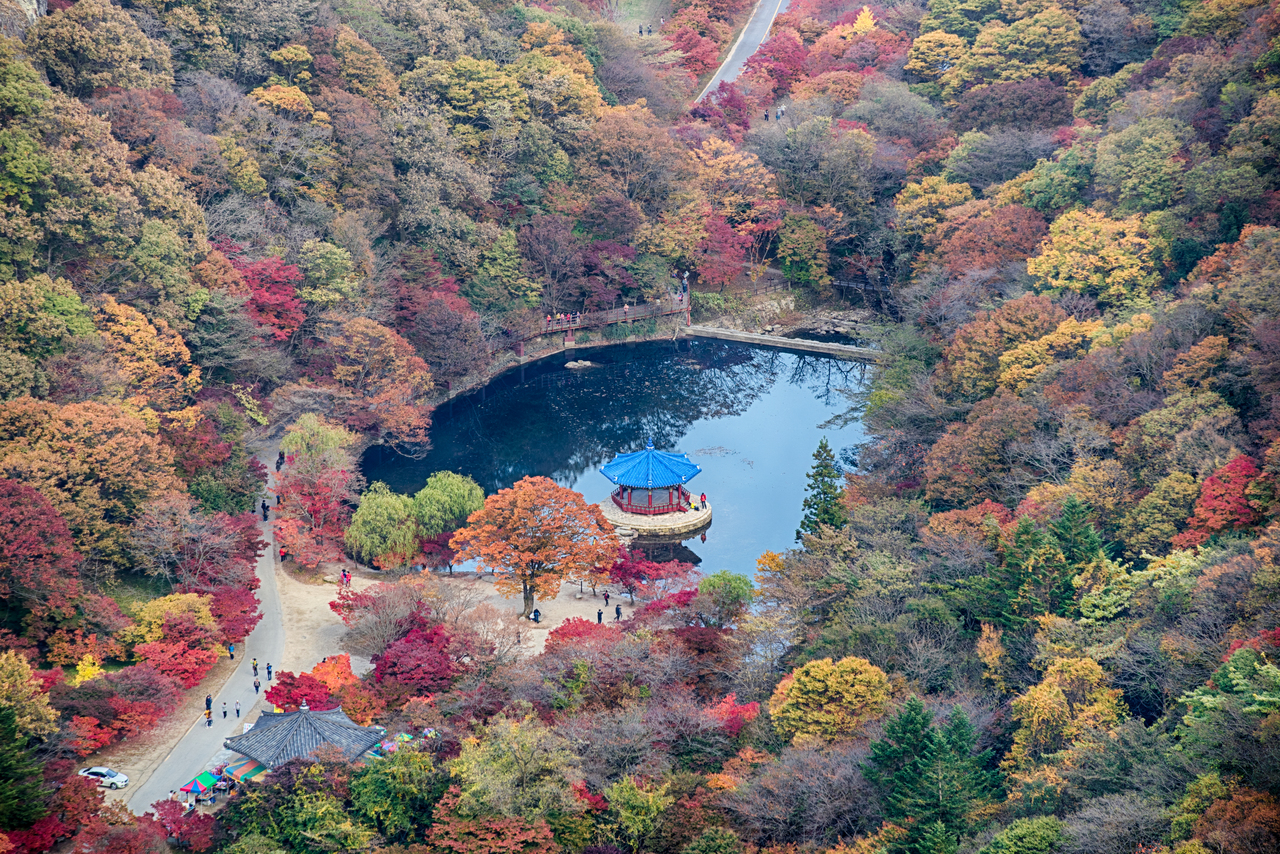
- Entry: no national park fee. Whether Naejangsa temple still charges a heritage fee could not be confirmed. Do not use the old temple website address, which now redirects to a gambling site.
- Car closures 2026: the inner road from Yeonjagyo bridge to the visitor centre (2.3 km) is closed to cars from 07:00 to 18:00 on 24–25 October, 30 October to 15 November and 21–22 November. The outer road from Naejangho car park to Wollyeonggyo (2.1 km) closes from 30 October to 15 November once car park 2 is full; a free shuttle runs on that stretch.
- Easy walk: the nature trail from the One-Pillar Gate via Byeongnyeonam and Wonjeogam to Naejangsa and back, 3.9 km, about 1 hour 20 minutes, rated easy.
- Cable car: from near the visitor centre up the side of Yeonjabong; a viewpoint is 300 m (10 minutes) further on foot. Usually 8:00–17:30, running continuously in foliage season. The 2026 fare could not be confirmed. One visitor at peak wrote that the view from the top is skippable.
- Ridge trail: Seoraebong (2.8 km) needs a reservation on the Korea National Park Service site until 16 November.
- Sunset: about 17:38 on 1 November.
In 1592, as Japanese troops overran Korea, the kingdom kept four copies of its official history, the Annals of the Joseon Dynasty. Son Hong-rok, a local scholar, and others carried the Jeonju copy, 804 volumes covering the first thirteen kings, along with the portrait of the dynasty's founder, into Naejangsan. Records name the hermitages differently: one says Yonggulam, another diary says Eunbongam in June and Biraeam in July. They paid the porters themselves and kept watch for about a year. The other three copies were burned. After the war, this single surviving set was used to make new copies, and the Annals are now on UNESCO's Memory of the World register. Monks of Naejangsa are said to have helped guard them.
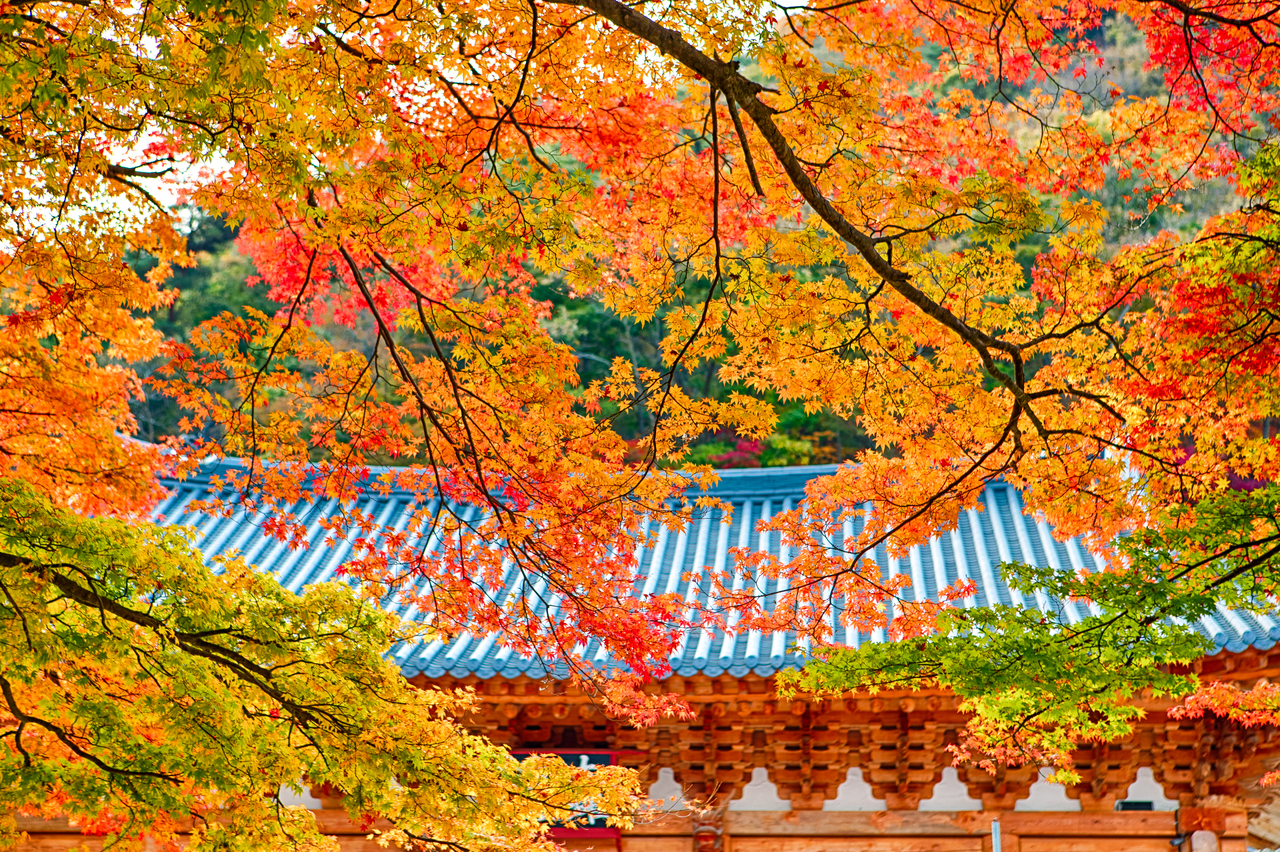
Naejangsa itself has burned again and again: in the Japanese invasions, in January 1951 during the Korean War, in a 2012 fire, and in 2021, when its rebuilt main hall was set alight by a monk. Whether the 2021 hall has been fully rebuilt could not be confirmed.
Early November, in the morning, at Uhwajeong, the pavilion on the pond near the entrance: on a still day the red maples double in the water. Arrive before 07:00, when the car closures start, or come by bus.
No verified filming location was found at Naejangsan.
Near Naejangsan
| Place | Why go | Hours · fee |
|---|---|---|
| Baegyangsa | The southern side of the same national park; Ssanggyeru pavilion reflected in its pond is a classic autumn photo | Temple free since 2023. Train to Baegyangsa Station, then an hourly bus |
| Gangcheonsan (Sunchang) | Korea's first county park (1981), small maples and a suspension bridge | ₩5,000 adults (₩2,000 back in local vouchers). 07:00–17:00 in November |
| Jeonju Hanok Village | A base with hanok stays and food; no direct bus to Naejangsan | Free. Jeonju intercity terminal to Jeongeup, then bus 171 |
4Korea first, then Japan
Many visitors combine Korea and Japan. Comparing the forecasts, Seoul's hills peak roughly a month before Tokyo's ginkgo. Mountain to mountain, it is closer: Seoraksan peaked on 16 October and Nikko's Irohazaka is forecast for around 23 October. So the order that works is Korea's mountains and Seoul in late October to mid-November, then Kyoto and Tokyo in late November.
| Place | 2026 forecast or observation | Source |
|---|---|---|
| Seoraksan | Peak observed 16 Oct | Korea Meteorological Administration |
| Nikko (Irohazaka) | Around 23 Oct | Weathernews |
| Seoul (hills · streets) | Around 28 Oct · early to mid Nov | KMA usual date (hills); Seoul city pattern and traveller reports (streets) |
| Naejangsan | 4–8 Nov | Korea Forest Service · park office |
| Kyoto (Arashiyama) | Around 24 Nov | Weathernews |
| Tokyo (ginkgo · maples) | 26 Nov · 28 Nov | Japan Meteorological Corporation |
| Osaka (maples) | 4 Dec | Japan Meteorological Corporation |
| Kyoto city (maples) | 11 Dec | Japan Meteorological Corporation |
Japanese forecasts as published on 1–8 October 2026; both forecasters update them in late October and early November. No official source compares the two countries side by side; this table puts their forecasts together.
- Gimpo (Seoul) → Haneda (Tokyo): about 2 hours 5 minutes.
- Incheon → Kansai (Osaka, for Kyoto): about 2 hours 5 minutes.
- Busan → Fukuoka: about 55 minutes by air, or the overnight New Camellia ferry (about 11 hours, leaving around 20:00). The fast Queen Beetle ferry has stopped for good; JR Kyushu announced its end in December 2024.
What to bring
- Layers. November averages: Seoul 3.5–11.9 °C, Sokcho 4.7–13.1 °C, Jeongeup 3.7–14.2 °C. The top of the Seorak cable car (699 m) is colder and windier.
- Proper shoes. Even the "easy" Seorak paths are rocky, and the last stretch to Ulsanbawi is a long climb.
- A head torch if you hike late; in early November the sun sets before 17:40.
- Cash and a T-money card for city buses (₩1,530 by card in Sokcho), plus a foreign card that works for Klook.
- Your passport, which you need to buy a Korea Rail Pass.
- Data: an eSIM or SIM. If Naver Map blocks you on a foreign eSIM for "unusual activity," connect to local Wi-Fi once.
Getting there and apps
Seoul → Seoraksan
- Express bus: Seoul Express Bus Terminal → Sokcho Express Bus Terminal, about 2 h 25 min, from 06:00 to 23:30 roughly every 30 minutes. Sokcho city lists the fare as ₩31,500; fares rose by about 9% on 1 October 2026, so check the current price.
- Booking as a foreigner: the Korean bus booking sites generally do not accept foreign cards. Buy at the terminal counter, or use Klook for routes it sells. Some buses stop at Yangyang first; stay on until Sokcho Express Bus Terminal.
- Sokcho → park: city bus 7 or 7-1 to the Seoraksan terminus, about every 15–20 minutes. Last bus back from the park at 20:35. Weekend traffic near the entrance can double the ride.
- Day trip: possible on the first bus (06:00), leaving the park by about 16:00–17:00. Staying one night in Sokcho is far more relaxed.
Seoul → Naejangsan
- Train + bus (Korea National Park Service route): Yongsan → Jeongeup by train, then city bus 171 or 171-1 from Jeongeup Station or Terminal to Naejang Terminal. About 3½ hours in total. Weekend KTX trains back to Seoul sell out fast in foliage season; book as soon as tickets open, one month ahead.
- Korea Rail Pass: 2–5 day passes cover KTX unreserved and standing seats plus up to two reserved seats a day; not valid on SRT. Korail posted a notice in August 2026 titled "Temporary Unavailable Foreign Credit Card Services" (with no details), so have a backup.
- From Jeonju: no direct bus. Go from Jeonju's intercity terminal (not the express terminal) to Jeongeup, then take bus 171. Jeongeup Station has lockers.
Or take a day tour
Day tours from Seoul solve the bus-booking problem and leave around 06:00. Two examples on Klook (prices on 23 October 2026):
- Naejangsan autumn day tour — about ₩80,300, 14 hours, rated 4.5 (732 reviews); includes a one-way park shuttle ticket, about 4½ hours at the park. See on Klook
- Seoraksan autumn day tour — about ₩84,000, 13 hours, rated 4.5 (235 reviews); about 5½ hours at the park, cable car ticket not included. See on Klook
Apps
- Maps: Naver Map or KakaoMap. South Korea conditionally approved Google's request to export detailed map data in February 2026, but travellers still report weak walking directions.
- Taxis: a traveller reported paying about ₩20,000 from Sokcho beach to the park.
How much does it cost?
Per adult, Seoraksan as a day trip from Seoul. US dollar figures use ₩1,327 = US$1 (23 October 2026).
| Item | On your own | With a tour / comfort |
|---|---|---|
| Transport | about ₩66,000 (express bus both ways + city buses; fare may be higher after 1 Oct) | ₩84,000 (Klook day tour) |
| Cable car | ₩16,000 | ₩16,000 (not included in the tour) |
| Meals | about ₩19,000 (kimchi-jjigae set + kalguksu) | about ₩33,000 (bibimbap + samgyeopsal 200 g) |
| Hotel in Sokcho (optional, room price) | from about ₩67,000 | from about ₩227,000 (resort) |
| Total, day trip | about ₩101,000 (US$76) | about ₩133,000 (US$100) plus a hotel if you stay |
Meal prices are Seoul averages for September 2026 (price.go.kr); Sokcho is usually a little cheaper. Naejangsan costs about the same by tour (₩80,300 including a shuttle ticket). Train fares to Jeongeup could not be checked: Korail's site blocked automated searches, so look them up on letskorail.com. Hotel prices are the lowest Klook listed on 23 October 2026; real prices depend on your dates.
Where to stay
For Seoraksan, sleeping in Sokcho lets you be at the park before 9:00, when the car parks fill and the cable car queue grows.
Why: about 900 m from the centre of Sokcho, where the city buses to the park run.
See prices on Klook
Why: 1.1 km from Daepo harbour, for a slower trip with a morning on the coast.
See prices on Klook
Why: 200 m from Seorak Waterpia, on the Seorak side of town, for an early start at the park.
See prices on Klook
Ratings and lowest prices as shown on Klook, 23 October 2026. For Naejangsan, Jeongeup hotels have very few reviews; Jeonju's hanok village is the better-known base. These are affiliate links: if you book, Korea Routes may earn a small commission at no extra cost to you.
Watch out
- Do not plan around one forecast date. A cold snap or warm spell moves everything; travellers' advice is to come, then day-trip to whatever is at its best.
- Peak in the mountains is not peak in the city. Seoraksan's date is mid-October; in past years Seoul's streets have been at their best in early to mid-November.
- Go early. On foliage weekends the Seorak car parks fill by 9:00 and the cable car has no booking; Naejangsan's roads close to cars from 07:00.
- High trails close in late autumn. National parks close upper trails in the autumn fire-prevention season (a traveller reported that in 2025 Seorak's summit trail closed from 15 November to 15 December while Ulsanbawi and Biseondae stayed open). The 2026 list is due in early November.
- Reservation trails: Heullimgol (Seorak) is booking-only, and walking Seoraebong (Naejangsan) without a booking can mean a fine.
- Last buses: 20:35 from Seoraksan to Sokcho. Buy your bus back to Seoul in the morning on weekends.
- At the Seorak entrance, a travel guide warns of shops offering a taste of local wine and then selling a cheaper bottle; check what you pay for.
Outdated tips you will still find online
| You may read | Correct in 2026 | Source |
|---|---|---|
| Seoraksan park fee ₩3,500, cash only | No fee. Park fees ended in 2007; the temple's heritage fee ended in May 2023 | Korean government briefing (2023 temple fees); Seoul Shinmun (2007 park fees) |
| Seorak cable car ₩10,000 (adults), ₩5,500 (children) | ₩16,000 return only, no booking | sorakcablecar.co.kr |
| Nami Island ₩10,000, ₩8,000 for foreigners | ₩19,000; no foreigner price | Nami Island official site |
| Book express buses on the English KOBUS site | Foreign cards generally fail; buy at the terminal or on Klook | Traveller reports, 2026 |
| Google Maps does not work in Korea | Map export conditionally approved in 2026; walking directions still weak, use Naver Map | Reuters, traveller reports |
| Seoul foliage peaks in mid-October | Hills late October, streets early to mid-November | KMA (hills, usual date); Seoul city pattern and traveller reports (streets) |
| Fast ferry Busan → Fukuoka in 3 hours | Queen Beetle ended; overnight ferry or 55-minute flight | JR Kyushu announcement (Dec 2024), via Wikipedia |
| Ride the gondola from Myeong-dong up Namsan | Delayed to 2027 | Seoul press |
FAQ
Is it too late for foliage in the second week of November?
Not in Seoul or Naejangsan. Seoul's streets and palaces are usually at their best in early to mid-November and Naejangsan around 4–8 November in 2026. Seoraksan's upper slopes will be well past their best.
Seoraksan or Naejangsan?
Late October: Seoraksan's lower valleys. Early November: Naejangsan. Seoraksan has rocky peaks and the sea nearby; Naejangsan is smaller, redder and easier to walk.
Can I do Seoraksan as a day trip from Seoul?
Yes, on the 06:00 bus or a day tour, but it is a 13-hour day. One night in Sokcho is better.
Do I need to book the Seorak cable car?
You cannot. Tickets are sold only on the day at the station. Arrive early on weekends.
Will I still see autumn leaves in Japan after Korea?
Yes. Kyoto's Arashiyama and Tokyo are forecast to peak in the last week of November 2026, and central Kyoto's maples in early to mid-December.
Sources (checked 23 October 2026): Korea Meteorological Administration mountain foliage observations (weather.go.kr) and 1991–2020 averages as reported by Segye Ilbo; Korea Forest Service forecast map (as reported, September 2026); Korea National Park Service for Naejangsan notices 2026-33, 2026-39 and 2026-41, trails, routes and reservations (knps.or.kr, reservation.knps.or.kr); Sokcho city transport information (sokcho-pti.kr) and traffic plan reports; Seorak cable car official site (sorakcablecar.co.kr); Korea Heritage Service royal palaces site (royal.khs.go.kr); Seoul Metropolitan Government (seoul.go.kr, parks.seoul.go.kr, mediahub.seoul.go.kr); Korea Heritage portal for the Munmyo ginkgo and Ulsanbawi; Encyclopedia of Korean Culture (encykorea.aks.ac.kr) for Son Hong-rok and Sokcho; Korean government policy briefing (korea.kr) on temple fees; Nami Island official site; Japan Meteorological Corporation (n-kishou.com) and Weathernews (weathernews.jp) for Japan; price.go.kr for Seoul restaurant prices (September 2026); Hana Bank exchange rate. Also: November climate normals (1991–2020) via Wikipedia, citing KMA; sunset times calculated with sunrise-sunset.org; YTN (2020) on Kingdom; Herald Corporation and Newsis on Sinheungsa and Naejangsa; Jeonbuk Ilbo on the Annals; Reuters on Google Maps; flightconnections.com and ferryscanner.com for routes; Klook for tours and hotels. Traveller experiences from r/koreatravel. Photos: Korea Tourism Organization photo gallery; dates are when each photo was taken, not this year.


Comments
Post a Comment