





















Gyeongbokgung to Changdeokgung: One-Day Seoul Palace Route
Stand in front of Gwanghwamun Gate and you are looking at a building that has been burned by invaders, moved aside by a colonial government, shelled in a war, rebuilt in concrete, and finally rebuilt again in wood, in its true place, in 2010. Seoul's palaces are not museum pieces that survived untouched. They were lost and slowly won back, and almost every courtyard has a story: a queen murdered before dawn, a crown prince who died in a rice chest, a palace turned into a zoo, the last princess of Korea coming home.
This route links the three palaces that tell that story best, Gyeongbokgung, Changdeokgung with its Secret Garden, and Changgyeonggung, in one unhurried day. It ends after dark by a lit-up glasshouse, and along the way it shows you where BTS, NewJeans and Netflix's Kingdom filmed, where to rent a hanbok, what to eat, where to park, and the mistakes visitors make most often.
1Gyeongbokgung (morning, 2–3 h) → 2walk 25 min or 1 subway stop → 3Changdeokgung + Secret Garden (afternoon, about 4 h) → 4Changgyeonggung (evening, open until 9 pm)
Best days: Wednesday to Sunday. Gyeongbokgung closes on Tuesdays; Changdeokgung and Changgyeonggung close on Mondays.
Free days: since 7 October 2026, every Wednesday is free at Changdeokgung, Changgyeonggung and Jongmyo (not Gyeongbokgung). From 29 October to 15 November 2026 the four main palaces and Jongmyo are free for the Korea Grand Festival. The Secret Garden is not part of either.
Tickets for the day: from ₩11,000 per adult (₩6,000 Integrated Palace Pass + ₩5,000 Secret Garden), less on free days.
Hours, prices and schedules checked on 22–23 October 2026 with the Korea Heritage Service palace website (royal.khs.go.kr) and the other official sources listed at the end.
In this guide
- Route map and timetable
- Lost and rebuilt: 600 years in one table
- Gyeongbokgung: stories, beauty, filming spots
- Renting a hanbok
- Between the palaces: Bukchon, lunch, views
- Changdeokgung and the Secret Garden
- Changgyeonggung after dark
- Evening and date ideas
- More places nearby
- Experiences and the king's table
- Parking, transport and apps
- Costs and where to stay
- Watch out, and outdated tips
- FAQ
Route map
The red line is the walking route from Gwanghwamun Gate to Donhwamun Gate (about 1.7 km, roughly 25 minutes at an easy pace). Tap a number for directions.
Map © OpenFreeMap, data © OpenStreetMap contributors. Walking line from OpenStreetMap routing. Google Maps gives only limited directions in Korea; most visitors use Naver Map or KakaoMap, both available in English.
Plan for the day
| Time | Where | Why then |
|---|---|---|
| 8:45 | Gwanghwamun Gate | Be in line before the 9:00 opening; tour groups arrive from about 11:00 to 14:00 |
| 9:00–11:30 | Gyeongbokgung | Walk north through the throne hall, then west to Gyeonghoeru and up to Hyangwonjeong |
| 10:00 | Royal guard changing ceremony | Free, about 20 min, at the main gates |
| 12:00 | Walk east + lunch | Samcheong-dong, Anguk, Insadong or Ikseon-dong |
| 14:30 | Secret Garden English tour | Book 6 days ahead; be at Donhwamun by 14:00, the walk to the meeting point takes 10–15 min |
| 16:30 | Changdeokgung halls, Nakseonjae | Last entry 17:00 (Oct), 16:30 (Nov–Jan) |
| 17:30–21:00 | Changgyeonggung | The only palace open until 9 pm; sunset over the pond and the glasshouse lights |
What happens when: daily events
| Time | Where | Event |
|---|---|---|
| 9:35 · 13:35 | Gyeongbokgung | Royal guard open training (about 15 min) |
| 10:00 · 14:00 | Gwanghwamun–Heungnyemun | Royal guard changing ceremony (about 20 min, not Tuesday) |
| 11:00 · 13:00 | Gwanghwamun | Gate guard-on-duty ceremony (about 10 min) |
| 15:00 Sat, Sun | Gyeongbokgung area | Royal guard patrol procession (until 29 Nov) |
| 11:00 · 13:30 · 15:30 | Gyeongbokgung | Free English guided tour, no booking under 10 people |
| 10:15 · 13:15 | Changdeokgung | Free English tour of the palace halls (about 50 min) |
| 10:30 · 11:30 · 14:30 · 15:30 | Changdeokgung | Secret Garden English tours (Mar–Nov) |
| 11:00 · 15:00 | Changgyeonggung | Free English tour |
| 10:00 · 12:00 · 14:00 · 16:00 | Jongmyo | English tours (Mon, Thu, Fri are tour-only days) |
| 19:00 · 19:30 · 20:00 | Changgyeonggung | “Mulbit Yeonhwa” light show, Wed–Sun until 1 Nov 2026 |
Special events this season
| Date (2026) | Where | Event |
|---|---|---|
| 29 Oct – 1 Nov | Gyeongbokgung, Heungnyemun Plaza | Royal guard troop review (Cheopjong), 11:00 and 14:00, free. On these days the changing ceremony is replaced by the Gwanghwamun gate-guard ceremony at 10:00 and 13:00 |
| 29 Oct – 15 Nov | Four palaces + Jongmyo | Free entry for the Korea Grand Festival (Secret Garden not included) |
| 4 – 8 Nov | Gyeongbokgung, royal soy-sauce storehouse | “Janggo Story” exhibition 10:00–17:00, free to view |
| 7 Nov (Sat) | Jongmyo | Autumn royal ancestral rite: 10:00–12:00 at Yeongnyeongjeon, 14:00–16:30 at Jeongjeon, free, no booking |
| 10 – 15 Nov | Changgyeonggung → Changdeokgung | “Donggwol Dongnak” night walk through both palaces, ₩40,000, about 110 min, lottery on Ticketlink (enter by 28 Oct; leftover seats on sale from 5 Nov) |
Lost and rebuilt: 600 years in one table
Almost nothing you will see today is as old as it looks, and that is the heart of the story.
| Year | Palace | What happened |
|---|---|---|
| 1395 | Gyeongbokgung | Built as the first palace of the new Joseon dynasty |
| 1405 | Changdeokgung | Built as a second palace east of Gyeongbokgung |
| 1483 | Changgyeonggung | Built for three queen dowagers |
| 1592 | All three | Burned during the Japanese invasions (Imjin War). Gyeongbokgung lay in ruins for about 270 years |
| 1610 | Changdeokgung | Rebuilt first; served as the main royal palace for about 270 years |
| 1865–1867 | Gyeongbokgung | Rebuilt on a huge scale (7,225 kan, a unit of rooms), paid for partly by forced “donations” and a new coin that set off inflation |
| 1895 | Gyeongbokgung | Empress Myeongseong murdered in Geoncheonggung |
| 1909 | Changgyeonggung | Halls torn down for a zoo, botanical garden and museum; renamed “Changgyeongwon” (a mere “garden”) in 1911 |
| 1910s | Gyeongbokgung | About 4,000 kan demolished and sold; of some 500 buildings, only 36 were left by the time restoration began |
| 1917–1920 | Changdeokgung | Fire destroys the royal quarters; halls from Gyeongbokgung are taken apart to rebuild them |
| 1926 | Gyeongbokgung | Japanese Government-General Building completed right in front of the throne hall; Gwanghwamun is moved aside (1926 or 1927) |
| 1950 | Gwanghwamun | Wooden gate tower destroyed by shelling in the Korean War |
| 1968 | Gwanghwamun | Rebuilt in concrete, out of line with the palace |
| 1983–1986 | Changgyeonggung | Zoo moved out, name restored, halls rebuilt |
| 1995–1996 | Gyeongbokgung | Government-General Building demolished |
| 2010 | Gwanghwamun | Rebuilt in wood, in its original place |
| 2023 | Gwanghwamun | Stone terrace (woldae) and a new black-and-gold name board restored |
| 2045 | Gyeongbokgung | Target of the current restoration plan: 80 more buildings, about 41% of the 1860s palace |
1Gyeongbokgung — the palace that was taken apart
Its name means “palace greatly blessed by heaven.” It was the first palace of the Joseon kings, the seat of King Sejong, who gave Korea its alphabet, and later the most deliberately erased: by the time restoration began only 36 of its roughly 500 buildings still stood, and a colonial office block sat in front of the throne hall until 1995. What you walk through today is a palace in the middle of being rebuilt.
- Hours: 9:00–18:00 in Mar–May and Sep–Oct, 9:00–17:00 in Nov–Feb, 9:00–18:30 in Jun–Aug. Last entry one hour before closing.
- Closed: every Tuesday (if Tuesday is a public holiday it opens, and closes the next non-holiday day).
- Ticket: ₩3,000 for adults. Foreign visitors aged 18 and under or 65 and over enter free. Free for everyone from 29 October to 15 November 2026 (Korea Grand Festival; still closed on Tuesdays).
- Getting there: Line 3 Gyeongbokgung Station, Exit 5 (about 2 min), or Line 5 Gwanghwamun Station, Exit 2.
- How long: 2–3 hours. Go in through Gwanghwamun and head north and west; many tour groups arrive by bus on the east side and move the other way.

Gwanghwamun and the fire-eating haechi
The two stone beasts in front of the gate are haechi, mythical creatures that can tell right from wrong. A popular legend says they guard the palace against fire from Gwanaksan mountain to the south; historians think that story grew up later, but it was strong enough that when a colonial office burned in 1924, people whispered it was because the haechi had been moved. In October 2023 the gate got back its woldae, a raised stone terrace destroyed in the 1920s when tram lines were laid, and a name board in its historical colours, gold letters on black. Two stone animals at the end of the terrace came from the collection of the late Samsung chairman Lee Kun-hee, donated by his family.
Geunjeongjeon, the throne hall
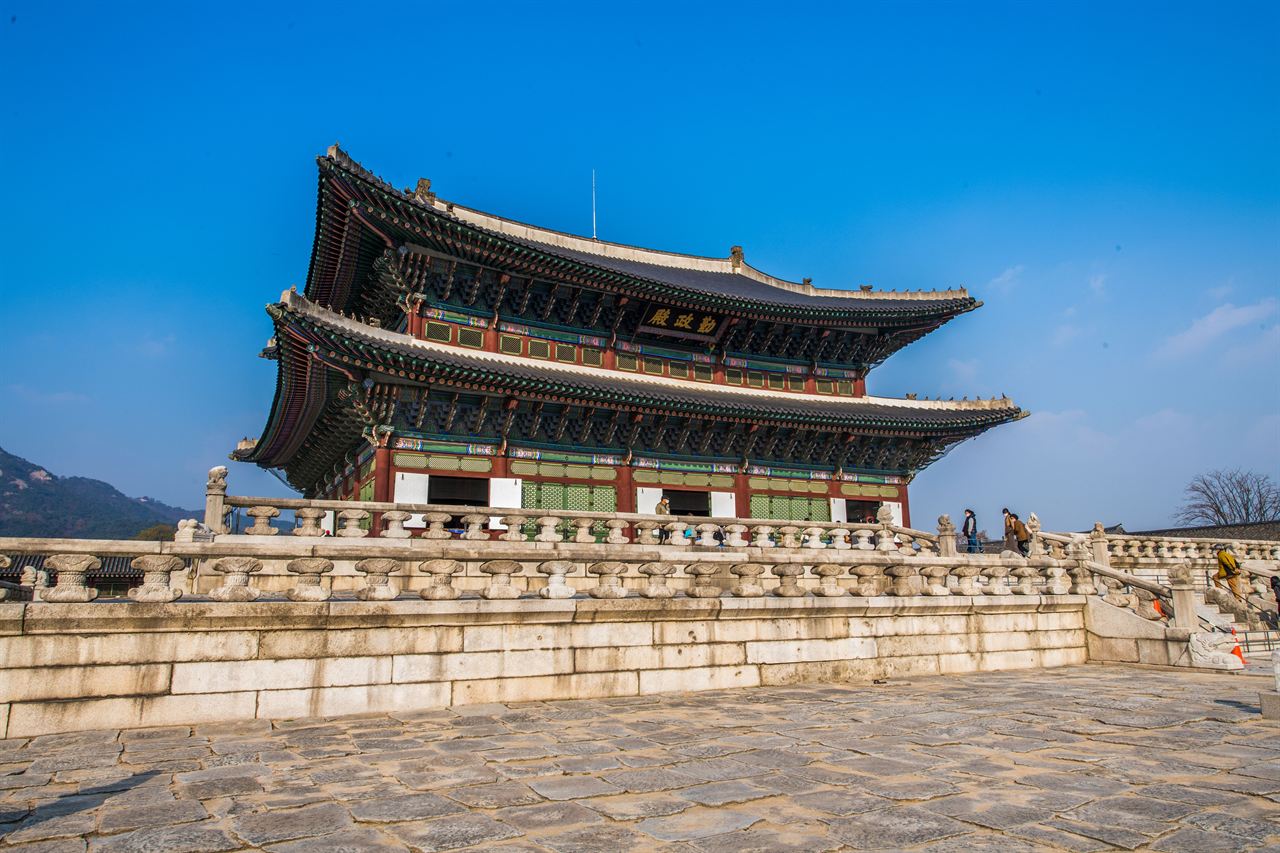
Look down before you look up: two rows of small stone markers run from the gate to the hall. These are rank stones; officials lined up beside them by rank, from the first grade nearest the king to the ninth at the back. Under the ceiling a pair of golden dragons with a pearl watches over the throne. By the stairs stand big iron water vessels called deumeu: a fire demon, it was believed, would see its own reflection, take fright and run away.
Gyeonghoeru, the banquet hall on the water
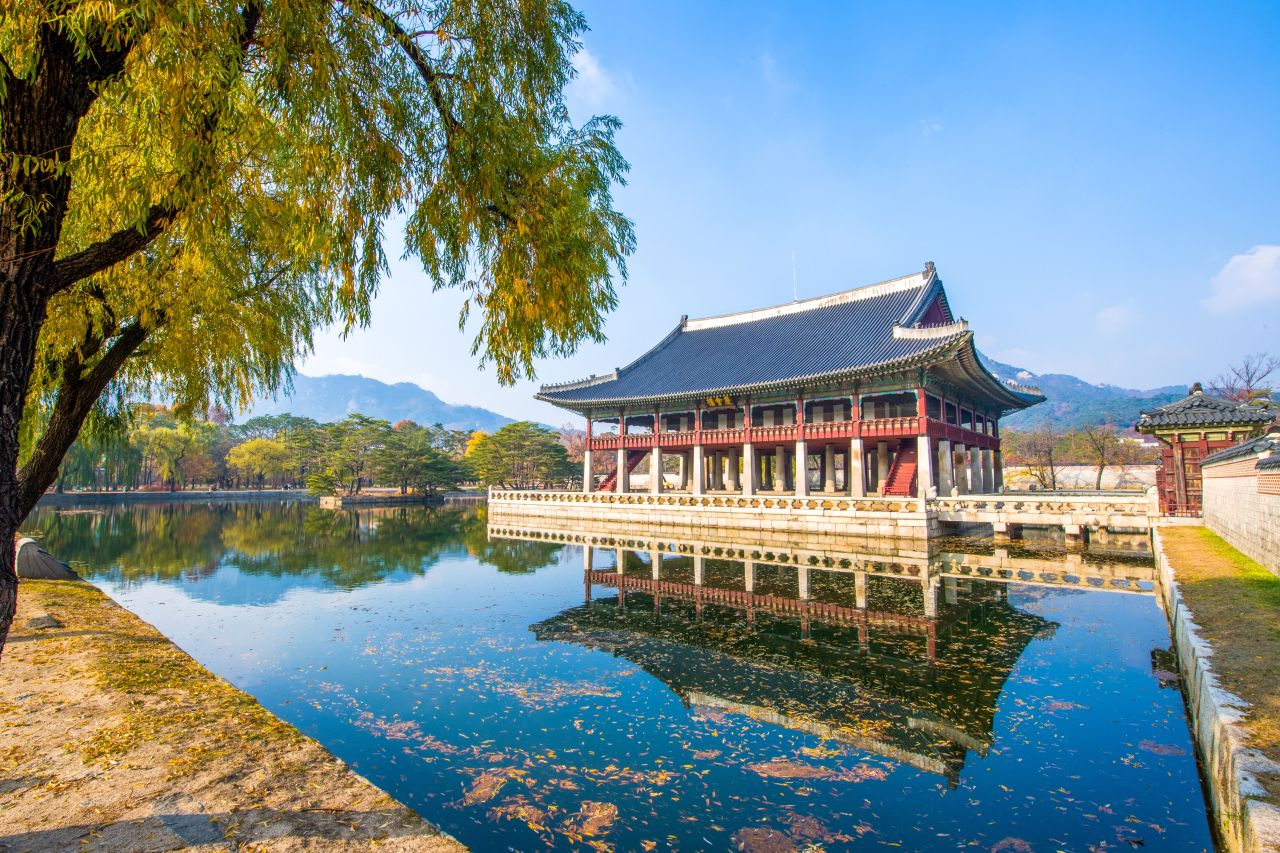
Korea's largest single-floor pavilion stands on 48 stone pillars in a square pond; the outer 24 are said to stand for the 24 seasonal divisions of the year. It was built for state banquets and for receiving foreign envoys. The tyrant king Yeonsangun turned it into a stage for excess: he recruited hundreds of court entertainers, built an artificial island in the pond and threw parties so wild that the Korean phrase heungcheong-mangcheong, “squandering without a thought for tomorrow,” is said to come from the name of his entertainers. In 1997, workers dredging the pond found a bronze dragon pressed under a rock on the bottom, placed there in the 1860s to protect the building from fire. It is now in the National Palace Museum.
On a still morning the pavilion and Inwangsan mountain behind it double in the water, and in late autumn the willows by the pond turn gold. The upper floor of Gyeonghoeru opens only in special seasons (in 2026, Wednesdays and Fridays from 2 September to 30 October, by reservation); one Korean report described the western view of Inwangsan from up there as an ink landscape painting.
Sujeongjeon and King Sejong's scholars
The low hall south of Gyeonghoeru stands on the site of Jiphyeonjeon, the Hall of Worthies that King Sejong set up in 1420 for his scholars. Nearby, in 1434, his engineer Jang Yeong-sil installed Jagyeongnu, a self-striking water clock that kept the kingdom's official time. The original is gone; a 1536 version survives in the National Palace Museum next door.
Hyangwonjeong and Geoncheonggung — beauty and tragedy side by side

At the north end, a small six-sided pavilion sits on an island, reached by a curved wooden bridge. Hyangwonjeong was restored from 2018 to 2021, and the bridge, broken in the Korean War and later rebuilt in the wrong spot, was put back on the north side where it first stood. Behind it is Geoncheonggung, a private residence King Gojong built in 1873. In 1887 it became the first place in Korea lit by electric light.
Before dawn on 8 October 1895, a group of armed Japanese agents broke into Geoncheonggung and killed Queen Min, later honoured as Empress Myeongseong, in the Gonnyeonghap quarters. Her body was burned on a nearby hill. Four months later King Gojong fled to the Russian legation. The buildings were torn down in 1909 and rebuilt only in 2006–2007.
Behind Geoncheonggung lie the foundation stones of Jaseondang, the hall King Sejong built for his crown prince. In the 1910s it was dismantled and shipped to Tokyo as a private art museum for a Japanese businessman; it burned in the 1923 Great Kanto Earthquake, and only the stones survived. They were found at the Hotel Okura and returned in 1995–96, too damaged to reuse, so they rest here as a memorial.
BTS — “IDOL” and “Mikrokosmos” for The Tonight Show Starring Jimmy Fallon (NBC, 2020). During the show's “BTS Week,” the group performed “IDOL” in hanbok in front of Geunjeongjeon and “Mikrokosmos” at Gyeonghoeru. The shoot was proposed by Korea's Cultural Heritage Administration to show the palaces to the world during the pandemic.
NewJeans — “Cool With You” special stage (KBS, 2024). Filmed at Geunjeongjeon for Korea On Stage – New Generation, a concert hosted by the Korea Heritage Service; reported as the first K-pop girl-group stage at the throne hall.
BTS's 2026 Netflix comeback concert was held on Gwanghwamun Square, outside the gate, not inside the palace.
Two free museums inside the walls: the National Palace Museum by the main gate (royal seals, the 1536 water clock, the bronze dragon from the pond, and Emperor Sunjong's Cadillac limousine, thought to be a 1918 model; open until 21:00 on Saturdays, closed the last Monday of each month) and the National Folk Museum in the north-east corner (daily life in old Korea; Permanent Hall 1 is closed until 21 December 2026). Both are good shelters on a rainy or very hot day.
Renting a hanbok
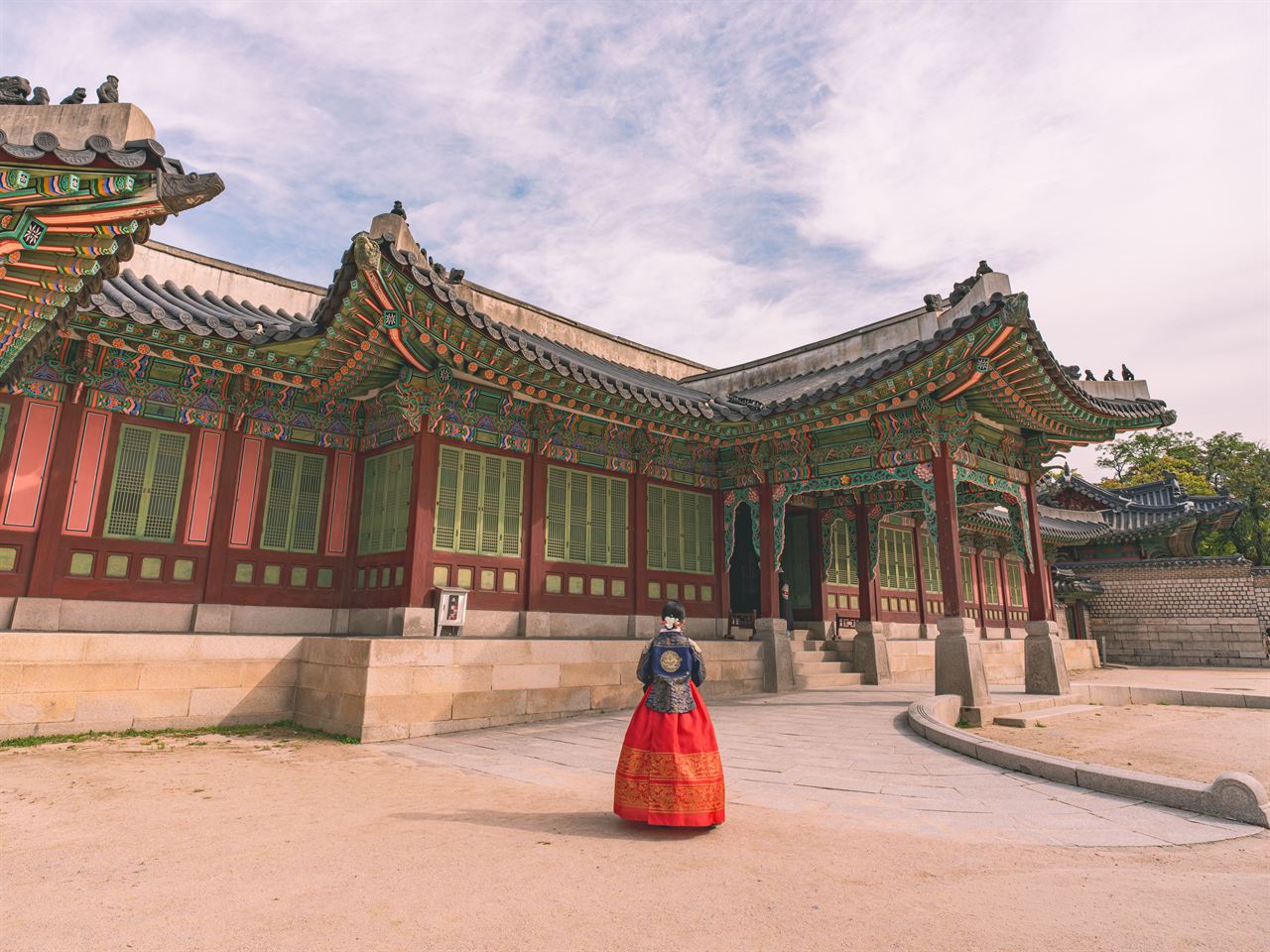
Hanbok rental shops line the streets around Gyeongbokgung Station and Anguk. Koreans generally welcome visitors wearing hanbok respectfully, and it is one of the most photographed sights in Seoul.
- What you get: free entry to Gyeongbokgung, Changdeokgung (halls), Changgyeonggung, Deoksugung and Jongmyo. The Secret Garden still costs ₩5,000.
- What counts: a jacket (jeogori) that wraps across the chest plus a separate skirt or trousers. A hanbok top with jeans, a skirt with a T-shirt, only an outer coat, or a one-piece “fusion” dress may be refused at the gate.
- Price: Visit Seoul lists about ₩15,000–₩20,000 for a typical 4-hour rental including hair accessories and a small bag. Visitors in 2025–26 report roughly ₩10,000–₩25,000 for 2–4 hours for a basic set, more for premium or themed sets.
- Rent for 3–4 hours at least; Gyeongbokgung alone takes 2–3. Go when the shop opens; the best sets go first.
- Bring: your passport (some shops keep it, others take a copy and a cash deposit, often around ₩50,000), a plain white T-shirt and leggings to wear underneath, and plain trainers; rental shoes are often uncomfortable on gravel.
- Late return: shops commonly charge ₩1,000–₩2,000 per 10 minutes.
- Sizes: visitors taller than about 175 cm report fewer choices; ask before you book.
- Season: rental hanbok are usually synthetic and hot in summer; in winter wear thermals underneath and ask for a warm vest or coat.
- Your bag: most rental shops keep your clothes and luggage while you are out.
- Best photo spots inside the palaces: Gyeonghoeru across the pond, the bridge to Hyangwonjeong, the long corridors around Geunjeongjeon, and Nakseonjae's patterned walls.
2Between the palaces
On foot (about 1.7 km, 25 min): leave by Gwanghwamun and head east past Songhyeon Green Plaza and Anguk Station to Donhwamun, the main gate of Changdeokgung. The red line on the map uses quieter side streets; the main road, Yulgok-ro, runs alongside.
By subway: Line 3 from Gyeongbokgung Station to Anguk Station is one stop. From Anguk Exit 3 it is about 5 minutes to Changdeokgung. A trip costs ₩1,550 with a T-money card.
Bukchon Hanok Village
The hill between the two palaces is covered with tiled hanok houses where Joseon officials once lived. Seoul has marked eight viewpoints; the best known are the view over Changdeokgung's roofs from the top of Wonseo-dong, the sloping lanes of Gahoe-dong where hanok roofs frame the modern city, and the stone stairs of Samcheong-dong carved out of rock. About 6,000 people still live here.
Drama locations in Bukchon: Joongang High School was the school in Winter Sonata (KBS, 2002) and Ji Eun-tak's school in Goblin (tvN, 2016–17); the old Bokjeong Well appears in Lovely Runner (tvN, 2024).
Lunch
Average restaurant prices in Seoul in September 2026: kimchi-jjigae set meal ₩8,846, kalguksu (noodle soup) ₩10,038, bibimbap ₩12,000, naengmyeon (cold noodles) ₩12,692, gimbap ₩3,923 a roll. In Seochon, west of Gyeongbokgung, Tongin Market runs a lunchbox café where you buy old-style brass coins (₩500 each in a 2025 report) and swap them at food stalls for small portions; the café opens about 11:00–16:00 and is closed on Tuesdays. Ikseon-dong, just south of Changdeokgung, is a lane of 1920s hanok turned into cafés and restaurants.
A free view over the palace
The rooftop garden on the 8th floor of the National Museum of Korean Contemporary History, across the road from Gwanghwamun, looks straight down on Gyeongbokgung with Bugaksan behind it. Entry is free.
3Changdeokgung — the palace the kings loved
Changdeokgung was meant to be the second palace, but after the 1592 invasions it was rebuilt first and became the real home of the kings for about 270 years. Its halls follow the shape of the hills instead of a straight line, which is one reason UNESCO listed it as a World Heritage Site in 1997. It is also where the kingdom ended: on 22 August 1910 the last royal council met in Heungbokheon, a room of the queen's hall, and Korea was annexed by Japan days later. Emperor Sunjong died in the same room in 1926.
- Hours: 9:00–18:00 in Feb–May and Sep–Oct, 9:00–17:30 in Nov–Jan, 9:00–18:30 in Jun–Aug.
- Closed: every Monday. Free on Wednesdays (palace halls).
- Tickets: palace ₩3,000 + Secret Garden ₩5,000. You need both.
- Getting there: Anguk Station (Line 3), Exit 3, about 5 min. No car park.
- Tip: the 10:15 English palace tour ends near the garden entrance, so it pairs well with an 11:30 Secret Garden slot.
Huijeongdang — a Western room inside a Korean hall
After the 1917 fire, the king's office was rebuilt in 1920 with timber from Gyeongbokgung, then fitted with glass windows, electric lights, Western furniture and a porch big enough for a car to pull up. Two large paintings of the Diamond Mountains by Kim Gyu-jin (1920) decorated the reception room; the originals are now kept in the National Palace Museum, along with the emperor's car.
Nakseonjae — where the last royals lived

Built in 1847 by King Heonjong, Nakseonjae is the only building in Changdeokgung left unpainted: plain wood, latticed windows, a quiet garden.
Empress Sunjeonghyo, Sunjong's widow, lived here until her death in 1966. Princess Deokhye, King Gojong's youngest daughter, was taken to Japan as a girl and spent decades there; she returned to Korea in 1962 and lived out her life in these rooms. Yi Bang-ja, the Japanese-born wife of the last crown prince, came back in 1963 and lived here too. The princess died on 21 April 1989, and Yi Bang-ja days later on 30 April, in the same small group of buildings. With them the royal household that once filled these palaces came to an end.
The Secret Garden (Huwon)

Behind the halls, the royal garden spreads over a wooded valley. The first pond you reach, Buyongji, is square with a round island, a picture of the old belief that heaven is round and the earth square. The cross-shaped pavilion Buyongjeong stands with two stone feet in the water; Korea's main encyclopedia calls its proportions “the height of beauty.” Kings held banquets here for scholars who had passed the state exam, and in 1795 King Jeongjo went fishing here with his officials. The small gate up to Juhamnu, the royal library, is called Eosumun, the “fish and water gate,” a reminder that a king and his ministers should be as close as fish and water. Beside the pond, Yeonghwadang was where King Jeongjo held state examinations.
Old trees here are protected as natural monuments: a juniper behind the library, around 700–750 years old and already shown propped up in a palace painting of the 1820s, and a 600-year-old hardy kiwi vine in the garden.
In late autumn; a Seoul city reporter wrote that the maples “pour red paint over visitors' heads.” Peak colour around Seoul usually arrives from late October into November and varies each year; see our 2026 autumn foliage dates. Early tours on a windless day give the best reflections in Buyongji.
- Guided only. English tours 10:30, 11:30, 14:30, 15:30 (Mar–Nov), about 70–90 minutes. 100 places per tour: 50 online, 50 sold at the palace from 9:00 on the day.
- Online booking opens 6 days before at 10:00 Korea time. You register and pay online (visitors report Visa, Mastercard and JCB working); unpaid bookings are cancelled after 24 hours. The e-ticket activates 30 minutes before your slot, so you need mobile data.
- In October and November on-site tickets can be gone by midday; visitors report queuing 30–60 minutes before 9:00.
- There are no toilets inside the garden. The route is a hilly forest path: wear proper shoes.
- Ongnyucheon, the stream at the far end, is closed for repairs until further notice.
- Missed the English slot? Visitors report joining a tour in another language when places remain.
Kingdom (Netflix, 2019–2020). The Korean heritage agency introduced the Secret Garden as a filming location of the zombie period drama in a video it released in 2020.
4Changgyeonggung — from palace to zoo and back
Changgyeonggung was built in 1483 for three queen dowagers, and because it began as a home for royal women its throne hall faces east instead of south. Its gate, Honghwamun, and throne hall, Myeongjeongjeon, are among the oldest palace buildings left in Seoul. From Donhwamun, walk round to Honghwamun on Changgyeonggung-ro (about 1.2 km, 15 minutes).
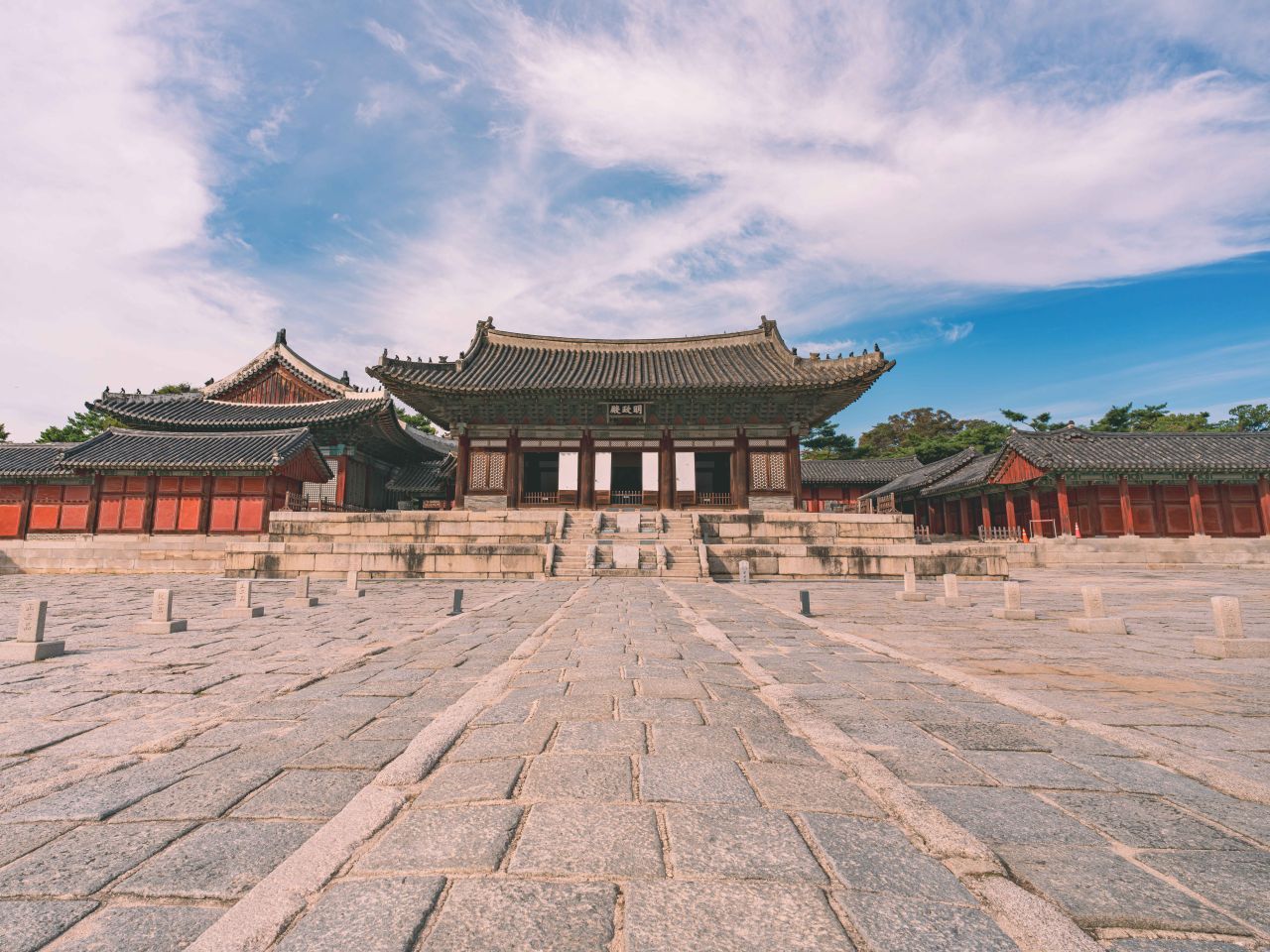
In 1909 more than 60 of its halls were pulled down for a zoo, a botanical garden and a museum, opened, it was said, “to comfort” Emperor Sunjong. Two years later the palace was renamed Changgyeongwon, “Changgyeong Garden.” Thousands of Japanese cherry trees were planted, night-time cherry blossom parties began in 1924, and for decades Seoul families came here to see elephants and lions. Only in 1983 were the animals moved out; the halls were rebuilt from old paintings and reopened in 1986.
Crown Prince Sado (1762). In the courtyard of Munjeongjeon, then called Hwiryeongjeon, King Yeongjo ordered his own son, Crown Prince Sado, into a wooden rice chest. The prince died eight days later. The king, regretting it, named him Sado, “thinking with grief.” Sado's son became King Jeongjo, born in Gyeongchunjeon in this palace, and Sado's widow, Lady Hyegyeong, later wrote her famous memoirs here.
Jang Hui-bin's curse (1701). After Queen Inhyeon died in 1701, it came out that Royal Consort Jang Hui-bin had set up a shrine west of her quarters to curse the queen. King Sukjong ordered her to take her own life, and then made it law that a royal concubine could never again become queen. Her story is one of the most retold in Korean drama.

The big pond, Chundangji, was once eleven small rice paddies where the king watched over farming each year; the colonial government dug it into a boating lake. Beyond it stands the Grand Greenhouse (Daeonsil), Korea's first Western-style glasshouse, built in 1909 with an iron and timber frame by a French company, and one of the few colonial-era buildings kept when the palace was restored.
After dark. Changgyeonggung is open until 21:00 every day except Monday (last entry 20:00, ₩1,000, free on Wednesdays). Seoul city describes the lit glasshouse as “a jewel box floating on the water,” and calls Chundangji a hidden spot for autumn colour. Note: from 10 to 15 November 2026 the regular night opening (17:30–21:00) pauses for a ticketed night walk (see Experiences).

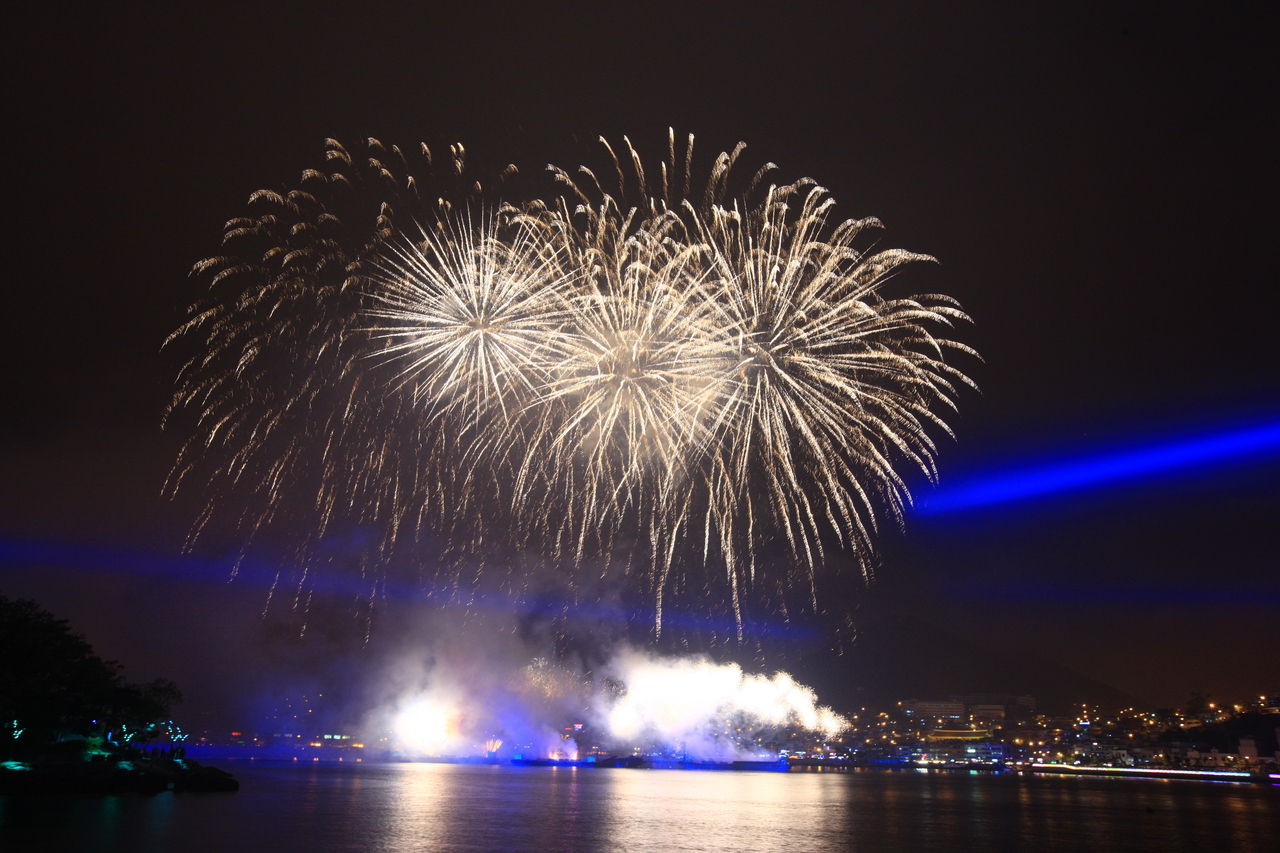
Until 1 November 2026: the Mulbit Yeonhwa light-and-water show runs Wednesday to Sunday at 19:00, 19:30 and 20:00 (16 minutes). Tickets for the Chundangji zone are ₩1,000 including palace entry, sold first-come on Ticketlink (400 per show, ages 7+); the glasshouse area is open with a normal ticket. Shows may be cancelled if 3 mm or more of rain is forecast.
Kingdom (Netflix). Seoul city's official media channel lists Changgyeonggung, including Tongmyeongjeon hall, among the drama's filming spots.
Evening and date ideas
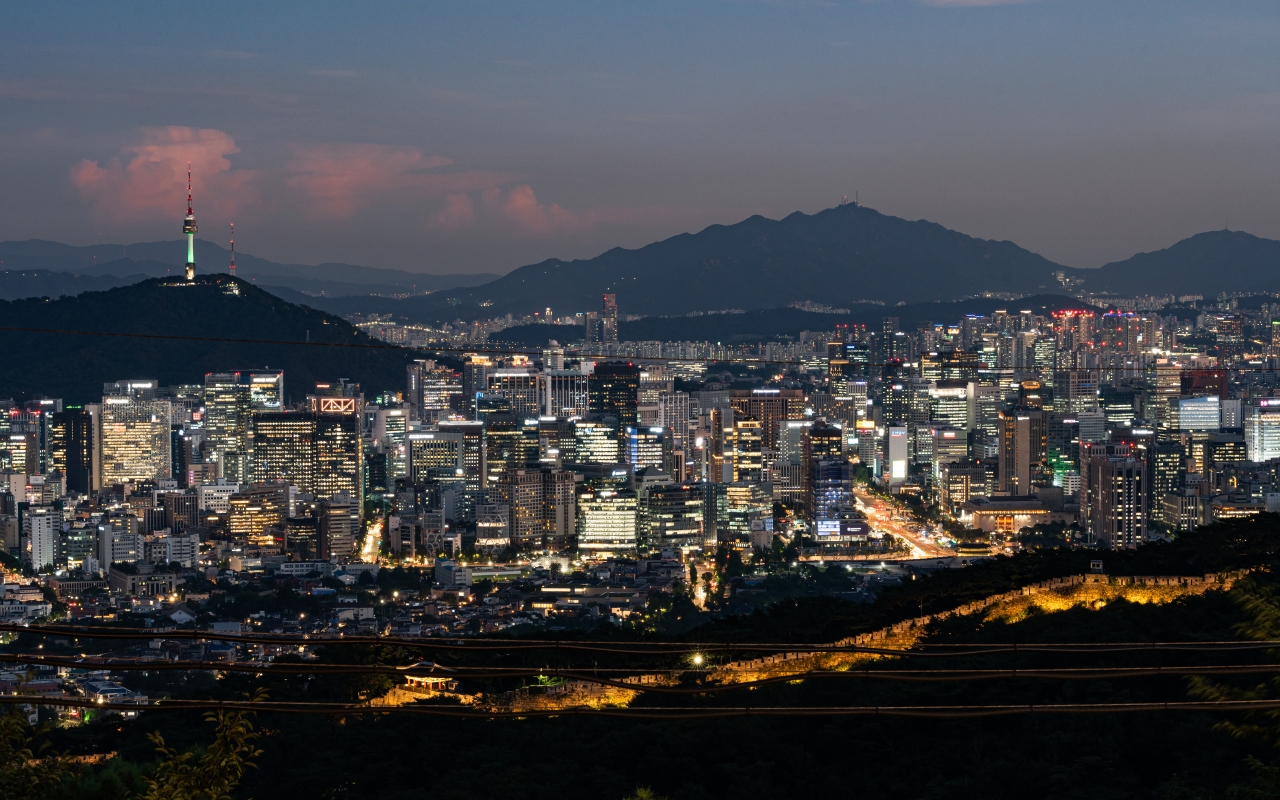
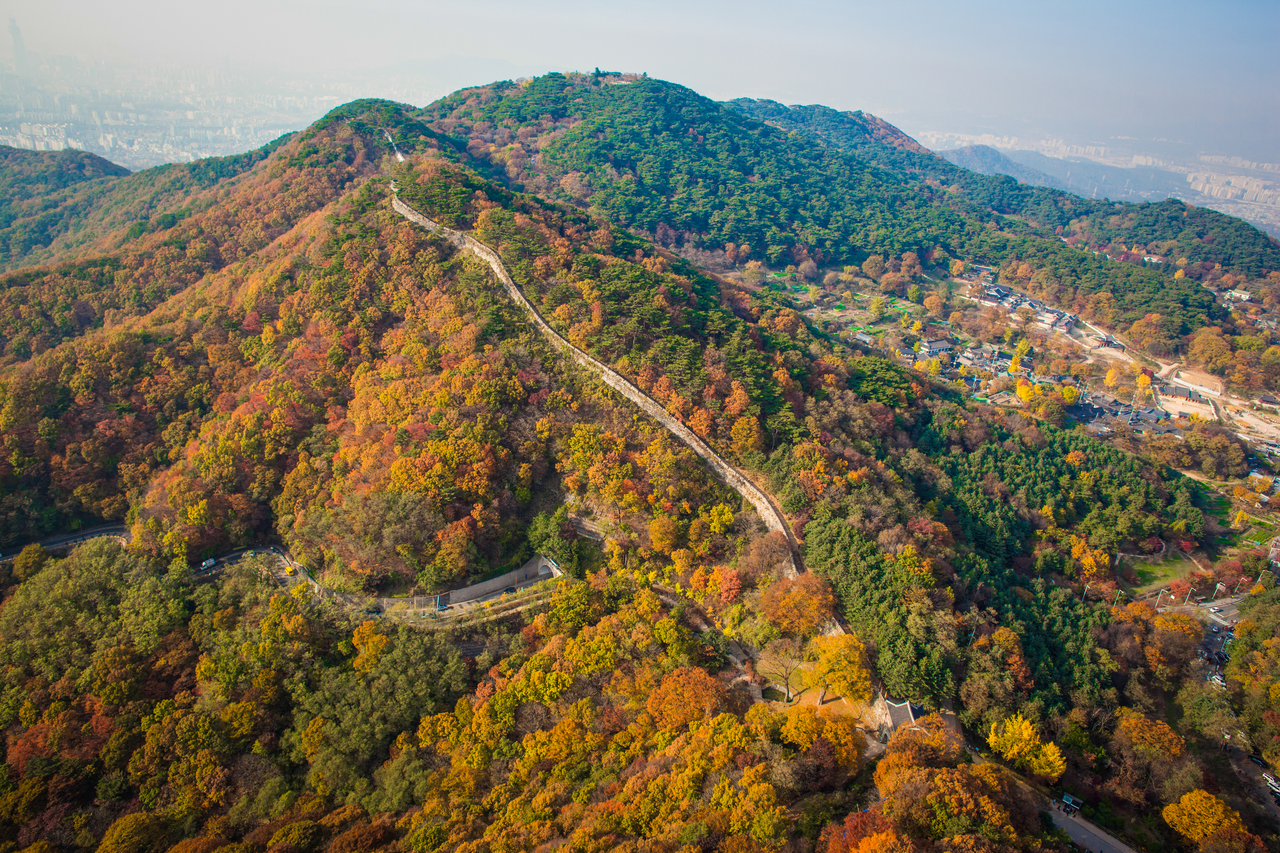
- Naksan Park and the City Wall — from Changgyeonggung, about 25–30 minutes on foot via Hyehwa Station. The lit fortress wall above the city lights is one of Seoul's best-loved night walks for couples.
- Unhyeongung — the house where King Gojong grew up and married Queen Min; free, and open until 21:00 (Tue, Wed, Fri–Sun) until 29 November 2026. About 7 minutes west of Donhwamun.
- Ikseon-dong — hanok cafés and restaurants that stay busy into the evening.
- Cheonggyecheon — the restored stream from Cheonggye Plaza, with light art from 19:00 to 21:00 (Mar–Nov).
- MMCA Seoul — the national modern art museum is open until 21:00 on Wednesdays and Saturdays, and free after 18:00.
- Gwangjang Market — food alley open until 23:00, about 20 minutes south of Changgyeonggung. Read the warning below first.
More places nearby
| Place | Why go | Hours · fee |
|---|---|---|
| Gwanghwamun Square in front of the palace | Statues of King Sejong and Admiral Yi, with free underground exhibitions about both. Redesigned in 2022 with excavated Joseon remains on show | Square 24 h, free Exhibitions 10:00–18:30, closed Mon |
| Seochon west of the palace | Old lanes, Tongin Market, Daeo Bookstore (said to be Seoul's oldest bookshop) | Market 07:00–21:00 |
| Samcheong-dong east wall of the palace | Free art galleries and cafés along the palace wall | Shops vary |
| Insadong · Ssamziegil near Anguk | Craft shops; the spiral Ssamziegil building sells real handmade goods (main-street souvenirs are often imported) | Ssamziegil 10:30–20:30 |
| Jongmyo Shrine south of Changgyeonggung | UNESCO-listed royal ancestral shrine, strikingly plain and long | ₩1,000, closed Tue; Mon, Thu, Fri guided only; Wed free |
| Cheong Wa Dae behind the palace | Closed to visitors since 1 Aug 2025; the presidential office moved back. A partial reopening is being planned for 2027 | Not open |
Experiences
- Free English tours at every palace (times in the table above). Visitors consistently say the guides tell you far more than the signs.
- Hanbok — see “Renting a hanbok.”
- National Palace Museum — free; royal seals, court paintings, the water clock and the emperor's cars.
- National Folk Museum — free; English tours Mon and Fri 10:30 and 14:30, Wed 14:30, Thu and Sun 10:30. The children's museum is free but needs online booking.
- Bukchon Traditional Crafts Experience Center — since May 2026, 46 short workshops by 16 craftspeople (knot-work, lacquer and mother-of-pearl, dancheong coasters, pottery), booked through Seoul's public reservation site.
- Seoul Museum of Craft Art by Anguk Station — free, no booking; open until 21:00 (Tue, Wed, Fri–Sun) until 30 November 2026.
- “A Day of the Crown Prince” at Changdeokgung's Seongjeonggak — Sundays 11:00, 13:00, 15:00, 10 people per session, until 8 November.
- Royal food — see “What the kings ate” below.
What the kings ate
A Joseon king's everyday meal, surasang, was served on several tables with rice, soup and twelve side dishes, cooked in palace kitchens called sojubang. Gyeongbokgung's restored kitchens now host seasonal food programs (in 2026 a tasting program ran in May, and an autumn night walk with a royal-style lunchbox ended in late October). They sell out fast and change every season, so watch the Korea Heritage Agency's announcements. The Institute of Korean Royal Cuisine, a short walk west of Changdeokgung, runs cooking and tasting programs by reservation; its 2026 prices and English availability were not published when we checked.
Parking, transport and apps
Gyeongbokgung has a car park on the Samcheong-ro side, just past Gwanghwamun (06:00–23:00, about 240 car spaces underground and 50 for buses). Cars pay ₩3,000 for the first hour, then ₩800 per 10 minutes; the first 10 minutes are free. Changdeokgung has no car park, and Changgyeonggung's car park is closed until the end of 2026 for restoration work. Public car parks near Jongmyo and Sejong-ro exist, but weekend traffic around the palaces is heavy: the subway is easier.
- Maps: install Naver Map or KakaoMap. Google Maps shows places but gives only limited directions in Korea.
- Taxis: Kakao T and K.Ride (Kakao's app for foreign visitors) accept foreign cards. Check the meter is running; Seoul taxi receipts now include English.
- Transit card: a T-money card works on the subway, buses and most taxis. Seoul's Climate Card also sells short-term passes for unlimited city transit.
How much does the day cost?
Per adult, for the route above plus one night nearby. US dollar figures use ₩1,325 = US$1 (22 October 2026).
| Item | Budget | Mid / Comfort |
|---|---|---|
| Palace tickets | ₩5,000–₩11,000 (only the Secret Garden on a free Wednesday or in hanbok; Pass + garden otherwise) | ₩11,000 (Integrated Palace Pass ₩6,000 + Secret Garden ₩5,000) |
| Subway | ₩3,100 (2 rides) | ₩3,100 |
| Meals | about ₩19,000 (kimchi-jjigae set + kalguksu) | about ₩33,000 (bibimbap + samgyeopsal 200 g) |
| Night show | ₩1,000 (Mulbit Yeonhwa, until 1 Nov) | ₩1,000 |
| Hotel, 1 night (room price; halve it if two share) | from about ₩65,000–₩100,000 | mid about ₩190,000–₩215,000 comfort from about ₩245,000 |
| Total | about ₩93,000–₩134,000 (US$70–101) | mid about ₩238,000–₩263,000 (US$180–199) comfort from about ₩293,000 (US$221) |
Hanbok rental is extra (see above). Hotel figures are the lowest prices Klook listed for hotels around Insadong and Anguk on 22 October 2026; real prices depend on your dates. Integrated Palace Pass: ₩6,000, valid 6 months, one entry each to Gyeongbokgung, Changdeokgung (halls), Changgyeonggung, Deoksugung and Jongmyo; it does not include the Secret Garden.
Where to stay
Insadong and Anguk sit exactly between the two palaces, so you can walk to both and come back after the night show without a taxi.
Why: ending a day of palaces in a hanok room fits this route; it is within 1 km of Anguk-dong-ro.
See prices on Klook
Why: under 500 m from Anguk-dong-ro, so both palaces are walkable.
See prices on Klook
Why: about a 7-minute walk from Anguk Station; useful for families or longer stays.
See prices on Klook
Distances and ratings as shown on Klook, 22 October 2026. These are affiliate links: if you book, Korea Routes may earn a small commission at no extra cost to you.
Watch out
- Closed days differ. Monday: Gyeongbokgung is open, Changdeokgung and Changgyeonggung are not. Tuesday: the reverse (Jongmyo is also closed on Tuesdays).
- The Secret Garden sells out, especially in October and November. Book the moment online booking opens.
- Hanbok gets you into the palaces free, but not the Secret Garden.
- Foreign-language tours are for foreign visitors. Korean friends can join as up to two companions.
- Geunjeongjeon's raised stone terrace is closed to visitors until 31 October 2026, to protect the stone railings during the busy season.
- Outdoor ceremonies can be cancelled in extreme heat or heavy rain.
- Gwangjang Market: its food alley is famous, and so are its overcharging cases. Since 2023, stalls have been suspended for charging foreigners more, for example ₩2,000 for a bottle of water in April 2026. Prices and portion weights must now be posted, and since June 2026 every street stall is registered by name, with removal after repeated violations. Check the posted price before you order and refuse anything added that you did not ask for.
Outdated tips you will still find online
| You may read | Correct in 2026 | Source |
|---|---|---|
| Integrated Palace Pass ₩10,000, 3 months, includes the Secret Garden | ₩6,000, 6 months, Secret Garden not included | royal.khs.go.kr |
| Book the Secret Garden online, pay at the gate | Payment is online; unpaid bookings are cancelled | Booking site, visitor reports |
| Guard ceremony every hour on the hour | 10:00 and 14:00, not on Tuesdays | Korea Heritage Agency |
| Visit the Blue House after Gyeongbokgung | Closed since 1 Aug 2025 | Visit Seoul |
| Any hanbok gets free entry | Jacket + separate skirt or trousers; one-piece fusion dresses may be refused | royal.khs.go.kr |
FAQ
Can I see Gyeongbokgung and Changdeokgung in one day?
Yes. They are 1.7 km apart. Spend the morning at Gyeongbokgung and the afternoon at Changdeokgung, with a Secret Garden tour booked for 14:30 or 15:30, then finish at Changgyeonggung.
Which palace if I only have time for one?
Gyeongbokgung for scale, the guard ceremony and its museums; Changdeokgung if you want the Secret Garden and a quieter, more natural setting.
Is the Integrated Palace Pass worth it?
If you visit three palaces on a normal day it costs less than separate tickets (₩6,000 vs ₩7,000) and stays valid for 6 months for Deoksugung and Jongmyo. On a Wednesday or during the free festival period you may not need it.
Is it respectful for foreigners to wear hanbok?
Yes. Koreans generally welcome it, and free entry exists to encourage it. Wear it properly rather than as a costume, and follow the dress rules.
Is there an English tour?
Yes, free with your ticket: Gyeongbokgung at 11:00, 13:30 and 15:30; Changdeokgung halls at 10:15 and 13:15; Changgyeonggung at 11:00 and 15:00. The Secret Garden is always guided and must be booked.
Sources (checked 22–23 October 2026)
Korea Heritage Service royal palaces website (royal.khs.go.kr) for hours, fees, tours, hanbok rules and the Integrated Palace Pass; Korea Heritage Agency (kh.or.kr) for the guard ceremony and night programs; Encyclopedia of Korean Culture (encykorea.aks.ac.kr), National Archives of Korea and Seoul Metropolitan Government media for history; National Palace Museum (gogung.go.kr) and National Folk Museum (nfm.go.kr); Visit Seoul and Seoul Metropolitan Government for nearby places, Bukchon and Gwangjang Market measures; Korea Times, YTN, The Fact, Edaily and Seoul Shinmun for filming locations and news. Visitor tips are summarised from travel guides and blogs and checked against official information. Seoul Metropolitan Government for the Bukchon special management zone; price.go.kr (Korean government price portal) for Seoul meal prices, September 2026; European Central Bank reference rate for the exchange rate. Photos: Korea Tourism Organization photo gallery; none were taken in 2026.


Comments
Post a Comment