



















Yu Gwan-sun: The Girl of 1919, Her Trial, Films and Places
At about one o'clock on the afternoon of 1 April 1919, market day in Aunae, a small town in the hills south of Seoul, some three thousand people filled the market square and began to shout for Korean independence. Many held paper flags that a sixteen-year-old schoolgirl had drawn by hand over the previous fortnight. Japanese military police fired into the crowd and used bayonets. Nineteen people died that afternoon, among them the girl's father and mother. She grabbed the barrel of a gendarme's rifle to stop him firing and was bayoneted in the side. Then she was arrested.
This is the story of Yu Gwan-sun (유관순, 柳寬順; also written Ryu Gwan-sun or Yu Kwan-sun), the face in the prison photograph that every Korean child knows: how a scholarship girl at a mission school in Seoul carried the news of the 1919 uprising home, what the Japanese court actually sentenced her to, the cell she shared with six other women and the song they made there, how she died at seventeen and how her body was lost, what was added to her story after 1945 and what the documents really say, how the New York Times, the New York State Assembly and Japan see her, the films and the songs, and the places in Seoul and Cheonan where you can follow her. Tap a tab or open a story to read more.
Who: a Korean schoolgirl who helped organise the independence demonstration at Aunae market on 1 April 1919 and died in Seodaemun Prison on 28 September 1920, aged 17
Lived: 1902–1920. Born in a Protestant farming family near Cheonan; a scholarship student at Ewha Haktang, Korea's first school for girls, from about 1915
Known for: the signal fire on Maebong-san the night before the market · the flags she drew · refusing to appeal her three-year sentence · the prison-cell song Korea Lives On · the only person to hold both the 1962 and 2019 grades of Korea's independence medal
See her in Seoul: cell no. 8 of the women's block at Seodaemun Prison History Hall (closed Mondays) and her old school in Jeong-dong
See her at home: the memorial hall, shrine and rebuilt birthplace at Byeongcheon, Cheonan, a day trip south of Seoul by KTX and bus or taxi (free, open every day)
Watch first: A Resistance (2019), the black-and-white film of her year in prison, with Go Ah-sung
Checked 29 October 2026 with the sources at the end.
In this guide
- Map: where to follow her in Seoul
- Her life in one table
- The market day: before, during and after
- The courts and the prison
- What the documents say, and what was added later
- What America, Japan and the world say
- Stories from her life
- On screen, on stage and in song
- Places to follow her
- Watch out, and outdated tips
Map: where to follow her in Seoul
The map shows the five Seoul sites: the prison where she died, the school and the church of her funeral in Jeong-dong, the hillside park above her lost grave in Itaewon, and the joint grave in Mangu-ri where her remains most likely went. Her home town, Byeongcheon in Cheonan, is a long day trip south and has its own tab below. Tap a number for its name.
Map © OpenFreeMap, data © OpenStreetMap contributors. Use Naver Map or KakaoMap for directions in Korea.
Her life in one table
She was born on 16 December 1902 in a hill village called Jiryeong-ri, in what is now Byeongcheon, on the eastern edge of Cheonan. Her father, Yu Jung-gwon, kept the Confucian family rites but sent his children to church and to school; her uncle led the village church, and in 1907 eighty-two of its members, her uncle and the neighbour Jo In-won among them, gave money to the national campaign to repay Korea's debt to Japan. She was the second daughter of five children. Around 1915 a Methodist missionary, Alice Sharp, recommended her for a scholarship at Ewha Haktang in Seoul, the school for girls that an American missionary had founded in 1886, and she entered its primary course; in April 1918 she moved up to the higher course. She was sixteen when the uprising of 1 March 1919 began.
| Date | What happened | Where you can see it |
|---|---|---|
| 16 Dec 1902 | Born in Jiryeong-ri, now Yongdu-ri in Byeongcheon, Cheonan, into a Protestant farming family | Rebuilt birthplace and Maebong church, Byeongcheon |
| c. 1915–16 | Enters Ewha Haktang in Seoul on a scholarship, recommended by the missionary Alice Sharp | Ewha Girls' High School, Jeong-dong; memorial hall, Byeongcheon |
| 1 Mar 1919 | Joins the Seoul demonstrations with classmates; on 5 March, the students' march at Namdaemun station, where she is held briefly and released | — |
| 13 Mar 1919 | Schools closed; goes home by train with her cousin Yu Ye-do, carrying the Declaration of Independence | Memorial hall, Byeongcheon |
| 31 Mar 1919 | Lights a signal fire on Maebong-san the night before market day | Beacon tower on Maebong-san |
| 1 Apr 1919 | Aunae market demonstration: about 3,000 people; 19 killed, including her parents, and some 30 badly wounded; she is bayoneted and arrested | Aunae market and memorial park; shrine of the fallen, Byeongcheon |
| 9 May 1919 | Gongju district court: five years for rioting and breach of the Security Law | — |
| 30 Jun 1919 | Gyeongseong appeal court cuts it to three years; she alone does not appeal further | Judgment shown at the memorial hall; original at the National Archives |
| 1 Mar 1920 | Leads a cry of independence from cell no. 8 on the first anniversary, and is beaten | Women's block, Seodaemun Prison |
| 28 Apr 1920 | Sentence cut to a year and a half in an amnesty for the crown prince's wedding; release due 2 January 1921 | — |
| 28 Sep 1920 | Dies in Seodaemun Prison at about 8:20 in the morning, aged 17 | Seodaemun Prison History Hall |
| 12–14 Oct 1920 | Body released to Ewha after two weeks of pressure from its American principals; funeral at Chungdong church; buried in Itaewon public cemetery without a stone | Chungdong First Methodist Church; Itaewon Bugundang History Park |
| mid-1930s | The cemetery is cleared and her grave is lost; unclaimed remains are cremated and buried together in Mangu-ri | Mangu-ri joint grave and marker |
| 1947 | A memorial society is founded; the first memorial stone at Aunae is unveiled, with a eulogy sent by Kim Ku; a biography and a film follow in 1948 | Memorial park, Aunae |
| 1962 · 2019 | Awarded the Independence Medal (third grade); in 2019, on the centenary, the Republic of Korea Medal (first grade) is added | Memorial hall, Byeongcheon |
| 1989 | A tomb for her spirit, without remains, is built on Maebong-san | Maebong-san |
The market day: before, during and after
The uprising of 1 March 1919 began in Seoul with a declaration of independence read in a park and crowds shouting manse, "long live", in the streets. Yu and her classmates joined the marches on the first day and again on 5 March at Namdaemun station, where she was picked up by the police and soon let go. On 10 March the colonial government closed the schools. On the 13th she and her cousin Yu Ye-do, who was in the same dormitory, took the train home with a copy of the declaration.
At home she told her father, her uncle and a neighbour, Jo In-won, what she had seen in Seoul, and the village decided to hold its own demonstration on the next big market day, the first day of the third lunar month, which fell on 1 April. For a fortnight she went from village to village with a towel over her head, persuading people to come, while she and Ye-do drew Korean flags at night. The plan itself, a 2019 Seoul Shinmun history series notes, was drawn up by a local school teacher, Kim Gu-eung, and on the day it was Jo In-won who led the crowd; her part was to carry the news, draw the flags and light the fire. On the night of 31 March she climbed Maebong-san, the hill behind the village, and lit a signal fire, and the surrounding villages answered with fires of their own.
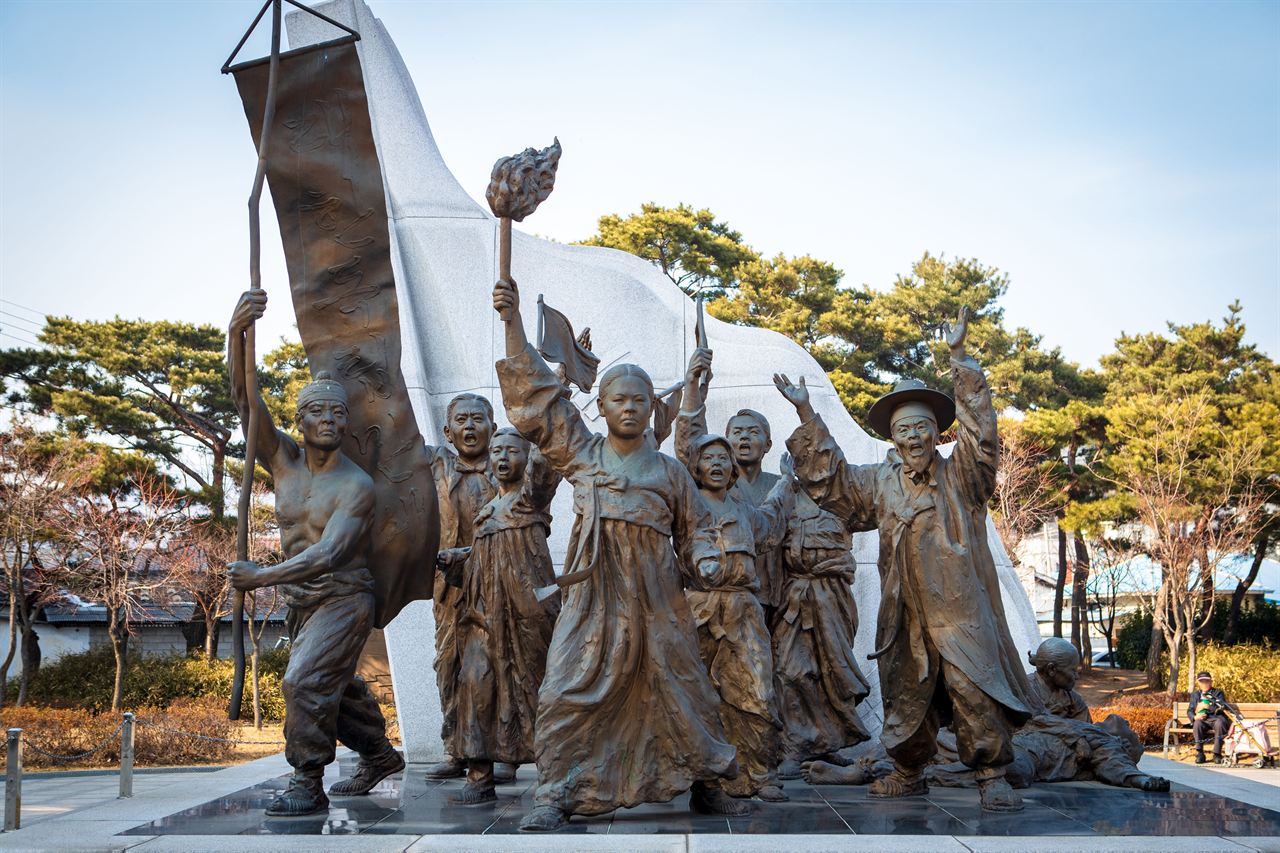
By the court's own record there were about three thousand people in Aunae market at one o'clock on 1 April. Jo In-won led the shouting. Japanese gendarmes from the post fifty paces away ordered the crowd to disperse, then fired and used their bayonets. The judgment of the appeal court, which still exists, counts nineteen dead on the spot and about thirty badly wounded; a government list compiled in 1953 names twenty from that place and day. The teacher Kim Gu-eung was killed, and so was his sixty-six-year-old mother. Yu's father was shot. Her mother was killed when she protested.
What Yu did next is in her own testimony to the court: she took hold of a gendarme's rifle to stop him firing, and was stabbed in the side with a bayonet. The veterans ministry's account adds that she carried her father's body to the gendarme post to protest. Her uncle Yu Jung-mu, with some forty villagers, carried his dying brother on his back to the post. The crowd was broken up after four o'clock. She was arrested that day, taken to the gendarmerie in Cheonan and tortured; there, the official accounts say, she told them she was the leader and demanded that the others be released. On the same day, in Gongju, her elder brother Yu U-seok was arrested for leading a demonstration at his own school.
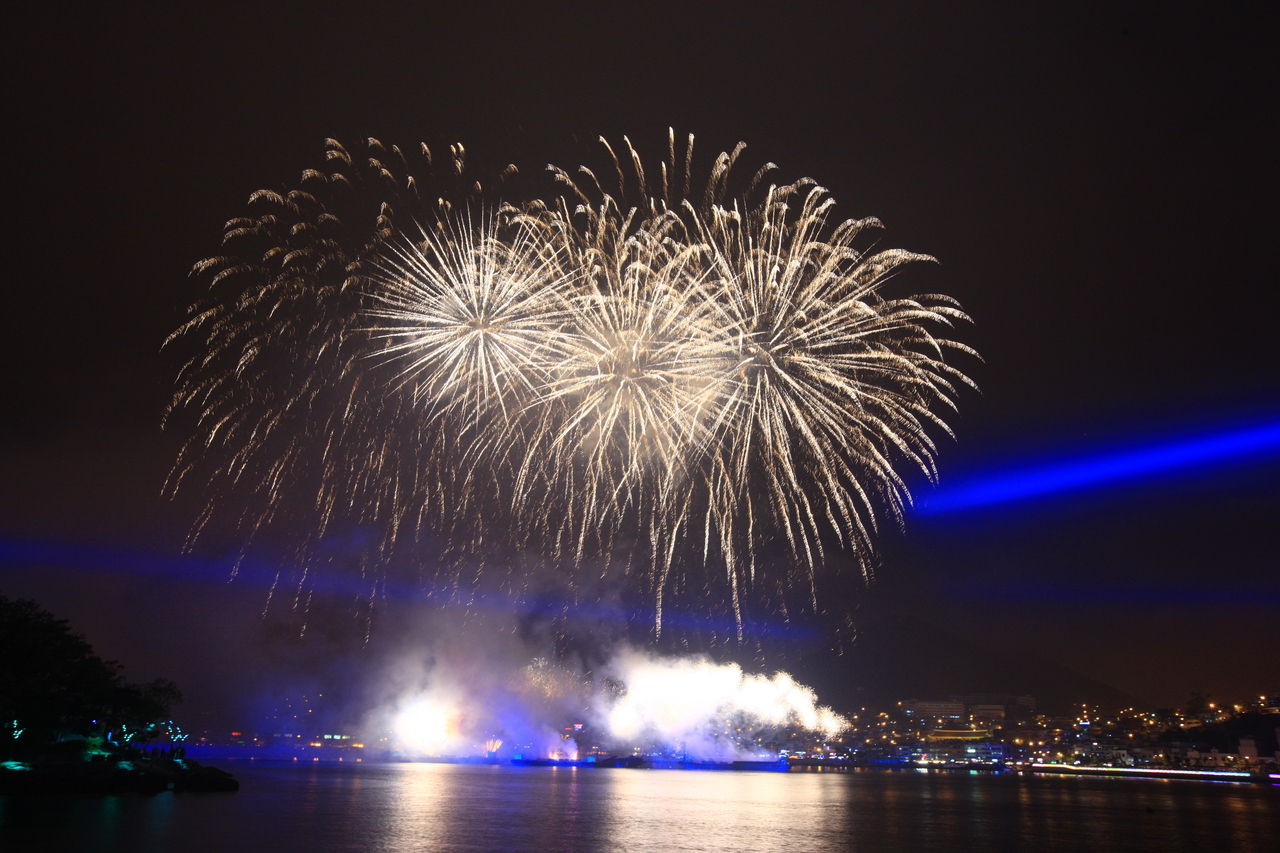
The town has remembered the day ever since. In November 1947 a memorial stone was unveiled on a hill above the market, and Kim Ku, the head of Korea's wartime government in exile, sent a eulogy; the handwritten original was restored by the National Archives in 2021. In 2009 the site of the gendarme post itself became a memorial park with bronze figures of the crowd. Every year since 1978, on the last day of February, the town holds the Aunae Beacon Festival: a fire on Maebong-san, a torch march of about 1.4 km from the historic site to the memorial park behind a giant flag, and fireworks; in 2026 it was on 28 February, with rites at the shrine at five and the ceremony and torch march at a quarter to six. And every 28 September there is a memorial at her shrine.
Her family paid for the day for years. Her parents were dead; her brother was in prison; her two small brothers were orphans. In the autumn of 1919 a young teacher named Jo Hwa-byeok, herself an activist from the March uprising in Gaeseong, came to the school in Gongju and took the two boys in. In 1923 she married Yu U-seok. Both were later decorated for their own part in the independence movement.
The courts and the prison

On 9 May 1919 the district court in Gongju sentenced her, her uncle and Jo In-won to five years each for "rioting" and breach of the Security Law. That judgment itself has not survived; the sentence was confirmed only in 2007, when a researcher found the court's register of criminal cases in the National Archives. Until then, the memories of her fellow prisoners had put it at six or seven years, and the higher figure is still repeated.
They appealed, and on 30 June 1919 the appeal court in Seoul cut the three sentences to three years. The judgment survives, with a Korean translation online at the National Archives: eighteen years old, of Yongdu-ri in Cheonan county, charged with rioting and breach of the Security Law; the flag she had drawn was confiscated by the court. At the gendarme post on the day of the market, a 2009 archives exhibition recorded, she said she had done a just thing to recover her country and asked why they had used weapons of war to kill her people. When the others took their case to the high court, she alone did not. The memorial society's publications give her reason in a sentence Koreans still quote: "Where in these three thousand li is not a prison?" The high court rejected the others' appeals on 11 September.
She was moved to Seodaemun Prison in Seoul for the appeal and stayed there. After the uprising the prison held about three thousand people, six times its capacity. In the women's block she shared cell no. 8 with six other women who had been arrested for the same cause: Eo Yun-hui, Gwon Ae-ra, Sin Gwan-bin, Im Myeong-ae, Sim Myeong-cheol, who was blind, and Kim Hyang-hwa, a gisaeng entertainer. Eo Yun-hui, who spent a year in the cell with her, remembered her afterwards as a tall, sturdy girl.
On 1 March 1920, the first anniversary, at two in the afternoon, a cry of independence went up from cell no. 8 and spread through the prison; the official histories say the whole prison answered. For that she was beaten by the guards, badly enough, the veterans ministry and the Cheonan memorial say, to rupture her bladder. The women made a song in the cell, now known by its refrain, "Korea lives on". No tune survives. Sim Myeong-cheol's son had written down the words as a schoolboy, listening to his mother sing them, and kept the page for 65 years; in 2019 they were published, and two composers set them, and the version by Jung Jae-il, sung by Park Jung-hyun with narration by the skater Kim Yuna, was sung at the centenary ceremony on 1 March 2019. In August that year the old man sang it himself at the presidential residence.
On 28 April 1920 an amnesty for the wedding of Korea's former crown prince cut her sentence to a year and a half; she was due out on 2 January 1921. She died in the prison at about twenty past eight on the morning of 28 September 1920. She was seventeen; Korean sources usually say eighteen. The veterans ministry's account is that the bladder injury was never treated and that she died of the after-effects of beatings and torture, and of malnutrition; the standard Korean encyclopedia says the direct cause was never established; the government's 1953 list of those killed in the uprising records simply that she was "beaten to death in prison".
The prison would not release the body. The two American principals of Ewha, Lulu Frey and Jeannette Walter, pressed for it for two weeks, English-language accounts say with a threat to make the torture public, and on 12 October it was handed over on condition of a quiet funeral. The students laid it in the gatehouse; a doctor from Severance hospital prepared it. The funeral was at Chungdong First Methodist Church on 14 October, and she was buried in the public cemetery at Itaewon without a stone. In the mid-1930s the cemetery was cleared for development and her grave was lost; the city of Seoul's account is that some 28,000 unclaimed graves were cremated and reburied together at Mangu-ri on the eastern edge of the city, and a marker for her now stands beside that joint grave. In 1989 her home town built her a tomb for the spirit, with no remains, halfway up Maebong-san.
What the documents say, and what was added later

Almost nothing of her story was written down while she lived, and for twenty-five years after her death almost no one wrote about her at all; the standard history of the uprising published in 1920 names the teacher Kim Gu-eung at Aunae and not her. What is documented is this: her prisoner record card, with the two photographs in prison dress that every Korean knows, one of 6,264 cards found in a police storeroom in the early 1980s, now held by the National Institute of Korean History, registered as cultural heritage in 2018 and shown in the original for the first time in July 2025; the appeal court's judgment of 30 June 1919; the register that gives the first sentence; the family register that gives her dates; the government's 1953 list of the dead; and the memories of the women of cell no. 8.
The rest came after 1945. In 1947 two women of the Ewha circle who had made careers under the Japanese took up her memory; a memorial society was founded that autumn, a biography by the pastor and novelist Jeon Yeong-taek and a film by Yun Bong-chun followed in 1948, and both told the story as a Christian martyrdom, with the tortures enlarged. Korean historians since 2009 have traced how the "symbol of the uprising" was built, and some have argued that the invented parts have done her a disservice: that a girl who was arrested, tortured and died in prison at seventeen needed nothing added. On the other side, a 2017 book claiming she never existed was answered by the record card, the judgment, the register and the photographs, and lost in two courts. The table sorts the stories you will meet.
| The story | Verdict | Why |
|---|---|---|
| She threw a stool at the judge and got seven years for contempt | False | Five years at first instance, three on appeal, cut to eighteen months in 1920. The seven comes from a fellow prisoner's memory; no stool is in any record |
| She led the Aunae demonstration on 1 March 1919 | Half true | The date was the first of the third lunar month, which was 1 April; she was one of several organisers |
| She died on 12 October 1920, aged 19 | False | 12 October is the day the body was released. She died on 28 September, at 17 |
| She died two days before her release | False | Release was due on 2 January 1921, three months later |
| Her body came back in six pieces | False | A rumour of the late 1940s. Jeannette Walter, who dressed the body for burial, said on tape in 1959 that it was not mutilated, a 2003 history records, and the family says her brother found it whole |
| She was kept for months in an underground cell | No evidence | The prison museum's own website says the story that she was held in the basement has no basis |
| Her last words: "Even if my fingernails are torn out … my only sorrow is that I have but one life to give for my country" | No contemporary source | The passage is carved on memorials in Seoul and quoted abroad, but no letter, visitor's note or cellmate's account records it; it first appears in post-war commemorative writing |
| She was 169 cm tall | Disputed | The height on her record card is read two ways; the only agreement is her cellmate's word that she was tall |
| She was tortured to death | Supported | The official account is injuries from beatings and torture, untreated, with malnutrition; the 1953 list says beaten to death |
| Her name is really Ryu, not Yu | A spelling, not a fact | For some years before 2014 the memorial society used Ryu, then went back to Yu, which is the official form |
Two grades of one medal
In 1962 she was given the Independence Medal, the third of five grades of Korea's order of merit for the founding of the nation. For decades Koreans asked why the symbol of the uprising ranked below men whose names few remembered, and the answer was that the law does not allow a decoration, once given, to be raised, or the same deed to be decorated twice. On 26 February 2019, three days before the centenary, the cabinet found a way: it decorated her again for a different deed, her service after death as a symbol that had united the nation and taught its values. On 1 March 2019 her family received the Republic of Korea Medal, the first grade, at the centenary ceremony in Gwanghwamun square. She is the only person to hold both.
What America, Japan and the world say
In 1919 the Western press reported the uprising from Seoul and Pyongyang and the massacre at Jeam-ri; foreign papers of the time do not seem to have named her or her market town. Her name crossed the ocean late. The first English book to use the phrase "this Korean Joan of Arc" seems to be Dictée (1982) by the Korean-American artist Theresa Hak Kyung Cha, which opens a chapter with her photograph. The phrase went round the world in a Bloomberg article in November 2014 about a quarrel over Korean textbooks.
On 28 March 2018 the New York Times gave her an obituary in its "Overlooked" series for people the paper had failed to notice when they died, under the line "Dying in prison at 17, she became a national hero", and in March 2026 it listed her among 104 women who shaped history. In January 2019 the New York State Assembly and Senate passed a resolution for the centenary of the uprising that honours her as "one of the youngest female human rights movement leaders"; the Korean community in New York calls 1 March "Yu Gwan-sun Day" after it, though the resolution does not use the phrase. In the United States House of Representatives a resolution introduced on 28 February 2019 by Grace Meng and Andy Kim named her in four clauses and cited the Times obituary. Since 2019 a Korean-American museum and Nassau County on Long Island have given a Yu Gwan-sun Award to local high-school students for essays on courage and justice; the seventh was presented in March 2026. There is still no statue of her outside Korea; a Korean-American women's society in Los Angeles began raising money for one in November 2025.
Japan does not deny the day. Its standard encyclopedias, under the uprising, list "the Cheonan incident: on 1 April twenty demonstrators were shot dead at Byeongcheon market" and add that "Yu Gwan-sun was arrested and died in prison". But she is not a public figure there, and Japan's main newspapers have written almost nothing about her. The few Japanese who have include a communist daily and an anti-war children's author, Saotome Katsumoto, who published The Blue Sky of Yu Gwan-sun for parents and children in 1995; a Japanese history paperback on the uprising and Newsweek Japan, in 2014, also mention her. Japan's national library lists her with the wrong dates. The official Japanese name for the uprising in 1919 was the "Korean riots"; today's dictionaries call it the March First Independence Movement.
Unlike Ahn Jung-geun, whose shooting of Itō Hirobumi China claims as part of its own resistance, she is almost absent from the Chinese press, and the Chinese Wikipedia entry gives a seven-year sentence alongside the three and a wrong birthday. The comparison with Joan of Arc, said to go back to the memorial campaigns of the late 1940s, has one flaw worth knowing: Joan was executed; Yu was not sentenced to death and died of what was done to her in prison. An episode of Mysteries of the Abandoned about Seodaemun Prison, shown on Science Channel in November 2023, used the phrase anyway.
Two missionaries carry her story abroad. Alice Sharp, born in Canada and sent to Korea by the American Methodist women's mission in 1900, is said to have taken the girl under her wing, taught her at the mission school in Gongju and sent her to Ewha; a memorial room to Sharp opened at Mokwon University in 2022, and the school in Gongju has statues of the two of them together. Jeannette Walter of Ewha, who dressed the body, went home to teach high school in Kansas and, visiting Korea in 1959, recorded her account for the school.
Mocked online, and why Koreans react as they do
Her prison photograph, taken after torture, has been a target. In May 2021 two streamers joked about her in a sexual context on a live show and were suspended for ninety days. In February 2026 clips made with AI tools animated the photograph to have her break wind in a restaurant and fly off as a rocket; they passed 200,000 views, the broadcasting standards commission asked the platforms to take them down, and a descendant said it was "like being stabbed with a knife". In the spring of 2026 other posts drew her and Ahn Jung-geun as a couple. None of this has been prosecuted, because Korea's insult law protects only the living, and in April 2026 a lawmaker proposed a ban on content that mocks independence fighters. The cases, and the law, are set out in the Ahn Jung-geun guide.
Stories from her life

Thirty-six flags (February 1919)
On 28 February, when the students had decided to act, she and four others formed what they called a "squad of five", and on a night shortly before 1 March, the Cheonan memorial records, she and a classmate, Yi Jeong-su, made Korean flags in the school hall and pinned one in each of the thirty-six rooms of the Ewha dormitory. The five wept outside the palace gate for the dead former emperor and then joined the marchers.
The towel and the fires (March 1919)
For a fortnight after she came home she walked the villages around Aunae with a towel over her head, the way countrywomen did, telling people what had happened in Seoul and when the market day would be. Her cousin Ye-do was to be the messenger but was not strong, so she took that over too. On the night of 31 March she climbed Maebong-san and lit a fire; one account says fires answered from twenty-four hills. A tower stands on the summit now, and every February the town lights the fire again.
The rifle and the body (1 April 1919)
Her own words to the appeal court are the only first-hand account of what she did in the square: she seized a gendarme's rifle to stop the firing and was bayoneted in the side. The veterans ministry's biography adds that she carried her father's body to the gendarme post and that under torture at Cheonan she insisted she was the leader and the others should go free. Her uncle, who carried his dying brother on his back to the same post, was sentenced beside her.
The appeal she did not make (summer 1919)
Eleven people from Aunae were tried together. Ten of them took their case to the high court in Seoul and lost in September. She did not. The encyclopedia says she refused to recognise the Japanese courts; the memorial society gives her the sentence about three thousand li of prison. The sentence has outlived the appeal.
The song in cell no. 8 (1919–20)
Of the seven women in the cell, the one who remembered the song was Sim Myeong-cheol, who was blind, had studied at Hosudon girls' school in Gaeseong and lived to 1983. Her son, a boy in high school in the 1950s, wrote down the verses as she sang them and kept the paper for 65 years. When the words were published in early 2019 they had no tune, so two were written for them within a week of each other: one by the singer Ahn Ye-eun, filmed in the rebuilt women's block, and one by the composer Jung Jae-il for a bank's centenary campaign, sung by Park Jung-hyun. The second was sung at the centenary ceremony on 1 March 2019, and in August that year the son, by then an old man, sang the original at the presidential residence. In 2025 the composer released a new melody and asked the public for words, and the result passed ten million views in a month.
Two weeks for a body (October 1920)
The Korean accounts name Jeannette Walter, one of Ewha's principals, as the woman who got the body back; English-language ones name Lulu Frey, the principal, and say the two of them threatened to make the torture public. The prison gave way after two weeks, on condition that there be no fuss. The students carried it to the school gatehouse and wept; a doctor from the mission hospital prepared it; the pastor of Chungdong church buried her two days later. On a visit to Korea in 1959 Walter told a group from the school on tape, according to a 2003 history of Westerners in Korea, that the body had been whole and that she had dressed it herself.
The brother, the teacher and the two small boys
Her elder brother Yu U-seok, arrested the same day for the demonstration at his school in Gongju, served six months and spent the next fifteen years in and out of colonial prisons for other causes. The two youngest children, Gwan-bok and Gwan-seok, were taken in by Jo Hwa-byeok, a teacher who had carried a hand-copied declaration from Gaeseong to her own home town on the east coast and set off a demonstration there in April 1919. She married U-seok in 1923. In 1990 both were decorated. The family graves are on a hillside at Yongdu-ri, near the rebuilt birthplace.
On screen, on stage and in song
| Film | Yu · audience in Korea | Good to know |
|---|---|---|
| A Resistance (2019) | Go Ah-sung · about 1.16 million | Not a biography but her year in cell no. 8, shot in black and white except for memories of home. The director, Joe Min-ho, said he chose black and white "to show the small emotions that break out in that space", and that he made the film after seeing the eyes in her prison photograph. Go fasted for five days before shooting. North American premiere at the New York Asian Film Festival, June 2019; screened by the Korean cultural centres in London and Los Angeles for the 80th anniversary of liberation in 2025 |
| Yu Gwan-sun (1974) | Mun Ji-hyeon | By Kim Ki-duk, the 1960s director, not the later one of the same name; from a 1970 novel. The print survives at the Korean Film Archive |
| Yu Gwan-sun (1966) | Eom Aeng-ran | Yun Bong-chun's third version; only the script survives |
| Yu Gwan-sun (1959) | Do Geum-bong | Yun Bong-chun's second version, script by the playwright Yu Chi-jin. The print survives and the Korean Film Archive has put the whole film on its YouTube channel |
| Yu Gwan-sun (1948) | — | The first, made for the memorial society and a hit in Seoul that spring; the film is lost |
Audience figure: Korean Film Council total, checked 29 October 2026. A docudrama, 1919 Yu Gwan-sun, also came out in March 2019, and a KBS special about her and a school friend, Gwan-sun and Dong-sun, was shown on Liberation Day, 15 August 2026.
Korean television returns to her every spring. tvN's history show Naked Korean History gave her an episode on 28 February 2024, from the market to the prison; MBC's travel show Crossing Lines Returns took its cast into the women's block of Seodaemun Prison on 8 March 2020. In English, Arirang TV has a special on her and an episode of Spirit of Korea that pairs her with Yun Bong-gil, and the city of Cheonan made a fourteen-minute animated film, Torch, about a Korean guard in the prison who is changed by the cry of 1 March 1920; it has English subtitles and the city has released it for free use. The American radio programme The Takeaway ran a segment on her after the Times obituary in 2018.
There is no long-running show about her as there is about Ahn Jung-geun. A family musical, My Friend Yu Gwan-sun, in which the audience waves flags and shouts manse, ran at the Gyeongbokgung Art Hall from January to April 2025 and played a single date in Seoul on 1 August 2026. An oratorio, Yu Gwan-sun Opera Cantata, was given by the Seoul city choir at the Sejong Center on 2 March 2019 for the centenary. There is no regular show about her on the 2026 listings.
Two songs about her are in print. The old one is a children's song of 1952 or 1953, words by the poet Kang So-cheon, that begins "Looking quietly up at the March sky, I think of elder sister Yu Gwan-sun"; a generation of Korean schoolchildren sang it. The new one is Korea Lives On, the cell no. 8 song in Jung Jae-il's setting of 2019, with the English title A Prayer; its video was filmed in the prison. Unlike Ahn Jung-geun, she does not turn up in K-pop. In 1982 the post office put her on a 100-won definitive stamp, issued the same day as a 200-won stamp of Ahn Jung-geun, and in 2007 she was one of ten candidates for the face of a new banknote; the choice went to Kim Ku and the painter Sin Saimdang.
 ▶
A Resistance – official trailer — Lotte Entertainment (Korean)
The distributor's trailer for the 2019 film of her year in cell no. 8.
 ▶
Torch – animated short — City of Cheonan (English subtitles)
The city's fourteen-minute animation about the prison guard who hears the cry of 1 March 1920; subtitled in English and Chinese.
 ▶
Yu Gwan-sun, an 18-year-old independence activist — Arirang TV (English)
Korea's international broadcaster's English special on her life.
 ▶
Korea Lives On (A Prayer) – official video — Glove Entertainment (Korean)
The cell no. 8 song in Jung Jae-il's 2019 setting, sung by Park Jung-hyun, filmed at Seodaemun Prison.
Places to follow her

- Seodaemun Prison History Hall, 251 Tongil-ro: the colonial prison, kept as a museum. March–October 09:30–18:00, November–February 09:30–17:00, last tickets half an hour before closing (from 1 November 2026, 16:30). Closed Mondays (the next day if the Monday is a holiday), 1 January and the days of Seollal and Chuseok. Adults 3,000 won, teenagers 1,500, children 1,000; no separate price for foreigners. Exit 5 of Dongnimmun station (line 3), 50 m. Follow the museum's route through the main exhibition building, the central hall and the cell blocks to the far corner, where the women's block stands: built around 1916, pulled down in 1979 and rebuilt on its old plans in 2011, with cell no. 8 marked as the place where the cry of 1 March 1920 began. The basement of the main building has an exhibition on the prison life of women independence fighters, running to 2030, and a special exhibition on the prison's own history runs from August 2026 to the end of 2028. There is an audio guide app; ask at the desk about English.
- Seodaemun Independence Park, around the prison: a statue of her put up in December 2021, the Independence Gate of 1897 (under repair in early 2026) and the hall of independence martyrs. On 28 February and 1 March every year the district holds a two-day festival here, with a ceremony at the memorial at 10 on the morning of the 1st and a manse march at 10:30; free.
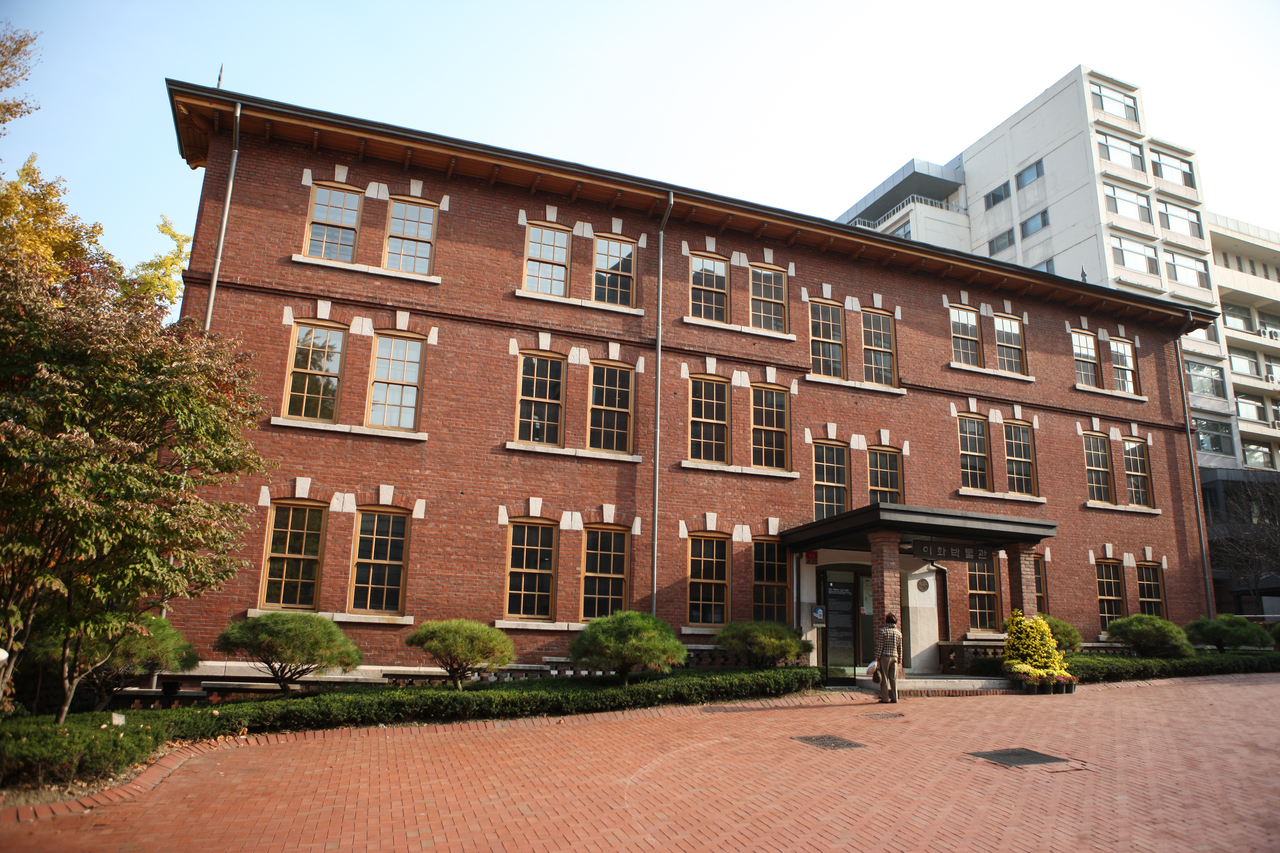
- Ewha Girls' High School, 26 Jeongdong-gil: her school, still a girls' school, in the quiet lane behind Deoksugung palace. The red-brick Simpson Hall of 1915, the oldest building on the campus, is the Ewha Museum: Tuesday–Saturday 10:00–17:00, closed Sundays, Mondays and holidays, free, no parking. The Yu Gwan-sun Memorial Hall on the campus, designated a national memorial site in August 2026, can be visited on a booked tour, at 10:00 or 14:00, not on Sundays, Mondays or holidays; book through the museum's website. A marker by the campus well, at least in past years, said she did her washing there. About ten minutes on foot from City Hall station (lines 1 and 2) or Seodaemun station (line 5).
- Chungdong First Methodist Church, 46 Jeongdong-gil, three minutes along the lane: the church of her funeral on 14 October 1920, with its Bethel chapel of 1897, a national historic site. Its history hall is open Tuesday–Saturday 10:00–17:00, closed Sundays, Mondays and Wednesday mornings; groups of twenty or more should book. From City Hall station, five minutes along the Deoksugung stone-wall road.
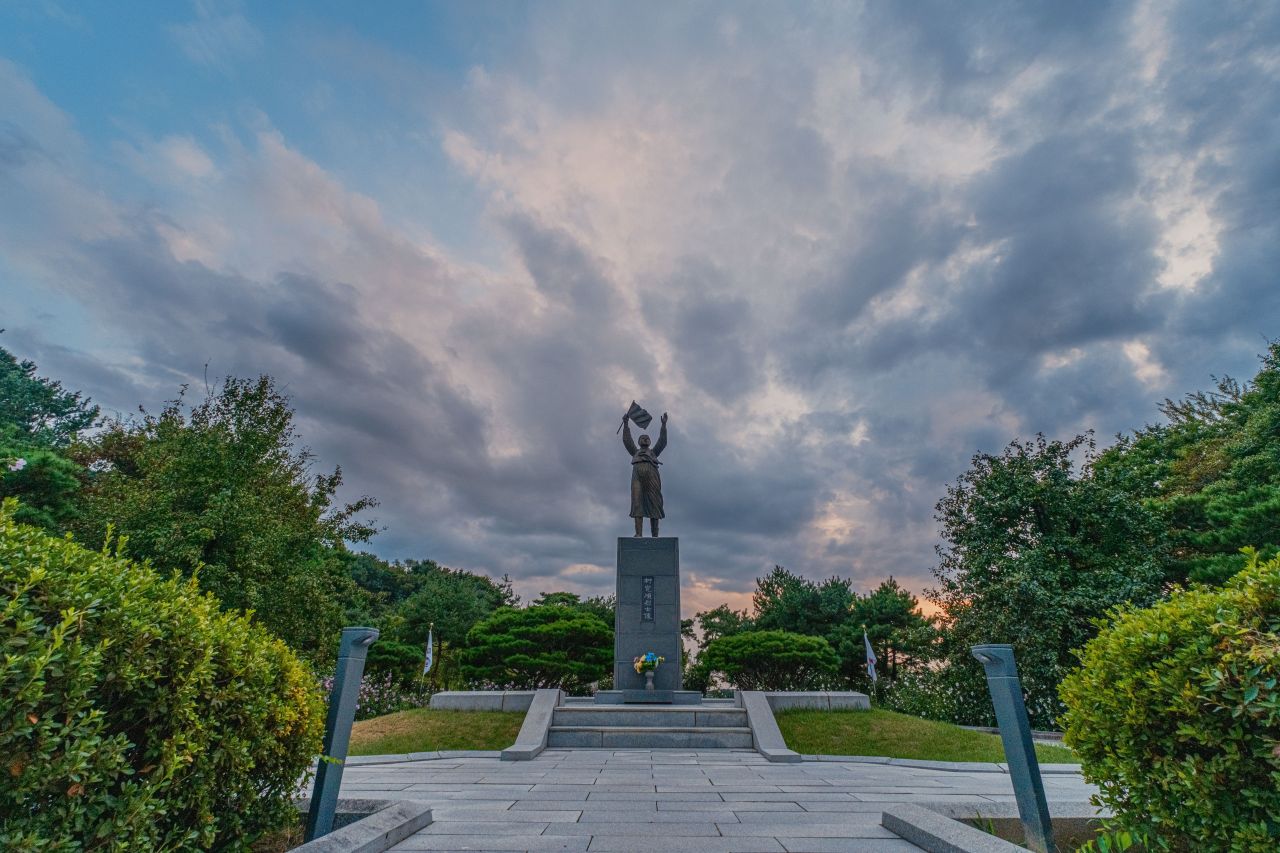
- Jangchungdan Park, 101 Jangchungdan-ro, below Namsan: her statue of 1970, three metres on a seven-metre base, near the Dongguk University station (line 3) end of the park.
- Itaewon Bugundang History Park, 33 Noksapyeong-daero 40da-gil: three memorial stones of 2015 on the hillside that looks down on the site of the old Itaewon public cemetery where she was buried; the lane up to it is named Yu Gwan-sun-gil. About ten minutes on foot from exit 1 of Noksapyeong or Itaewon station (line 6). The district holds a memorial here every 28 September.
- Mangu-ri History and Culture Park, in the east of the city: the stone of 1936 over the joint grave of the unclaimed dead from Itaewon, and a marker for her put up beside it in 2018. Exit 5 of Sangbong station (line 7) and a short bus ride; a free shuttle runs from the station from March to November. Ceremonies at the grave on 1 March at 11:00 and on 28 September at 15:00.
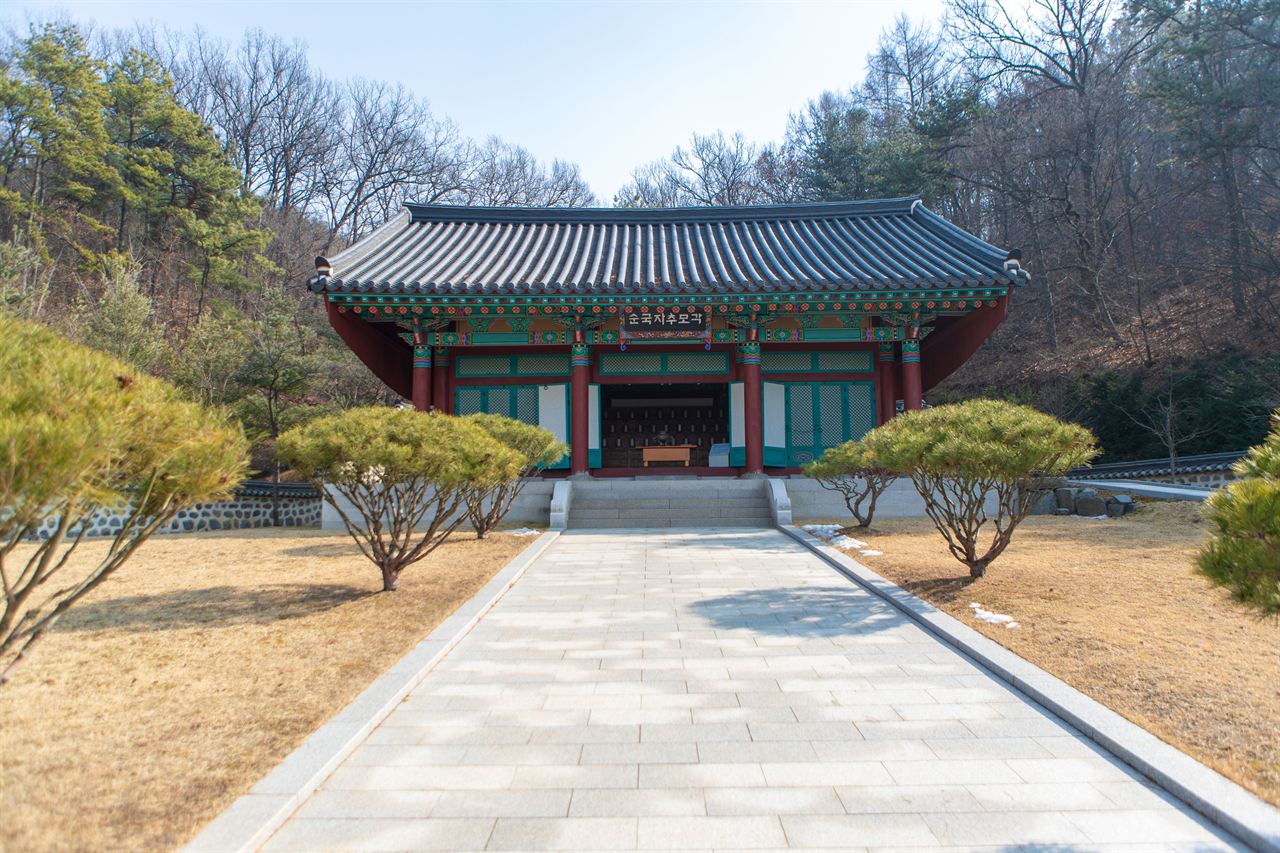
- Yu Gwan-sun Historic Site and Memorial Hall, 38 Yugwansun-gil, Byeongcheon: free, open every day of the year, March–October 09:00–18:00, November–February 09:00–17:00, last entry half an hour before. Free parking. The hall, opened in April 2003 for the centenary of her birth and refitted in 2020, shows the appeal judgment and her prisoner record card, the 2019 medal, Kim Ku's handwritten eulogy of 1947 and the hat she knitted for a baby nephew in 1917, and has a replica of cell no. 8 where visitors sing the song and shout manse. Beside it are the shrine with her official portrait, where the memorial is held every 28 September, a second shrine for the fifty-nine people of Aunae who died in the uprising, and her statue of 1983. Guided tours in Korean by phone booking; ask about English.
- Maebong-san: from the hall, 420 m and six minutes up to her tomb for the spirit of 1989, then 400 m, partly up stone steps, to the beacon tower on the 170-metre summit, built in 1977 where she lit the fire. The town's full circuit, down the far side to the birthplace, takes about two hours.
- Birthplace, 18-1 Yugwansun-saenga-gil: the thatched farmhouse rebuilt in 1991 on the site, a national historic site since 1972, with the Maebong church she attended beside it and the family graves on the hill. About 1.4 km by road from the beacon tower, or 4 km by car from the hall.
- Aunae market, about 2 km from the hall, the last stretch along the "street of the martyr": the square of 1 April 1919, market days on dates ending in 1 and 6, and the memorial park on the old gendarme post with its bronze crowd; the stone of 1947 is on the hill above. Byeongcheon is known across Korea for its sundae, blood sausage in a mild style made with the small intestine; some twenty shops line the street by the market, and a bowl of sundae soup is around 10,000–11,000 won in recent reviews.
- Getting there: from Cheonan station (on subway line 1 from Seoul) or Cheonan bus terminal, city bus 400, 405 or 500 to Byeongcheon 3-ri, about 50 minutes, then ten minutes on foot. The 400 runs every 20 minutes and passes the Independence Hall of Korea on the way, so the two can be done in a day. By KTX, Seoul to Cheonan-Asan is about 35–40 minutes, then a taxi of about 25 minutes to the Independence Hall or line 1 to Cheonan station for the bus.
- Independence Hall of Korea, Mokcheon, on the same bus: free; March–October entry until 17:00, November–February until 16:00; closed Mondays except public holidays; parking 2,000 won. Its third hall covers the 1919 uprising.

- Yeongmyeong school, Gongju: the Methodist school where she is said to have studied under Alice Sharp before Ewha, and where her brother led the demonstration of 1 April 1919; statues of her and of Sharp stand in the grounds, and the road from the school to the First Methodist Church is named Yu Gwan-sun street. It is a working school; ask at the gate.
- Samil Central Park, Gongju: her statue of 2019, where the city holds its 1 March ceremony.
| Time | Route | Avoid |
|---|---|---|
| Half a day | Dongnimmun station → Seodaemun Prison (women's block last) → Independence Park statue → subway to City Hall → Deoksugung stone-wall road → Chungdong church → Ewha Museum | Mondays; Sundays for the church and museum |
| 1 day | Add Jangchungdan Park and the Itaewon hillside, or Mangu-ri with its shuttle | Mondays |
| Day trip | KTX to Cheonan-Asan → Independence Hall → bus 400 → Byeongcheon memorial hall, Maebong-san, Aunae market and sundae | Mondays for the Independence Hall; the memorial hall is open daily |
1 March and 28 September
Korea marks her on two days. On 1 March, a public holiday for the uprising, the government holds the national ceremony in Seoul, Seodaemun holds its festival and march, and the town of Byeongcheon holds its beacon festival the evening before, with the fire on Maebong-san and the torch march to the market. On 28 September, the day she died, the city of Cheonan and the memorial society hold the memorial at her shrine, at 11 in the morning after a short concert, with a song in her memory and three cries of manse; in 2026 it was the 106th. There are smaller ceremonies that day at the joint grave in Mangu-ri, at three in the afternoon, and at the stones in Itaewon. All are open to anyone who comes.
· Seodaemun Prison, the Ewha Museum, Chungdong church's history hall and the Independence Hall all close on Mondays; the museum and church also close on Sundays. The Byeongcheon memorial hall is the one place open every day.
· The Ewha campus is a working school; the memorial hall inside is by booked tour only, at 10:00 or 14:00.
· Byeongcheon is reached by bus, not train. Allow an hour each way from Cheonan, and check the last 400 back.
· Aunae market is a working market on dates ending in 1 and 6; on other days the square is quiet and the sundae street is the reason to come.
Outdated tips you will still find online
| You may read | What is right | Source |
|---|---|---|
| She was sentenced to seven years | Five at first instance, three on appeal, reduced to eighteen months in 1920 | National Archives judgment; Kyunghyang, Feb 2007 |
| She died on 12 October 1920 | 28 September 1920; the 12th is the day the body was released | Cheonan memorial chronology; family register, as reported |
| Her tomb is at the National Mang-hyang Cemetery in Cheonan | Her spirit tomb is on Maebong-san in Byeongcheon; her remains are most likely in the joint grave at Mangu-ri in Seoul | Cheonan memorial; Seoul city |
| The memorial hall in Byeongcheon closes on Mondays | It is open every day of the year | Cheonan city, Oct 2026 |
| See the underground cell where she was held | The museum says there is no evidence she was held in the basement | Seodaemun Prison History Hall website |
| Yu Gwan-sun Day is an official New York State holiday | The 2019 resolutions honour her; the name is the Korean community's | New York State Senate, resolutions K19 and J60 |
FAQ
Who was Yu Gwan-sun?
A Korean schoolgirl (1902–1920) who helped organise the independence demonstration at Aunae market near Cheonan on 1 April 1919, in which her parents were killed, and who died in Seodaemun Prison in Seoul on 28 September 1920, aged seventeen. She is the best-known face of Korea's 1919 uprising.
Was she executed?
No. She was sentenced to three years, reduced to eighteen months, and died in prison of injuries from beatings and torture, and of malnutrition, according to the official Korean accounts.
Why is she called Korea's Joan of Arc?
The comparison is said to go back to Korean memorial writing of the late 1940s; an English book used it in 1982, and a Bloomberg article spread it in 2014. It fits her age and her cause, but not her death: Joan was executed, Yu was not.
Where can I see her in Seoul?
Cell no. 8 of the women's block at Seodaemun Prison History Hall (closed Mondays, 3,000 won), her school and the church of her funeral in Jeong-dong, and the memorial stones above her lost grave in Itaewon.
Is Cheonan worth the trip?
Yes, if you have a day: the memorial hall, the shrine, the hill with the beacon tower and the market square are all within a walk of each other, the hall is free and open daily, and the Independence Hall of Korea is on the same bus route.
What should I watch?
A Resistance (2019) for her year in prison; in the United States in October 2026 it was free with advertising on Amazon's MX Player. For something short in English, the city of Cheonan's animated film Torch on YouTube.
Sources (checked 29 October 2026)
Yu Gwan-sun Memorial Hall, Cheonan city (chronology, life, historic site, hours, 2026 events); Encyclopedia of Korean Culture (Yu Gwan-sun, Yi So-je, Yu U-seok, Jo Hwa-byeok, Sim Myeong-cheol, Yeongmyeong School); Ministry of Patriots and Veterans Affairs press releases (January 2019 independence activist of the month; 26 February 2019 additional decoration; 2020 and 2024); National Archives of Korea (appeal court judgment CJA0000139; 1953 list of those killed; 1982 stamp list); National Institute of Korean History prisoner record cards, as reported by Seoul Shinmun (2018, 2025) and YTN (2023); Seodaemun Prison History Hall (hours, prices, outdoor exhibits, 2026 notices and exhibitions); Ewha Museum and Ewha Girls' High School (hours, tours, August 2026 designation); Chungdong First Methodist Church (history hall hours); Mangu-ri History and Culture Park (2026 ceremonies, shuttle); Seoul city news site (Itaewon park, Mangu-ri, Jangchungdan, Seodaemun festival); Independence Hall of Korea (hours, access); Korean Film Council and Korean Movie Database (A Resistance; the 1948–1974 films; Park Yu-hee's column, 2019); Ten Asia (director's remarks, Feb 2019); JustWatch (US and Korea, Oct 2026); New York Asian Film Festival; Korean Cultural Centres UK and Los Angeles (2025 screenings); Ministry of Culture performance listings and the Bukahyeon Art Hall (My Friend Yu Gwan-sun); Dailian, Newsis and the Journalists Association of Korea (the cell no. 8 song, 2019); Herald Economy (2025 campaign, Apr 2026); New York State Senate (resolutions K19, J60 and K889); U.S. Government Publishing Office (H.Res.164 text) and Rep. Meng's office; Korea Times, Korea JoongAng Daily, Kyunghyang and Asia Matters for America (New York Times obituary and New York resolutions, 2018–2026); Heibonsha encyclopedias via Kotobank and the National Diet Library catalogue (Japan); Asian Review of Books and the Korean Studies list (Dictée); Bloomberg via Macau Daily Times and Japan Times (2014); TVmaze (Mysteries of the Abandoned, 2023); Donald N. Clark, Living Dangerously in Korea (2003), via Wikipedia, and Korea JoongAng Daily (2009) on Walter's account and the family; Korea JoongAng Daily (2008, 2009: the body, the rumours, Lulu Frey); Mokwon University and Nocut News (Alice Sharp); Kyunghyang (2007 register of criminal cases), Seoul Shinmun (2013 list of the dead; 2019 judgment testimony; 2015 Itaewon stones; 2019 decoration debate), Kukinews (2009 testimony), People's Solidarity monthly (Kim Jeong-in, 2014), YTN fact check (2023); Korea Daily (Los Angeles statue fund, Nov 2025); Financial News and Kukinews (Nassau County award, Mar 2026); on the online mockery, Yonhap, Herald Economy and Korea Times (2021, 2026). Photos are from the Korea Tourism Organization gallery and were taken in 2013–2024, not this year.


Comments
Post a Comment